IMPROVEMENT IN PENS
An 1870 dip nib with a sliding flex regulator and edgewise-turned tines
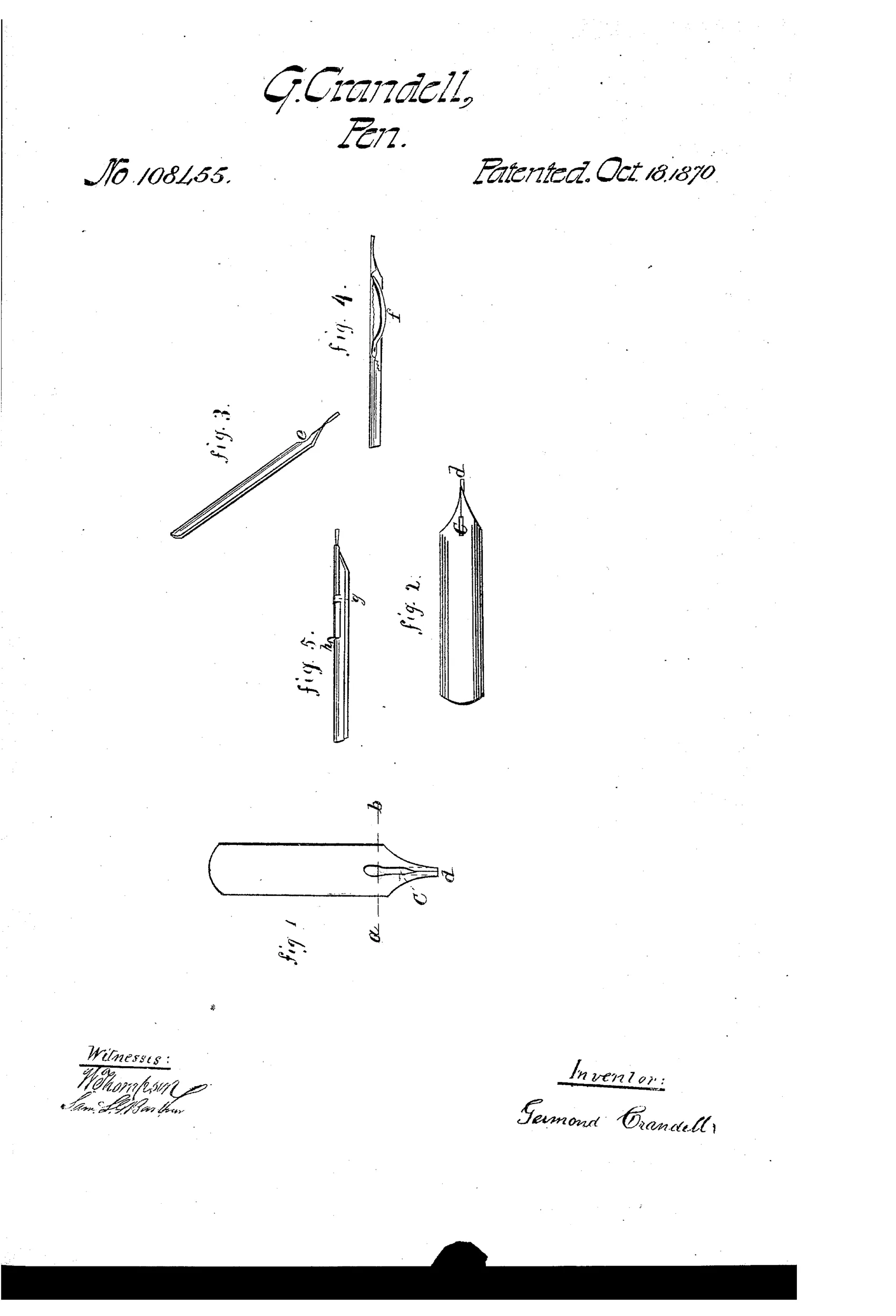
Improved metallic writing pen nib design
✒ How it works
The nib is cut with each half broader at the point, then turned up edgewise perpendicular to the pen body to create depth and prevent catching or spattering on the upstroke. This edgewise construction makes each side of the nib act like the blade of a drawing or ruling pen, forming a slightly indented channel that guides ink for a smooth downstroke line. A movable slide (h) fits under a loop or strap (g) on top of the pen; sliding it toward the point restricts the nib's flexibility for a fine hairline, while sliding it back allows the nib sections to spread slightly for a broader line. A separate loop or strap (f) can be secured to the underside of the pen body, extending toward the point, to hold a larger reservoir of ink than the pen would otherwise carry.
✒ What was claimed
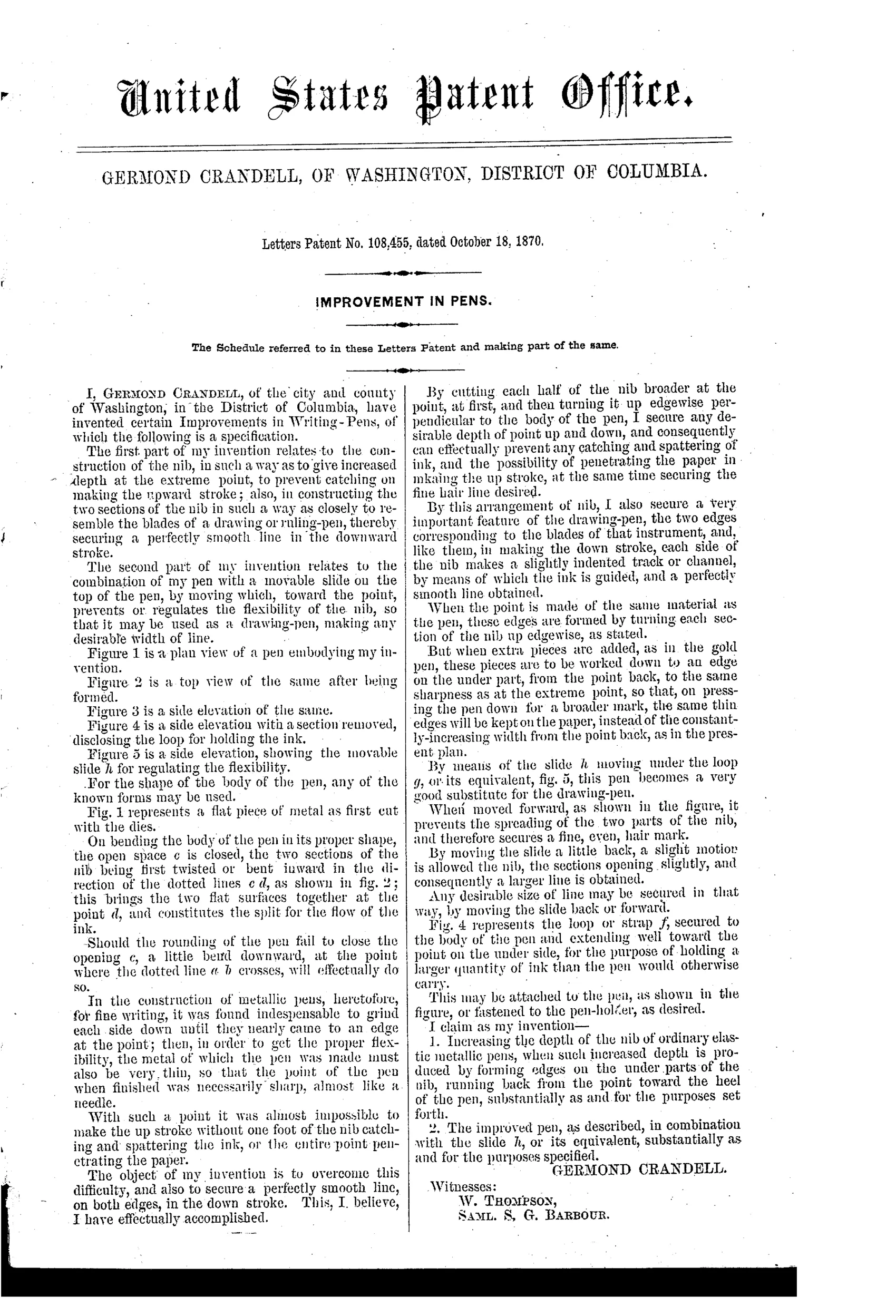
“1. Increasing the depth of the nib of ordinary elastic metallic pens, when such increased depth is produced by forming edges on the under parts of the nib, running back from the point toward the heel of the pen, substantially as and for the purposes set forth. 2. The improved pen, as described, in combination with the slide h, or its equivalent, substantially as and for the purposes specified.”
In plain English: The invention claims a metallic pen nib made deeper by forming edges on its underside running back from the point, combined with a sliding regulator that controls how much the nib flexes to vary line width.
✒ In the inventor’s words
“With such a point it was almost impossible to make the up stroke without one foot of the nib catching and spattering the ink, or the entire point penetrating the paper.”— Germond Crandell, from the specification
Fate unknown
No production Crandell pen matching this design is documented; a marked specimen or trade-catalog listing would settle it.
✒ Commentary
Fourteen years before Waterman solved the feed problem, Germond Crandell was attacking a humbler enemy: the upstroke. His complaint is vivid — with a conventional broad-pointed nib "it was almost impossible to make the up stroke without one foot of the nib catching and spattering the ink." His fix is genuinely lateral thinking. Instead of cutting the nib wider at the point, he cuts each half broader and then turns it up edgewise, so the tines present depth rather than width to the paper. Each tine now behaves like the blade of a draftsman's ruling pen, and the channel between them guides the ink.
The cleverest part is the slide, Fig. 5. A small piece rides under a strap on the nib's back; push it toward the point and the tines stiffen for a hairline, pull it back and they spread for a broad stroke. That's an adjustable-flex nib in 1870 — an idea that keeps resurfacing (nib makers were still patenting slide-on regulators decades later) because it lets one pen do the work of a graded set.
This is firmly in the pre-Waterman stratum: not a reservoir pen at all, despite the small ink-holding loop in Fig. 4, which just extends dip capacity. The mechanics are plausible, but edgewise tines would demand fussy manufacturing tolerances, and the steel-pen giants had cheapness on their side. An honest, thoughtful dead end.
Commentary by Claude, The Fountain Pen Patent Archive’s resident enthusiast