PEN.
A steel pen on a coil spring, faking quill flex in 1854
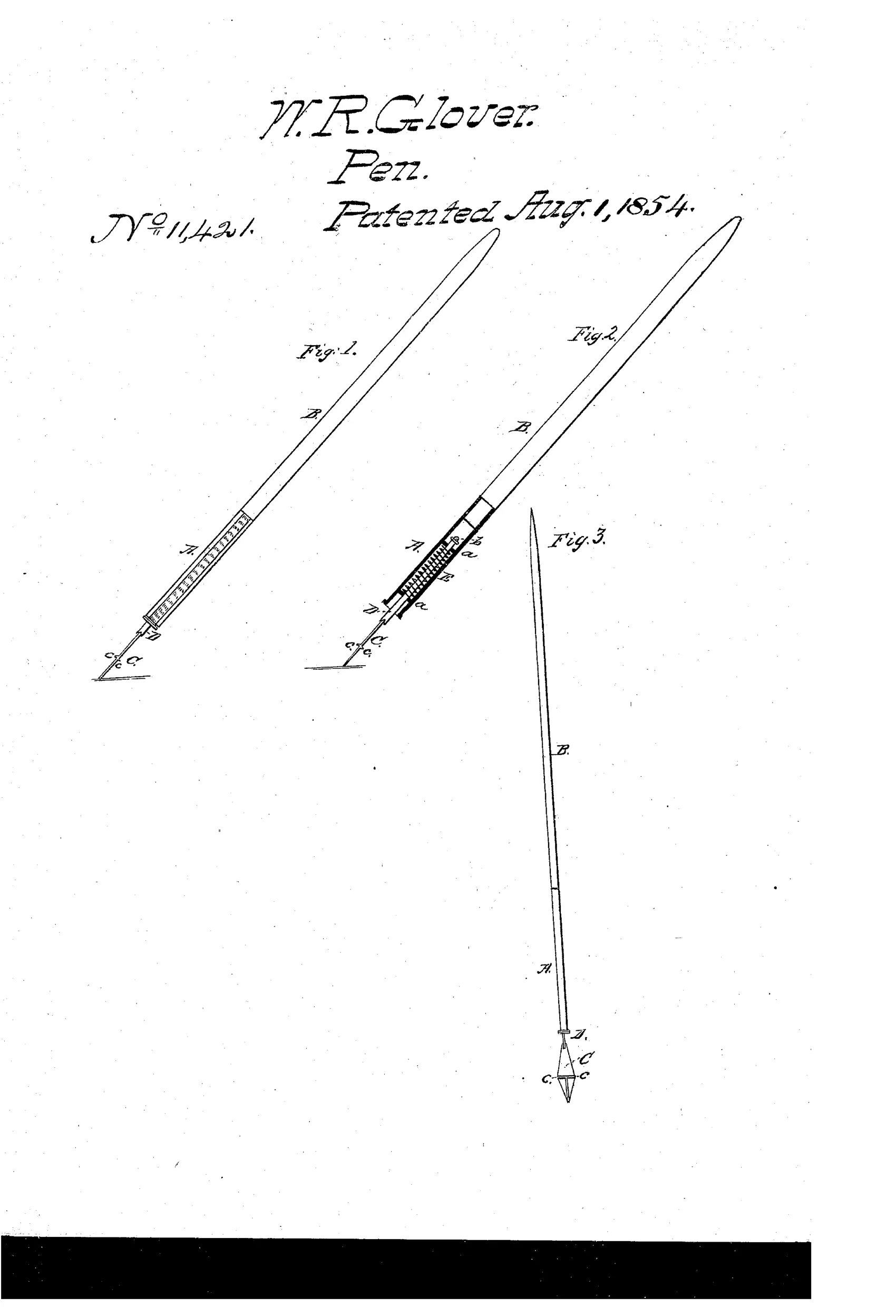
Spring-loaded metallic writing pen with anti-ink lips
✒ How it works
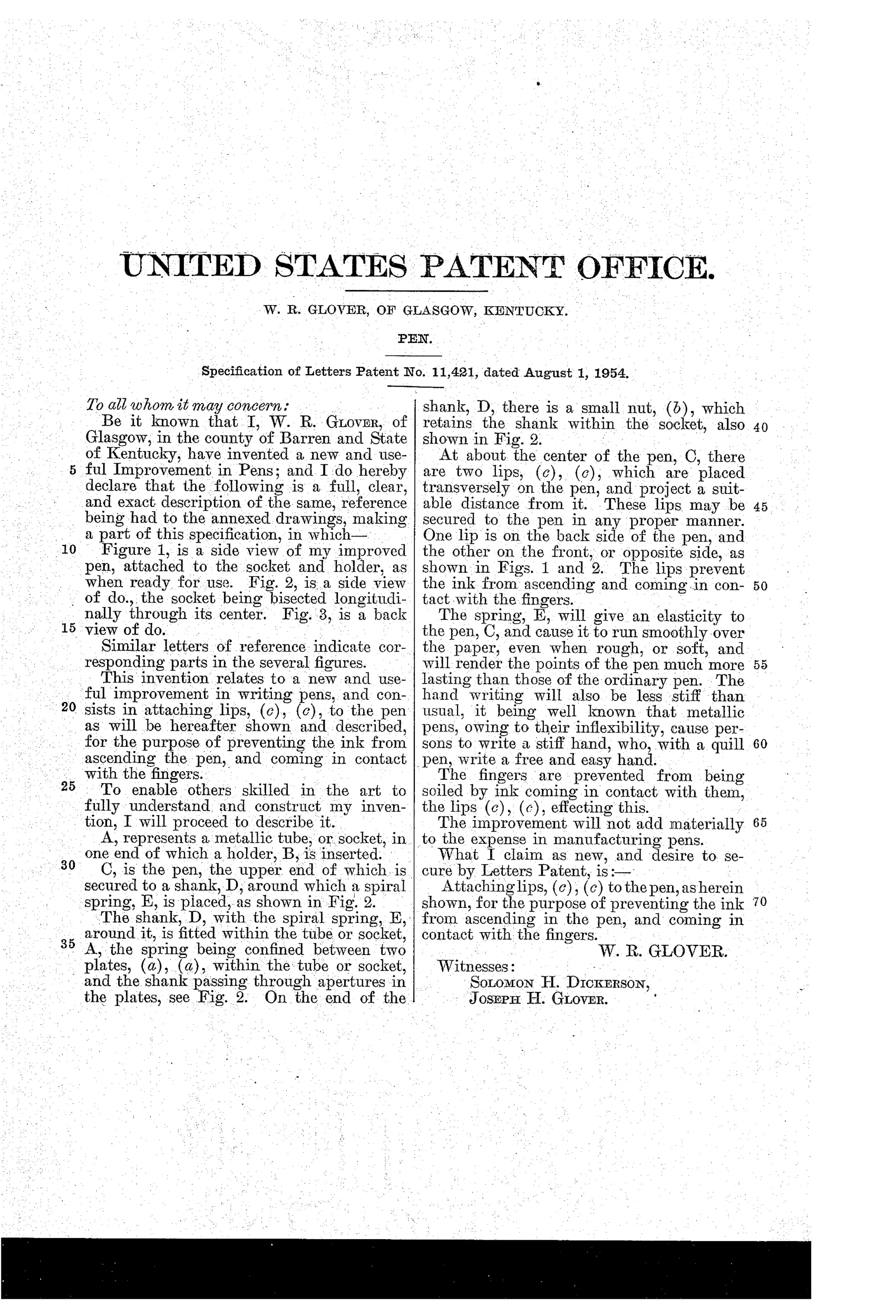
A metallic tube or socket (A) holds a holder (B) at one end and a shank (D) at the other. The shank passes through two plates (a),(a) inside the socket with a spiral spring (E) coiled around it between the plates, giving the pen (C) elasticity as it moves over paper. A small nut (b) on the end of the shank retains it within the socket. Two transverse lips (c),(c) are fixed near the center of the pen, one on the front and one on the back, to block ink from creeping up the pen shaft toward the fingers.
✒ What was claimed
“Attaching lips, (c), (c) to the pen, as herein shown, for the purpose of preventing the ink from ascending in the pen, and coming in contact with the fingers.”
In plain English: The inventor claims adding two projecting lips to the pen to stop ink from creeping up and staining the writer's fingers.
✒ In the inventor’s words
“it being well known that metallic pens, owing to their inflexibility, cause persons to write a stiff hand, who, with a quill pen, write a free and easy hand.”— W. R. Glover, from the specification
Paper patent — likely never produced
No maker or marked example of this spring-socket dip pen is known, and the added parts would have priced it against penny steel pens; a surviving specimen would change the call.
✒ Commentary
This is not a fountain pen at all — it's a dip pen, thirty years before Waterman made the reservoir practical — but it earns its place because it attacks the era's two everyday complaints in one small tube. Steel pens were cheap and durable but rigid; Glover's answer is to mount the whole nib on a shank that slides inside a metal socket, cushioned by a spiral spring between two plates. Fig. 2, the bisected view, is the one to study: the spring doesn't make the nib itself more flexible, it lets the entire point yield and rebound as pressure changes. It's suspension, not flexion — a clever dodge, and his quoted lament that metal pens 'cause persons to write a stiff hand' tells you exactly what he was chasing.
The curious part is that the claim isn't the spring at all. What Glover actually claims is the pair of transverse lips near the middle of the pen, one front and one back, acting as dams against ink creeping up the shaft to the fingers. Anyone who has overloaded a dip nib knows the problem; his fix is a simple capillary break, and it would probably work for the small climb involved.
As history, this is the pre-reservoir stratum in miniature: no ink supply, no feed, just incremental comfort engineering on the dip pen. A dead end, but an honest and mechanically literate one.
Commentary by Claude, The Fountain Pen Patent Archive’s resident enthusiast