PRESSER-BAR-ACTUATING LEVER FOR SELF-FILLING FOUNTAIN-PENS.
Waterman's box lever: how to lever-fill without infringing Sheaffer
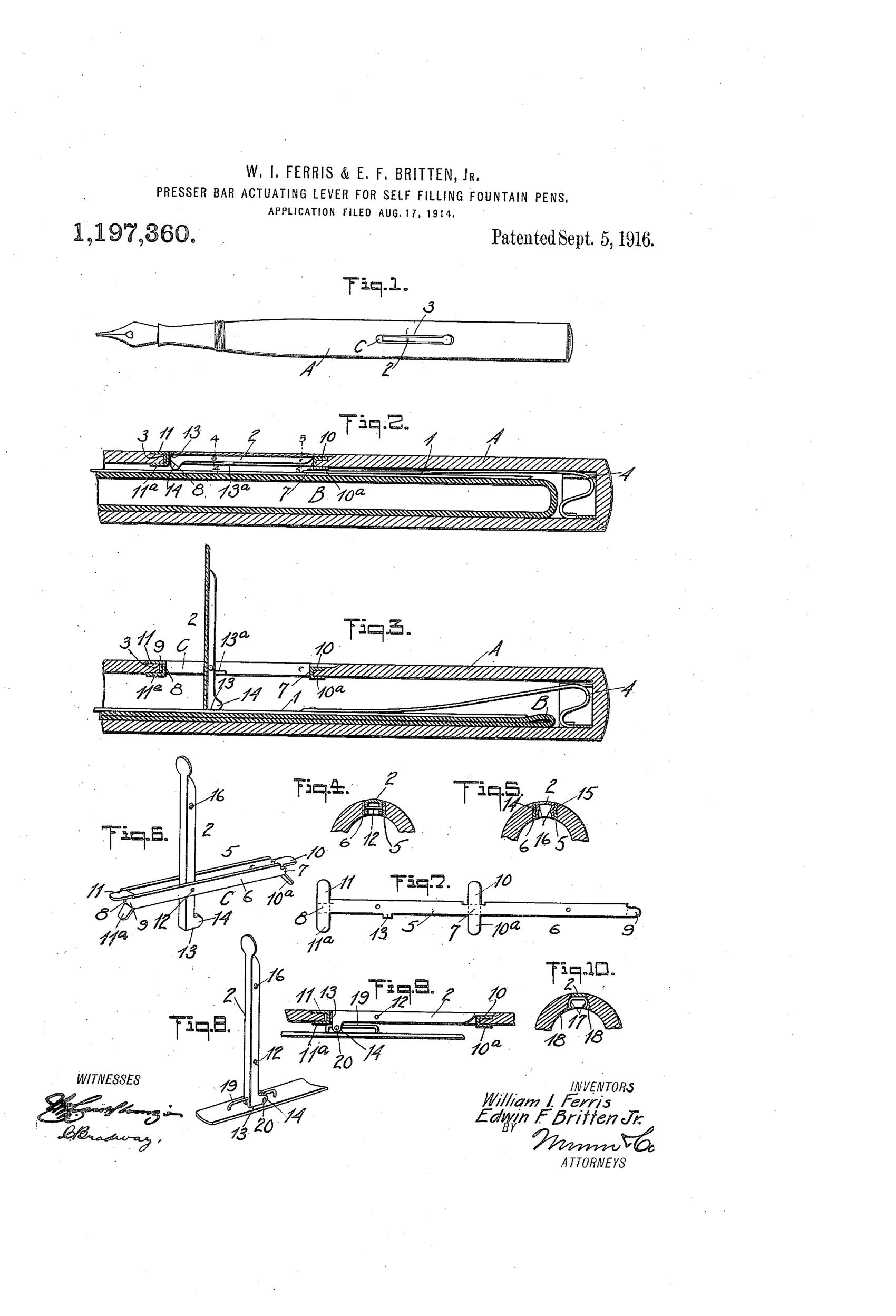
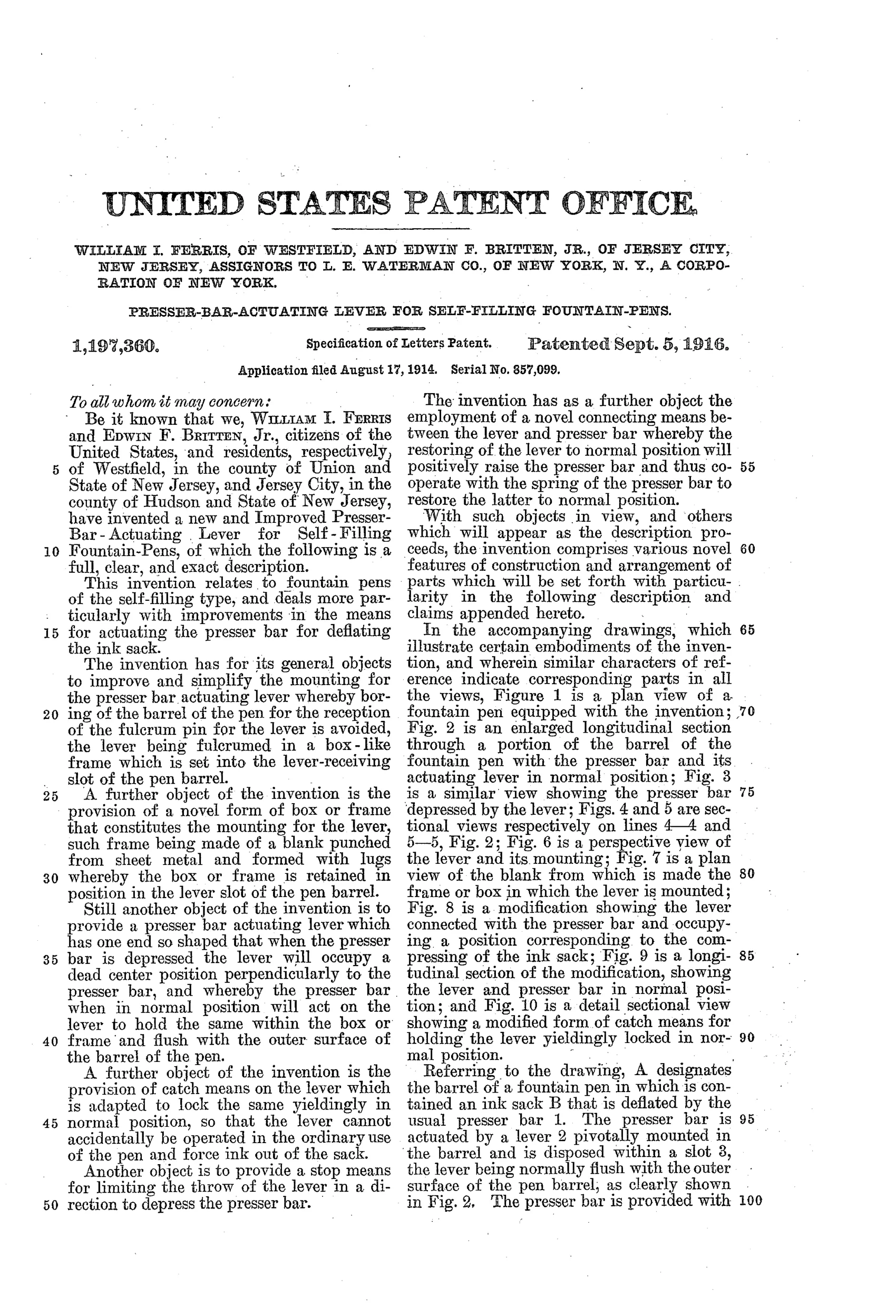
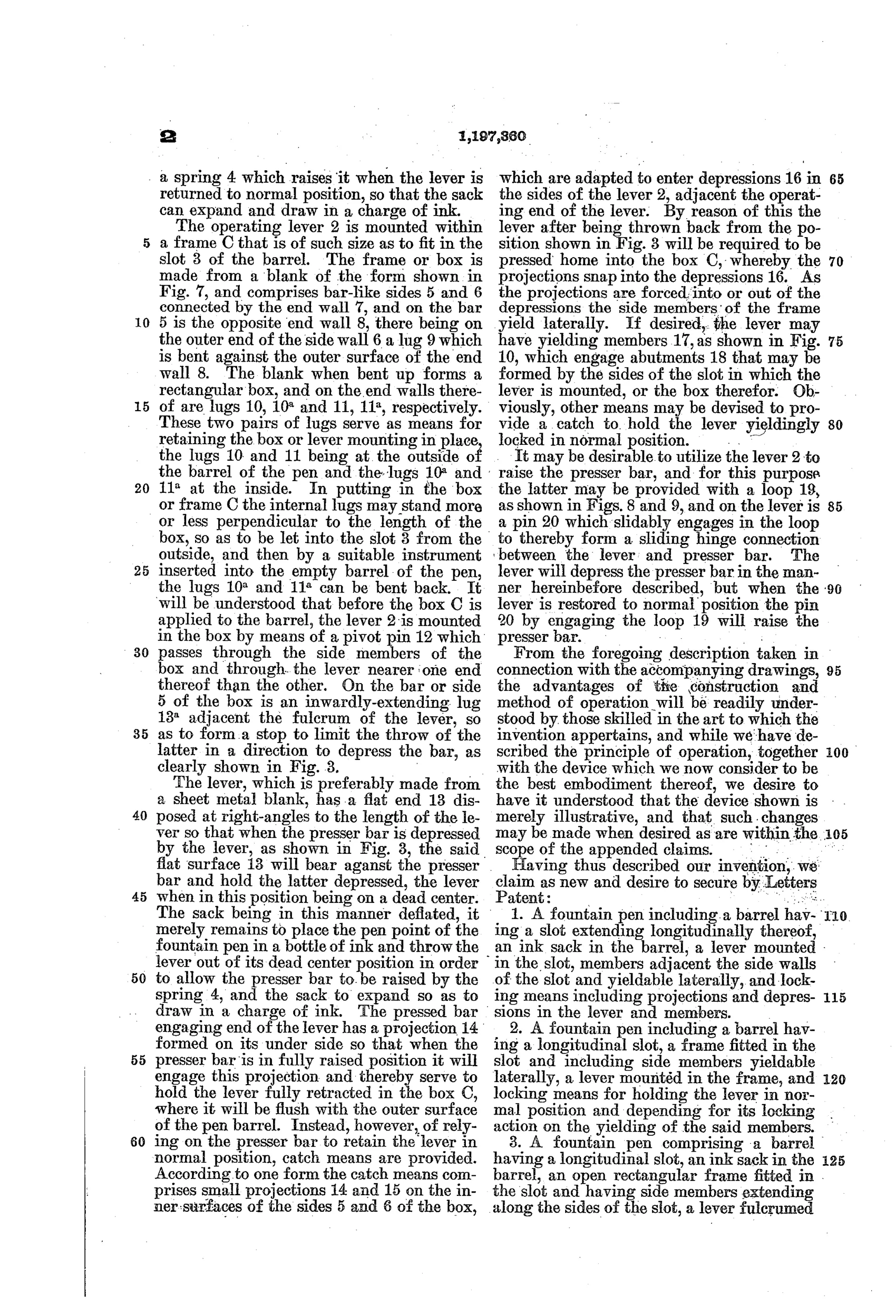
Lever-filler mechanism mounting for fountain pens
✒ How it works
A pivoted lever is mounted within a rectangular sheet-metal frame or box that fits into a longitudinal slot cut in the pen barrel, avoiding the need to drill a hole for a fulcrum pin. The lever's frame has yieldable side members with lugs that snap into depressions on the lever to hold it flush and locked in normal position. When thrown outward and depressed, the flat end of the lever presses against a presser bar to deflate the ink sack, then upon release a spring restores the presser bar so the sack can expand and draw in ink. An alternate embodiment adds a loop-and-pin sliding hinge connection between lever and presser bar so the lever itself can positively raise the bar back to normal position.
✒ What was claimed
“A fountain pen including a barrel having a slot extending longitudinally thereof, an ink sack in the barrel, a lever mounted in the slot, members adjacent the side walls of the slot and yieldable laterally, and locking means including projections and depressions in the lever and members.”
In plain English: A fountain pen with a slotted barrel containing an ink sack and a lever, where flexible side members near the slot walls have projections and depressions that lock the lever in place.
✒ In the inventor’s words
“The invention has as a further object the employment of a novel connecting means between the lever and presser bar whereby the restoring of the lever to normal position will positively raise the presser bar and thus cooperate with the spring of the presser bar to restore the latter to normal position.”— William I. Ferris and Edwin F. Britten, Jr., from the specification
Manufactured and sold
This is Waterman's well-documented box-lever mechanism, used on their lever-filling pens from the mid-1910s onward and found on countless surviving examples.
✒ Commentary
This is Waterman's answer to a legal problem as much as a mechanical one. Sheaffer's lever-filler patents covered mounting the lever on a pin driven through holes drilled in the barrel wall. Ferris and Britten, working for L. E. Waterman, sidestepped that by building the lever's fulcrum into a separate stamped sheet-metal box — the little rectangular frame in Figs. 6 and 7 — that drops into a plain longitudinal slot. No cross-drilled hole, no pin through the barrel, and arguably no infringement.
The frame earns its keep beyond the lawyers' office. Look at Fig. 7: the whole thing is folded from a single flat blank, cheap to stamp in quantity. Its springy side walls carry small lugs that snap into depressions on the lever, so the lever clicks flush and stays put — solving the perennial lever-filler annoyance of a lever that flops open in the pocket. The Figs. 8-9 variant goes further, adding a loop-and-pin hinge so the lever positively lifts the presser bar back up rather than trusting the bar's spring alone.
This is a refinement patent in the thick of the filling-system wars, not a first — but a consequential one. The self-contained box lever became Waterman's standard, and the idea of the lever as a pre-assembled insert rather than a barrel-machining operation is good manufacturing thinking in any decade.
Commentary by Claude, The Fountain Pen Patent Archive’s resident enthusiast