MOUNTING FOR PRESSER-BAR-ACTUATING LEVER FOR SELF-FILLING FOUNTAIN-PENS
Waterman's lever-box: how the giant lawyered around Sheaffer's lever patent
Frame-mounted lever mount for fountain pen presser bar
✒ How it works
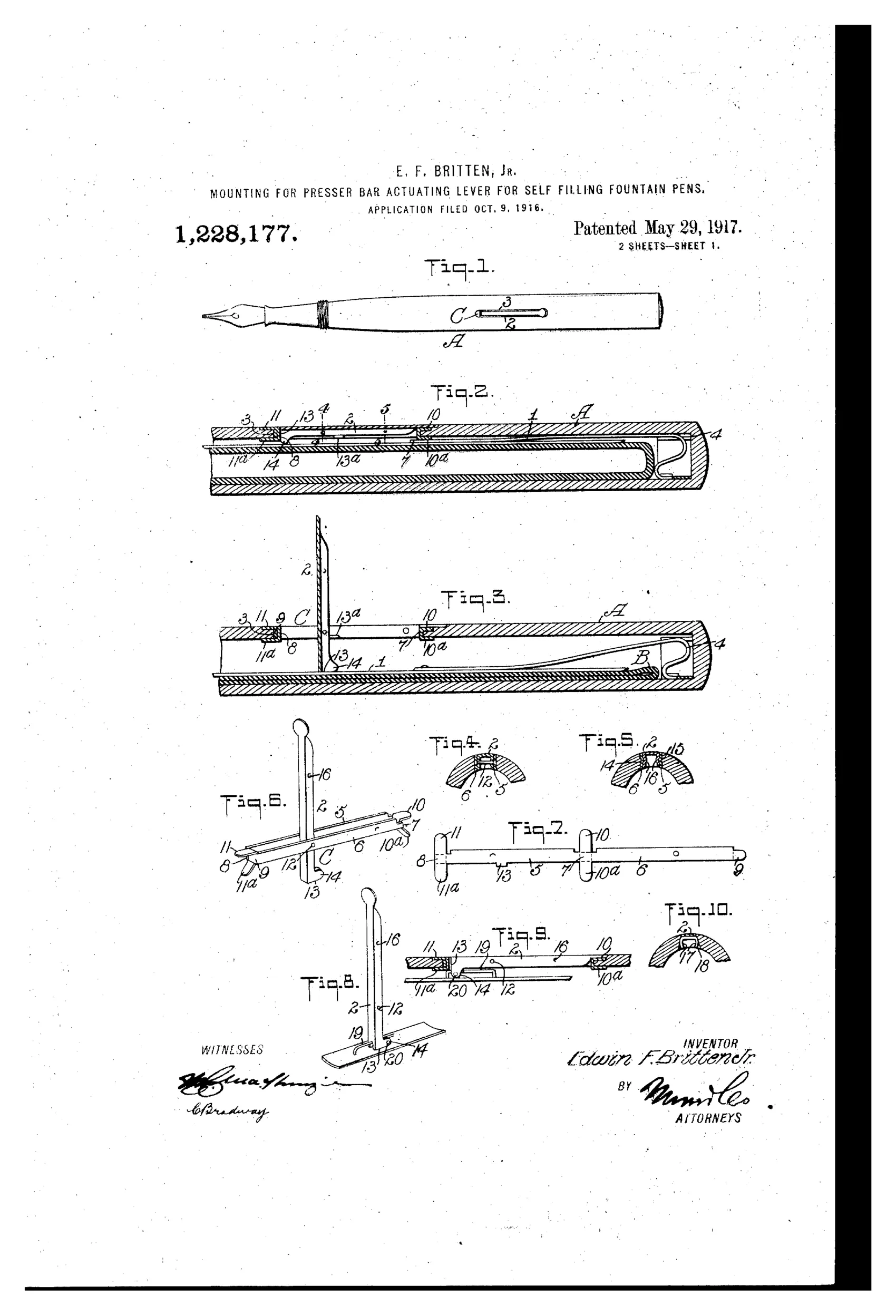
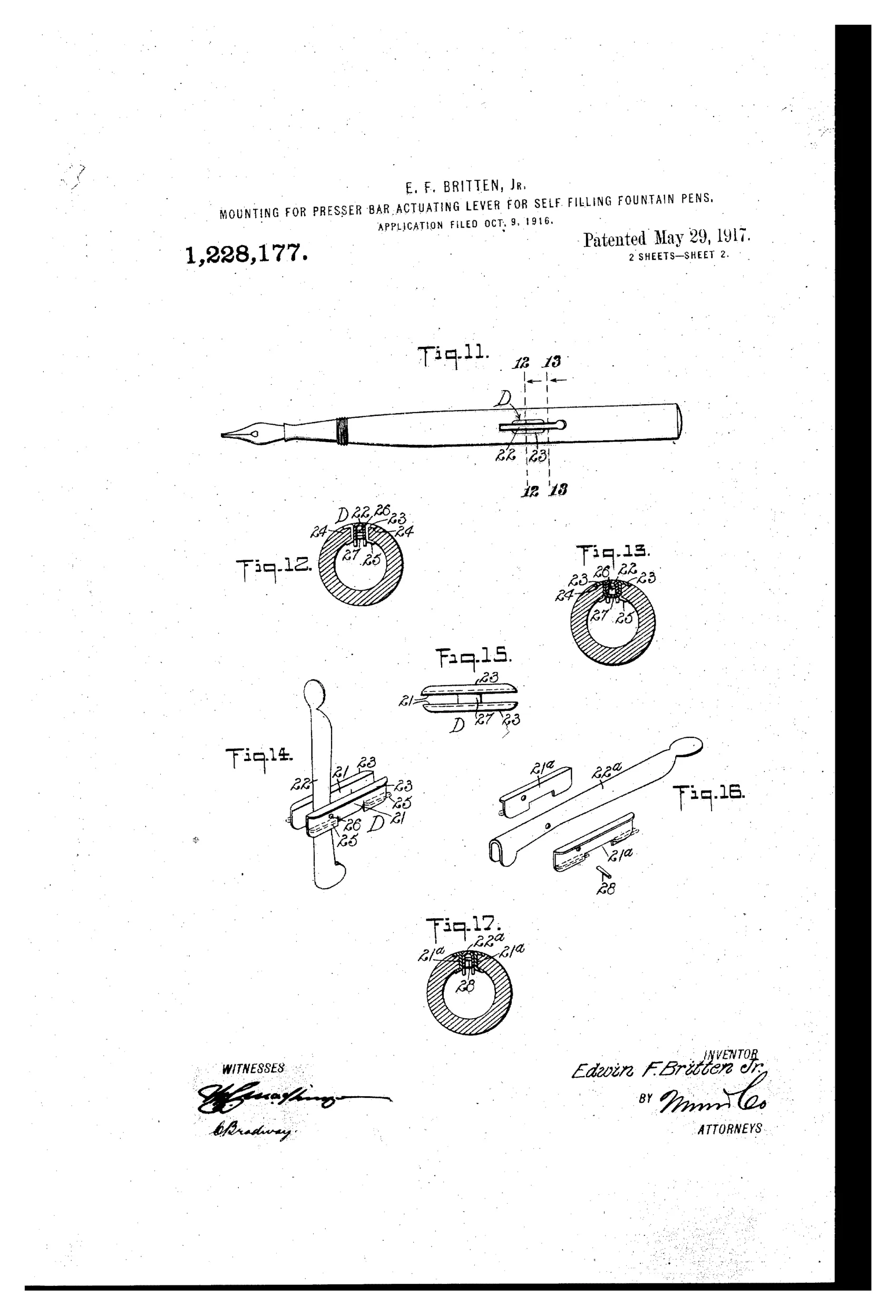
A box-like frame or member is fitted into a slot cut in the pen barrel, and the presser-bar actuating lever is fulcrumed on this frame via a pivot pin, avoiding the need to bore the barrel itself for the pin. Lugs punched from the sheet-metal frame blank are bent to internally and externally engage the barrel, retaining the frame in the slot. A stop lug on the frame limits the throw of the lever in the direction that compresses the ink sack, and the lever's flat bar-engaging end bears against the presser bar to hold it in a dead-center depressed position. Pressing the lever deflates the ink sack via the presser bar; releasing it lets a spring on the presser bar restore it and draw ink into the sack, with optional catch or loop-and-pin connections to positively raise the bar when the lever returns to normal position.
✒ What was claimed
“1. A fountain pen including a barrel having a slot, an ink holding sack therein, a presser bar for the sack, and actuating means for the presser bar, said means including a box fitted in the slot and a lever fulcrumed in the box.”
In plain English: The pen has a slot in its barrel holding a separate box-like frame, and the lever that presses the ink sack pivots on that frame rather than on the barrel itself.
✒ In the inventor’s words
“Another object is to provide a stop means for limiting the throw of the lever in a direction to depress the presser bar.”— Edwin F. Britten, Jr., from the specification
Manufactured and sold
This is the Waterman lever-box, manufactured in vast numbers on Waterman lever fillers from the late 1910s onward; the boxed lever is a standard identification point for collectors.
✒ Commentary
By 1916 the lever filler had won the self-filling war, but Sheaffer held the controlling patents on levers pivoted directly in the barrel wall. Waterman needed a lever filler and needed to not get sued. Edwin Britten's answer is this patent: a small sheet-metal box, punched flat (Fig. 7 shows the blank), folded up, and slipped into the barrel slot, with the lever fulcrumed on a pin inside the box rather than in the hard rubber itself. Legally, the lever pivots in the box, not the barrel — a distinction fine enough to keep Waterman out of court and coarse enough to be visible in every barrel they slotted for the next thirty years.
The engineering happens to be genuinely better than the workaround it was. Drilling a pivot hole crosswise through thin hard rubber weakens the barrel and invites cracks; the self-contained box takes all the stress and drops in as a complete unit on the assembly line. The bent lugs that grip the barrel inside and out, the stop lug limiting lever throw, the flat end that holds the presser bar in a dead-center depressed position — all of it is production thinking, not patent-office decoration.
Compare Figs. 2 and 3 and you can watch the whole filling cycle: lever up, bar depressed, sac flattened; release, spring returns the bar, ink draws in. This is a refinement, not a first — but it's the refinement millions of Watermans were built on.
Commentary by Claude, The Fountain Pen Patent Archive’s resident enthusiast