STEEL WRITING-PEN.
An 1840 nib built like an instrument: two rigid halves on pivots, adjusted by set screws.
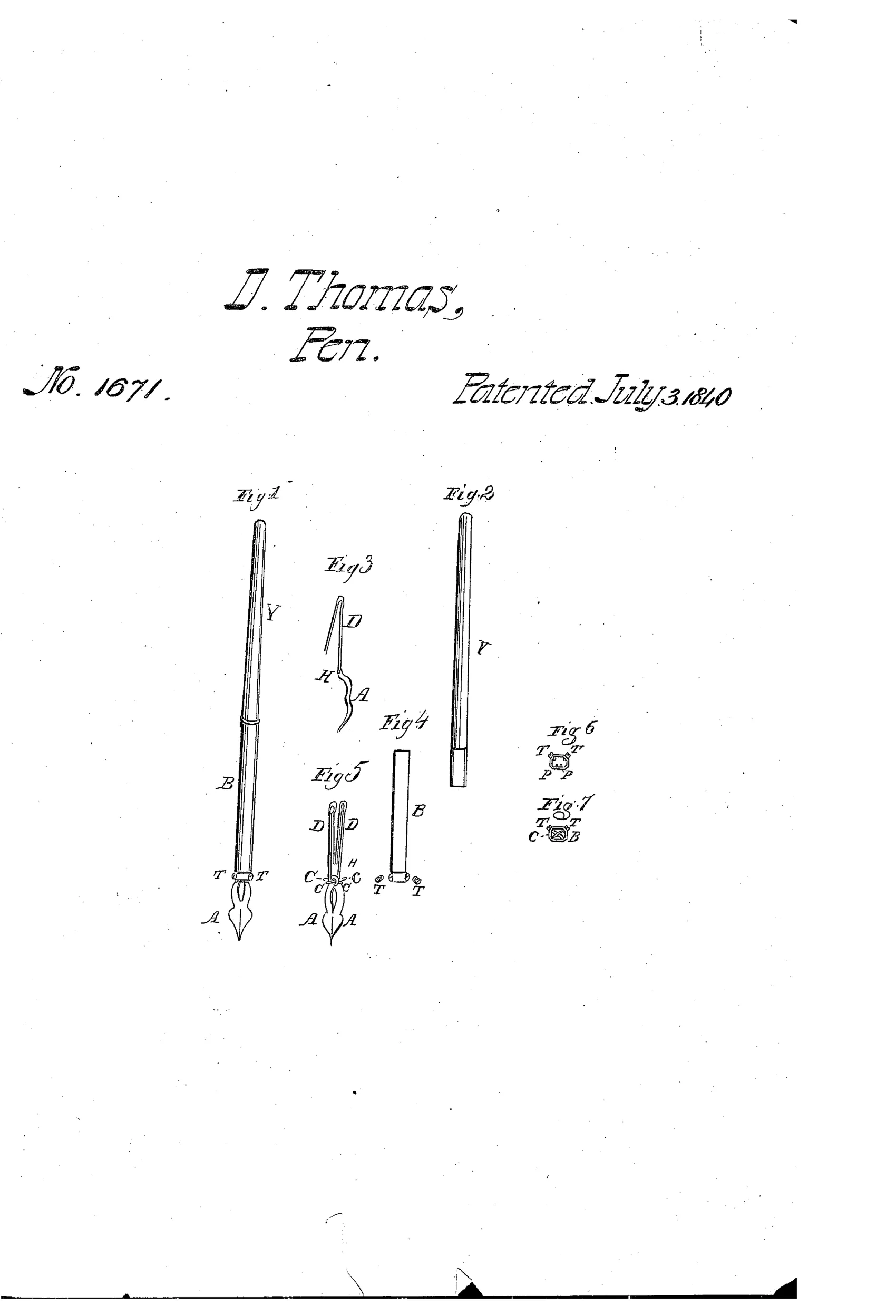
A two-piece elastic steel writing pen
✒ How it works
The pen is made of two separate steel pieces whose lower ends form the nibs, rather than a single slit piece as in ordinary pens. Each piece has projections that act as pivots, crossing diagonally and resting in cavities at the corners of a square or oblong holder, with set screws adjusting and securing the pivots. A steel spring strip attached to the upper end of each piece extends into the tube and presses against its inner wall, providing elasticity above the nibs rather than at the slit, with studs preventing the spring from shifting sideways. The holder itself may be covered with leather, gum caoutchouc, or a stuffed cushion for comfortable grip, and fitted with a wooden handle.
✒ What was claimed
“The before described mode of making the steel writing pen of two pieces of steel with firm unelastic nibs, the elasticity being produced above the nibs and suspending the same in a tube or holder by pivots crossed at angles and turning in cavities in two of the angles of said tube and in the points of set screws passing through the other angles by which the pen is properly adjusted for writing, and also the two stops or points in the tube for holding the shanks of the springs in their proper places as described.”
In plain English: The invention claims a pen made of two rigid steel pieces whose elasticity comes from springs above the nibs, held in a holder by crossed pivots resting in cavities and adjustable set screws, with stops to keep the springs positioned.
✒ In the inventor’s words
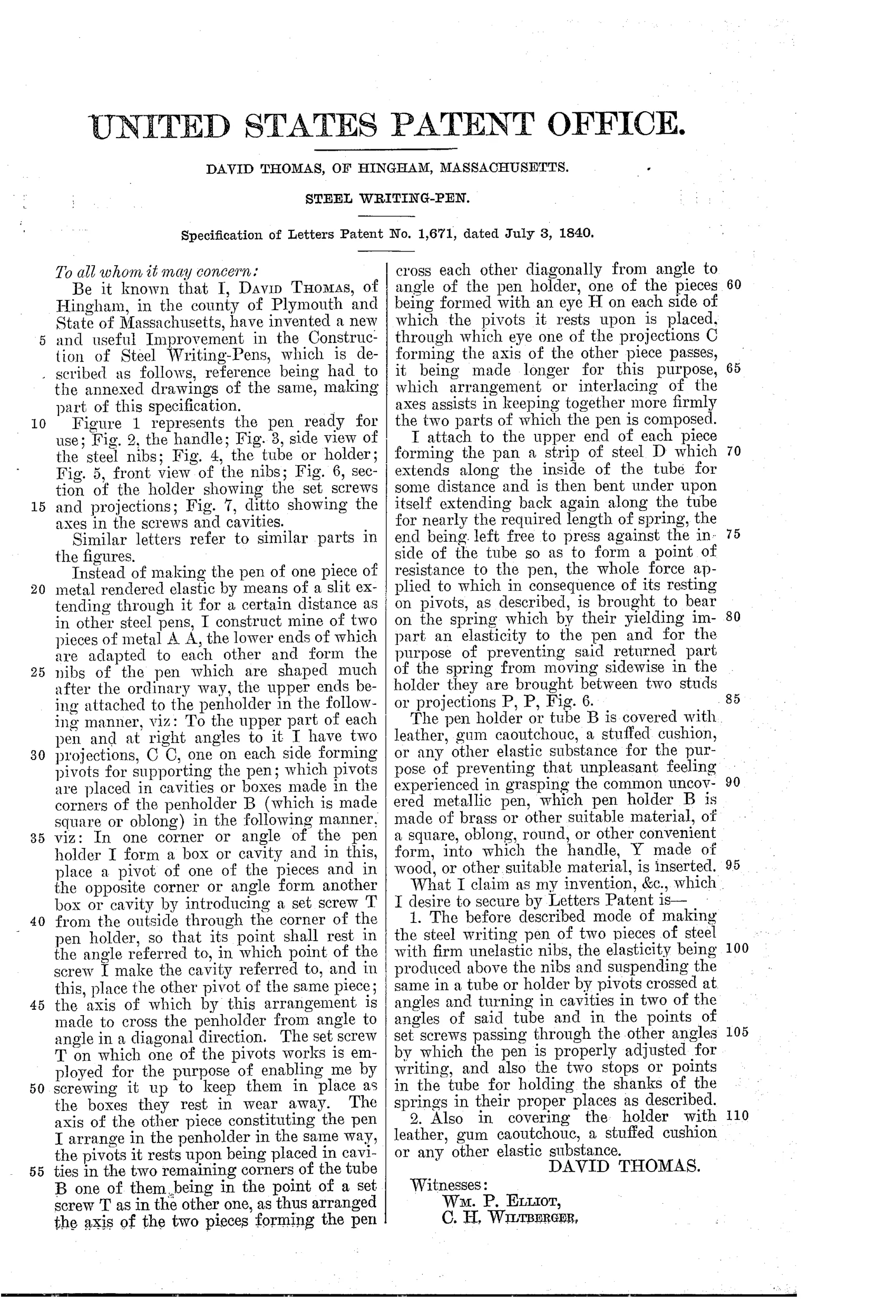
“Instead of making the pen of one piece of metal rendered elastic by means of a slit extending through it for a certain distance as in other steel pens, I construct mine of two pieces of metal A A, the lower ends of which are adapted to each other and form the nibs of the pen.”— David Thomas, from the specification
Paper patent — likely never produced
The precision-fitted pivot-and-set-screw construction would have cost many times what stamped pens sold for, and no manufactured example or maker is documented.
✒ Commentary
David Thomas looked at the ordinary slit steel pen — one stamped piece of metal that flexes at the cut — and decided the flexing was in the wrong place. His pen has two completely separate steel pieces forming the nibs, each one rigid at the tip. The spring comes from strips above, pressing against the inside of the tube, and the whole assembly hangs on crossed pivots seated in the corners of the holder, with set screws to bring the tines into alignment. He even upholsters the grip in leather or rubber. This is a pen designed the way a machinist designs a caliper.
The drawing repays a slow look. Fig. 5 shows the two nib pieces crossing diagonally, and Figs. 6 and 7 — those tiny sections at the right — show the pivot points sitting in cavities and screw tips. That means tine gap and alignment are user-adjustable, which is a genuinely interesting idea: worn or splayed nibs were a real cost in the dip-pen era, when a good steel pen was a consumable.
But the economics run the other way. A one-piece slit pen cost a fraction of a cent to stamp; Thomas's design needs fitted pivots, threaded holes, and hand assembly. This is patent number 1671 — the whole US system was young — and it belongs to the era when clever mechanics repeatedly discovered that the crude stamped pen was crude for a reason. A fascinating dead end, and an honest piece of engineering.
Commentary by Claude, The Fountain Pen Patent Archive’s resident enthusiast