IMPROVEMENT IN WRITING-PENS
Dip your pen in water: a solid-ink cartridge, eight years before Waterman
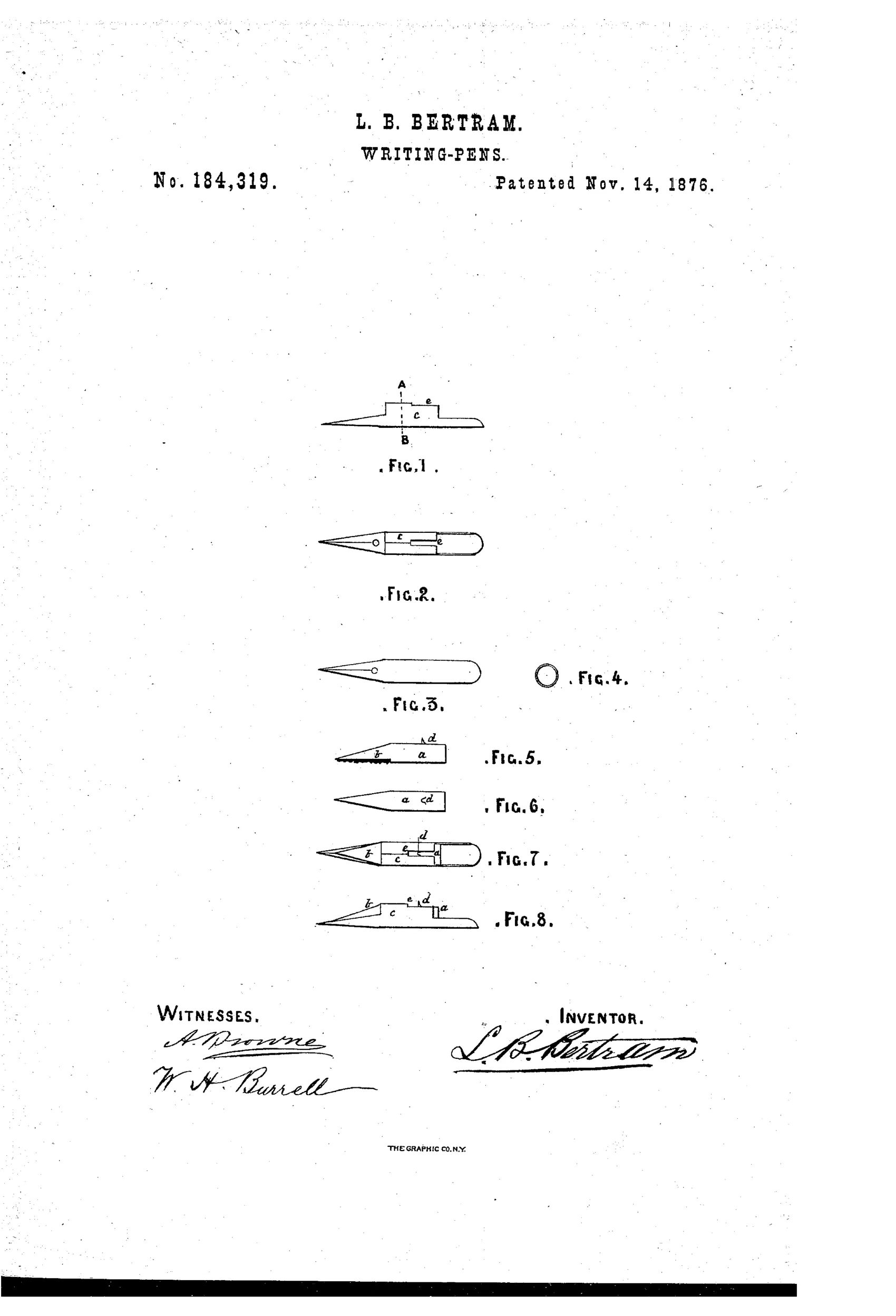
Pen with solid-ink cartridge, dip in water
✒ How it works
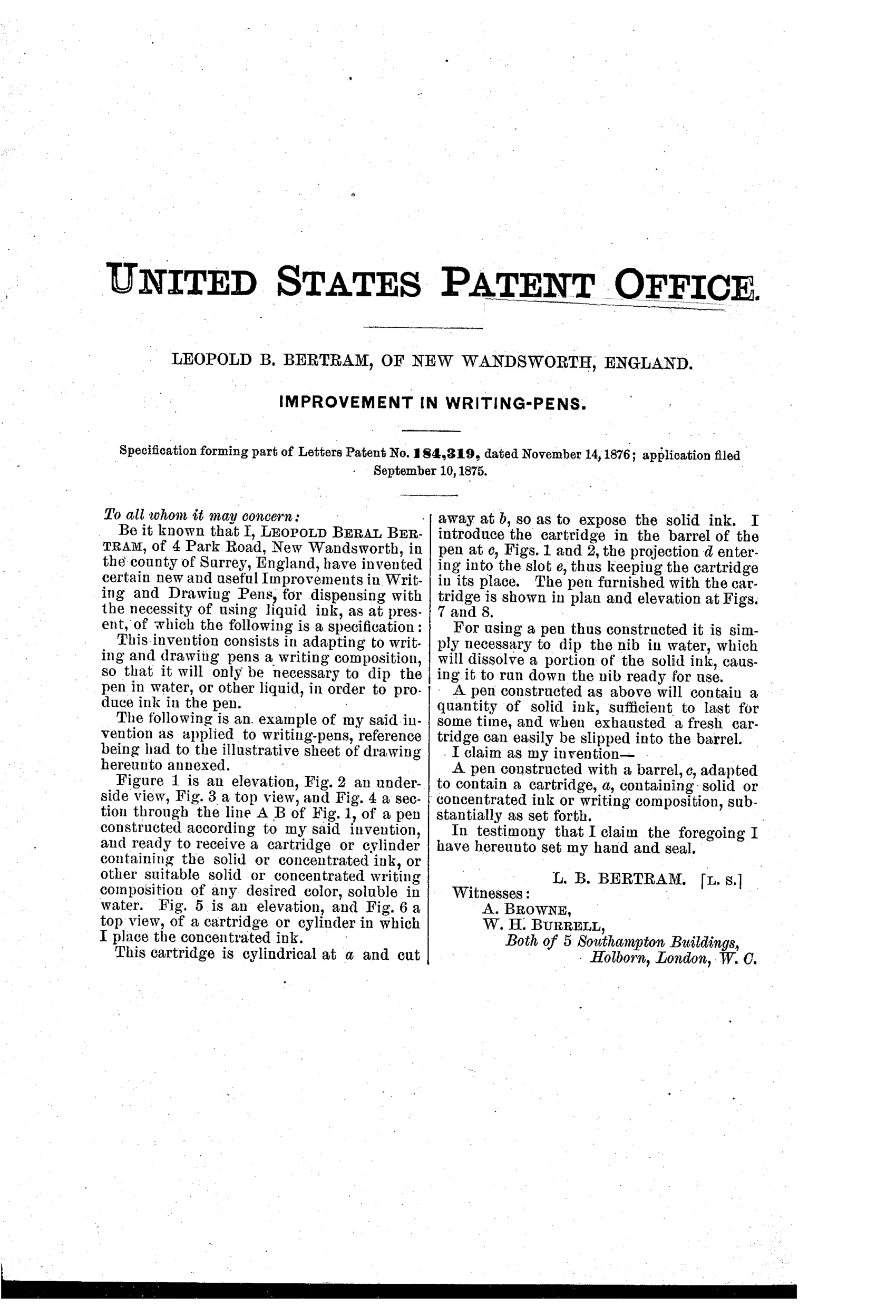
The pen barrel is formed with a chamber, c, sized to receive a removable cylindrical cartridge containing solid or concentrated ink or writing composition. The cartridge has a projection, d, that engages a slot, e, in the barrel to hold it in place, and is cut away at b to expose the solid ink. To use the pen, the nib is simply dipped in water, which dissolves a portion of the solid ink and causes it to run down the nib ready for use. When the ink cartridge is exhausted, a fresh cartridge can be slipped into the barrel.
✒ What was claimed
“A pen constructed with a barrel, c, adapted to contain a cartridge, a, containing solid or concentrated ink or writing composition, substantially as set forth.”
In plain English: The invention is a pen whose barrel holds a removable cartridge of solid or concentrated ink.
✒ In the inventor’s words
“This invention consists in adapting to writing and drawing pens a writing composition, so that it will only be necessary to dip the pen in water, or other liquid, in order to produce ink in the pen.”— Leopold Beral Bertram, from the specification
Paper patent — likely never produced
No marked example or maker's line matching this cartridge scheme is documented, and the variable-strength ink problem makes commercial production implausible; a surviving specimen would overturn this.
✒ Commentary
Bertram attacks the reservoir problem by refusing to fight it. Every leaky pre-Waterman fountain pen struggled with the same physics: liquid ink wants out faster than air wants in. His answer is to carry no liquid at all. The barrel has a chamber for a small cylinder of solid or concentrated ink, held by a projection engaging a slot (d and e in Figs. 5 and 2), with a cutaway at b exposing the composition. Dip the whole business in water, a little ink dissolves and runs down the nib, and you write. Any glass of water becomes your inkwell.
Look at Figs. 7 and 8 and you'll see how modest the hardware is — this is essentially a dip pen with a pocket, plus a genuinely early example of the replaceable-cartridge idea, decades before ink cartridges meant liquid in a tube. That's the clever part. The dubious part is chemistry: the ink strength depends entirely on how long you dip and how worn the cake is, so line one is pale grey and line three is nearly black. Copying-ink pencils, which arrived commercially in this same era, solved the same portability problem with less apparatus.
As pen history, this is a charming side path rather than a step on the main road. The industry needed controlled liquid flow, not soluble solids — but as an 1876 workaround, it's honest engineering around an unsolved problem.
Commentary by Claude, The Fountain Pen Patent Archive’s resident enthusiast