IMPROVEMENT IN SOLUBLE-INK PENS
Dip it in water: a solid ink stick hidden inside the holder
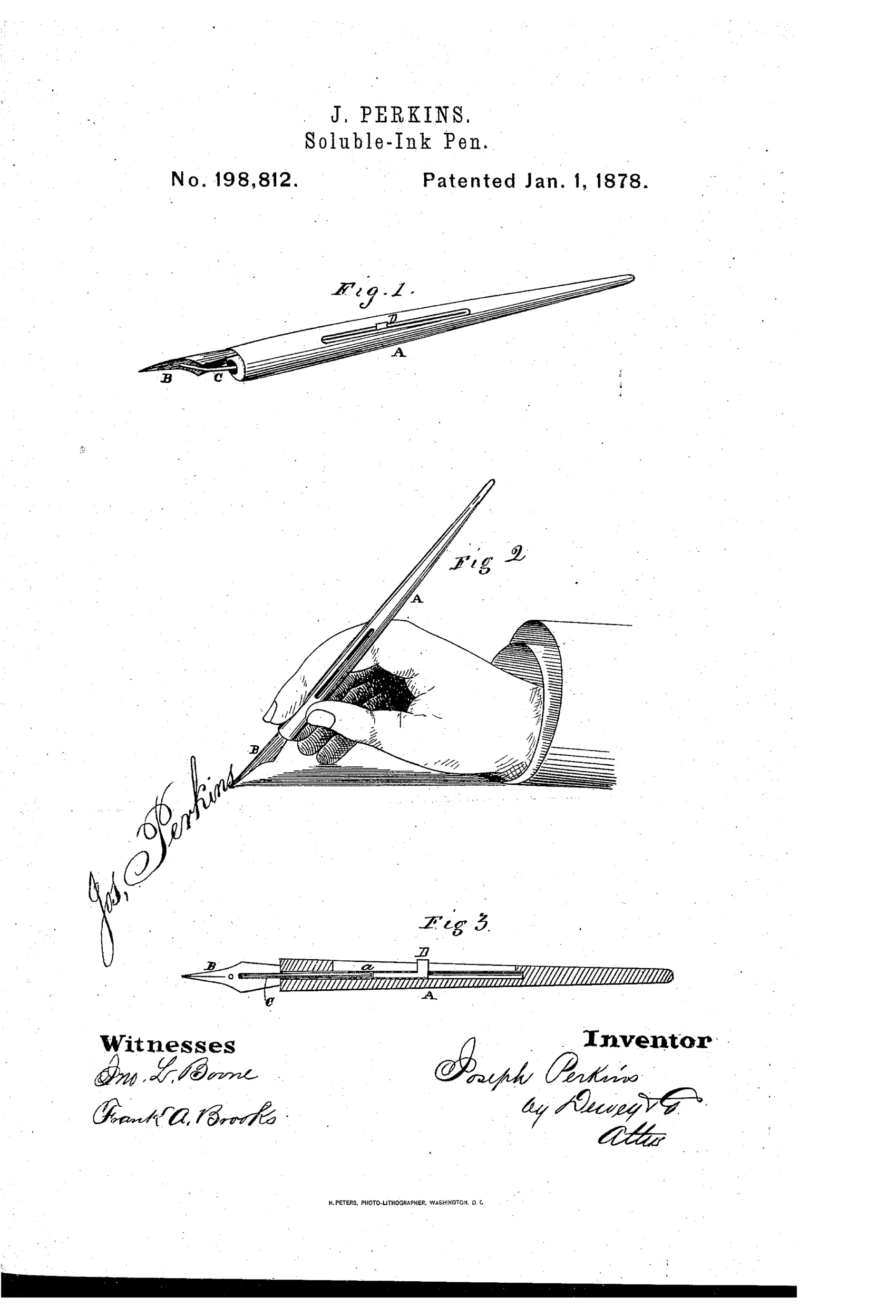
Pen holder with dissolvable ink rod
✒ How it works
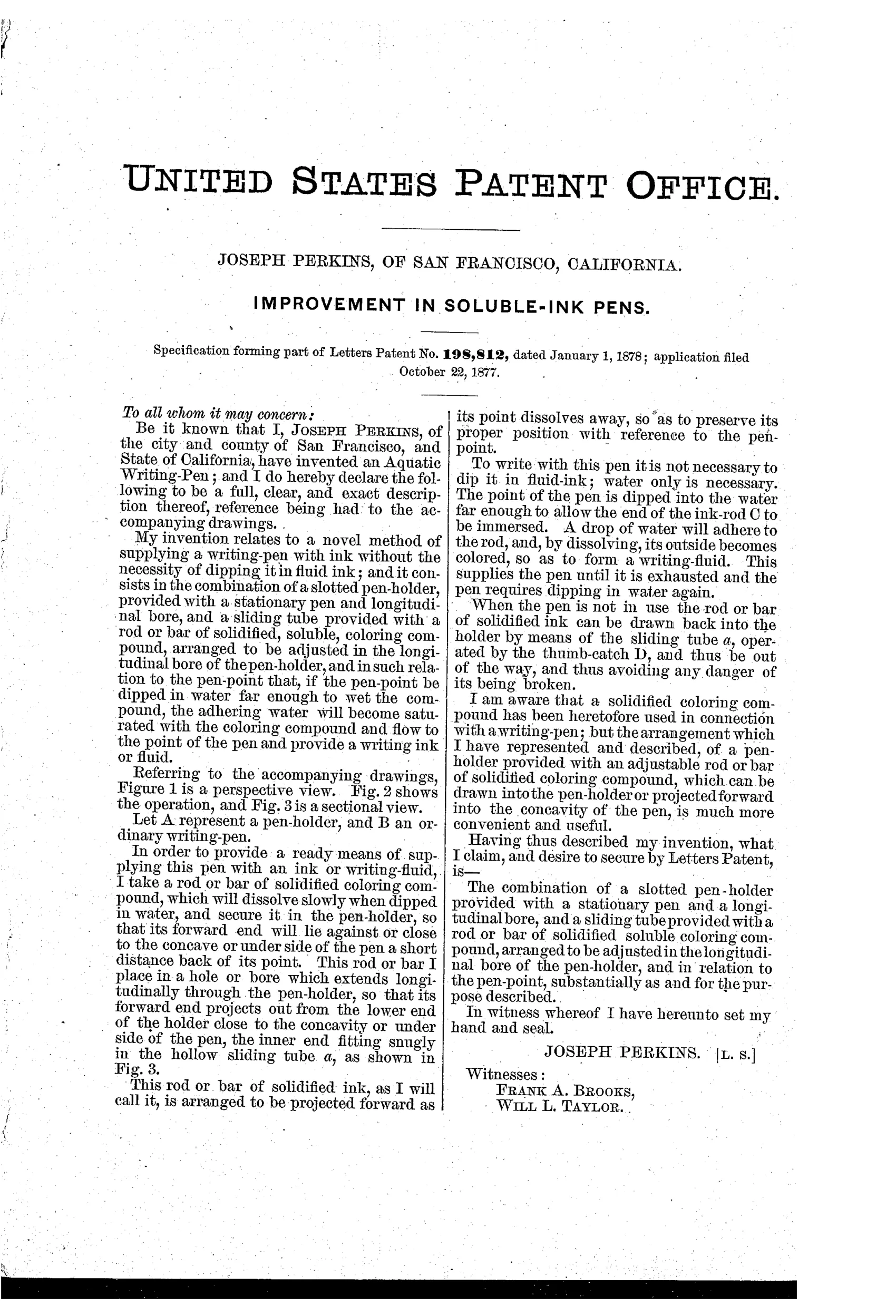
A stationary pen is mounted in a slotted holder that has a longitudinal bore running through it. A rod or bar of solidified, soluble coloring compound sits in this bore, held within a hollow sliding tube that can be adjusted forward or backward via a thumb-catch. When the pen point is dipped in water, the water wets the exposed end of the compound rod, dissolving it slightly so the resulting colored water flows to the pen point as writing ink. The sliding tube lets the user retract the ink rod into the holder when not in use, protecting it from breakage, and also allows the rod to be advanced as its tip dissolves away to maintain proper position relative to the pen point.
✒ What was claimed
“The combination of a slotted pen-holder provided with a stationary pen and a longitudinal bore, and a sliding tube provided with a rod or bar of solidified soluble coloring compound, arranged to be adjusted in the longitudinal bore of the pen-holder, and in relation to the pen-point, substantially as and for the purpose described.”
In plain English: A pen holder with a bore holding a sliding tube containing a dissolvable ink rod that can be positioned relative to the pen point to supply ink when wetted.
✒ In the inventor’s words
“To write with this pen it is not necessary to dip it in fluid-ink; water only is necessary.”— Joseph Perkins, from the specification
Fate unknown
No surviving marked example or maker's line is documented for this design; a specimen with the internal rod mechanism would settle it.
✒ Commentary
Six years before Waterman solved the feed, Joseph Perkins sidestepped the whole problem of carrying liquid ink by not carrying any. His holder conceals a rod of solidified, soluble coloring compound behind the nib. Dip the point in plain water, the water wets the exposed end of the rod, dissolves a little of it, and the tinted water runs to the pen point. Water is everywhere; an inkwell is not. That was the pitch, and the patent says it flatly: "water only is necessary."
The mechanical care is in the sliding tube. Fig. 3 shows the ink rod carried in a hollow slider worked by a thumb-catch in the slot along the barrel — visible in Fig. 1 as the long slit. Retract it and the brittle compound is protected in your pocket; advance it as the tip dissolves away, exactly like feeding lead in a mechanical pencil. Perkins clearly understood that a stick of dried ink would be fragile and self-consuming, and designed for both.
The weaknesses are just as easy to see. Ink concentration would swing with every dip — dark first stroke, pale trailing ones — and dissolution rate depends on water temperature and how long you linger. It's a dead-end branch of the pre-Waterman reservoir story, but an honest one: instead of fighting the leak problem everyone else was losing to in 1878, he redefined the reservoir as the world's water supply.
Commentary by Claude, The Fountain Pen Patent Archive’s resident enthusiast