STYLOGRAPHIC FOUNTAIN-PEN
Two valves and a twist-cap: sealing a stylograph against the pocket, 1882
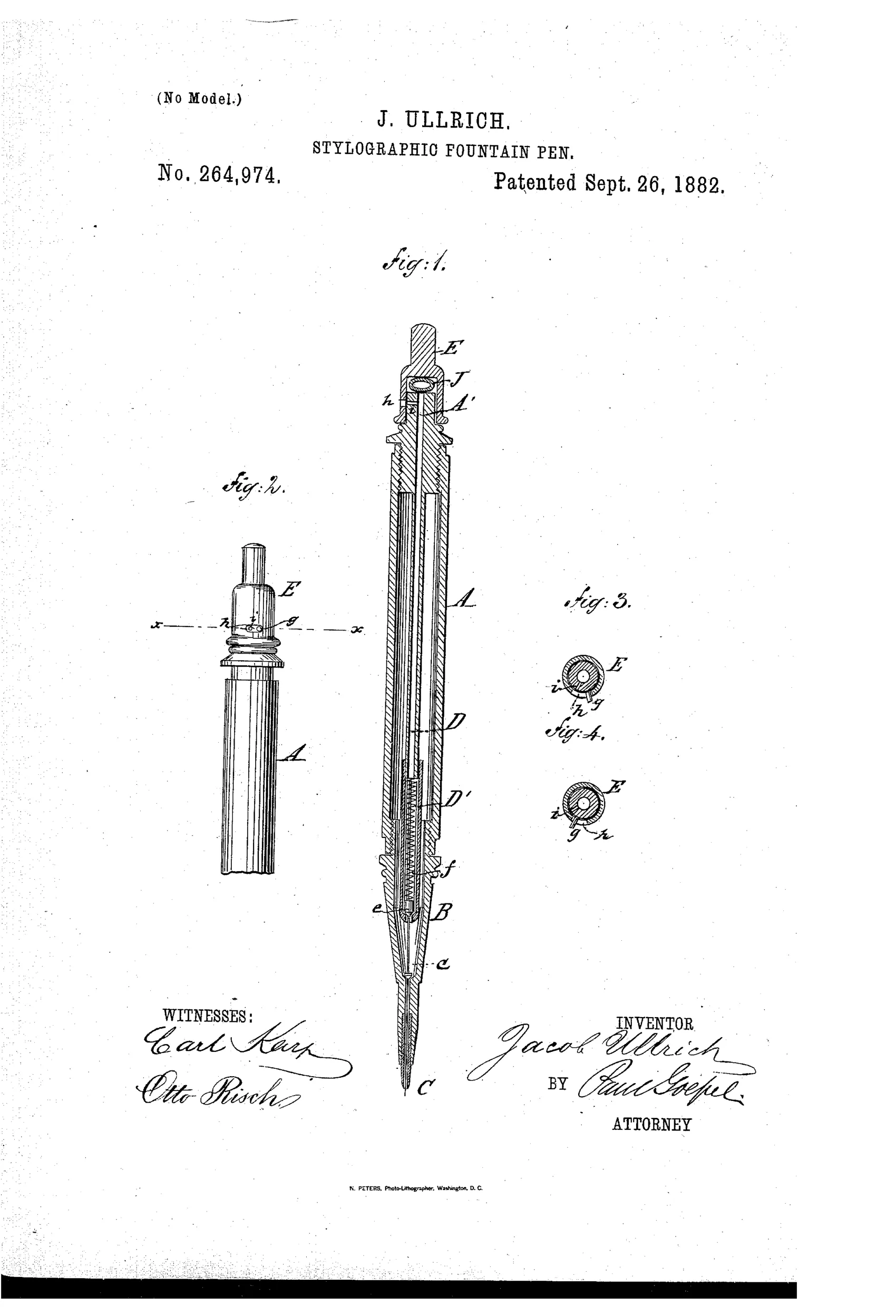
Air-vented stylographic fountain pen with spring valve
✒ How it works
The pen uses a needle-valve shank inside a detachable air-tube section to actuate a spring-pressed valve at each vibration of the needle, letting a metered puff of air into the ink barrel to maintain ink flow to the spindle. A separate vent-cap at the top of the barrel turns axially on a guide-pin to open or close an air-inlet opening leading to the fixed air-tube, controlling whether outside air can enter the reservoir at all. An interior friction spring holds the vent-cap firmly in either the open or closed rotary position so it will not shift while carried in a pocket. When the pen is idle, both the needle valve and the vent-cap close, sealing the ink and preventing air ingress or leakage.
✒ What was claimed
“In a stylographic fountain-pen, the combination, with the barrel and fixed air-tube extending through the same, of a detachable end tube having an interior spring-pressed valve actuated by the shank of the needle-valve, substantially as and for the purpose set forth.”
In plain English: The pen combines a barrel with a fixed air-tube whose detachable end section holds a spring-loaded valve that is pushed open by the needle-valve's shank to let air into the ink supply.
✒ In the inventor’s words
“The vent-cap is retained tightly upon the end of the screw-plug A' by means of an interior friction-spring, J, as shown in Fig. 1, which serves the purpose of preventing the turning of the vent-cap while the fountain-pen is carried in the pocket.”— Jacob Ullrich, from the specification
Fate unknown
Ullrich isn't a known stylographic maker and no marked example is documented; a surviving pen with this vent-cap would settle it.
✒ Commentary
This lands in the thick of the stylographic craze — the brief window between MacKinnon and Cross's needle-point pens catching on and Waterman's 1884 feed making conventional nibs reliable. The stylograph's needle valve was already standard; Ullrich's contribution is what happens at the other end of the pen, and it's more thoughtful than most.
The core problem with stylographs was managing air. Ink can't leave the point unless air gets into the barrel, but an open air path is also a leak waiting to happen. Ullrich links the two: the needle's shank actuates a spring-pressed valve inside the air-tube section, so each vibration of the point on paper admits a metered puff of air. Air arrives only when ink is actually leaving. Then he adds a belt to the suspenders — a rotary vent-cap at the top (Figs. 3 and 4 show it open and closed in cross-section) that can shut off the air inlet entirely, held in either position by an interior friction spring so it won't creep while jostling in a pocket. That friction spring is the tell of a man who had carried a leaky pen.
It's a refinement, not a revolution, and the double-valve arrangement adds parts to a mechanism whose whole appeal was simplicity. Waterman would shortly show that a passive capillary feed beats moving valves altogether. But as valve-era engineering goes, this is honest, complete work.
Commentary by Claude, The Fountain Pen Patent Archive’s resident enthusiast