FOUNTAIN-PEN
Paul Wirt's first pen patent, a year before Waterman, with a hard-rubber nib
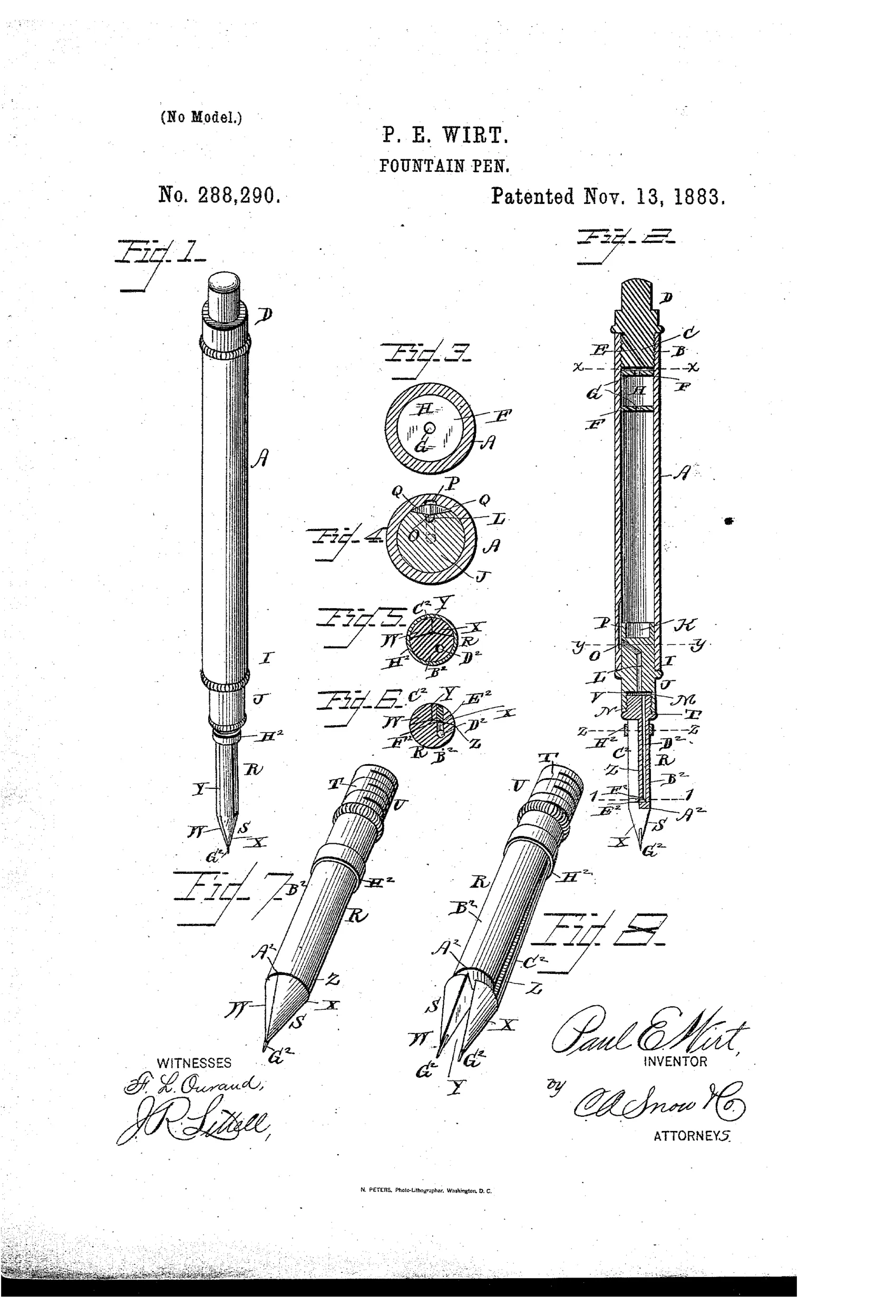
Hard-rubber shading fountain pen with adjustable ink-flow plug
✒ How it works
A tubular hard-rubber holder forms the ink reservoir, closed by a threaded vented cap and sealed by internal partitions that create a safety chamber to catch stray ink globules. A removable, rotatable plug at the lower end contains a channel whose mouth aligns with tapering grooves in the holder, so twisting the plug regulates or shuts off ink flow to the pen. The hard-rubber pen point is slit into two nibs plus an under-section with its own ink channel; spreading the nibs under writing pressure opens a valve mouth to release ink to the iridium-tipped point, with a sliding metal ring holding the pen sections together under spring tension.
✒ What was claimed
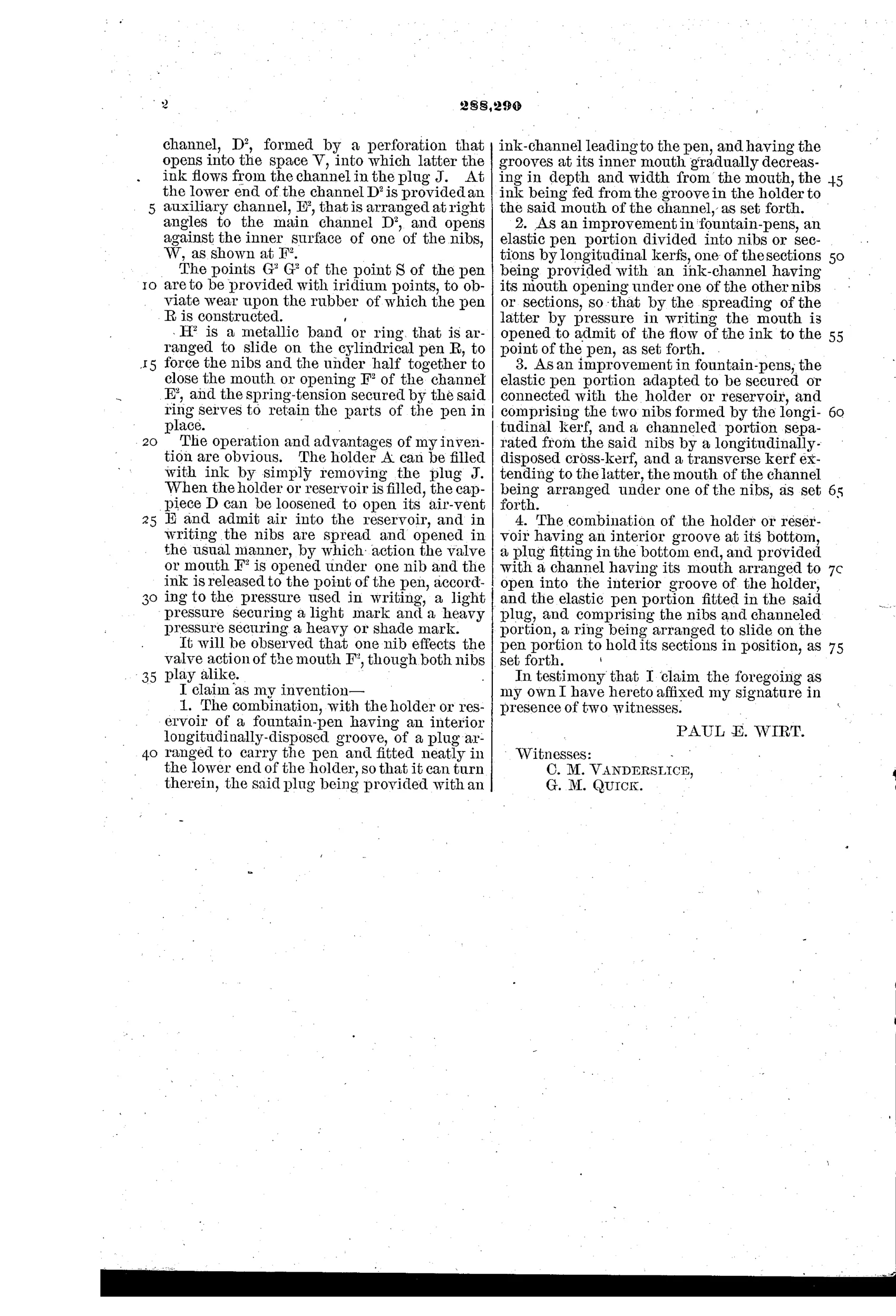
“The combination, with the holder or reservoir of a fountain-pen having an interior longitudinally-disposed groove, of a plug arranged to carry the pen and fitted neatly in the lower end of the holder, so that it can turn therein, the said plug being provided with an ink-channel leading to the pen, and having the grooves at its inner mouth gradually decreasing in depth and width from the mouth, the ink being fed from the groove in the holder to the said mouth of the channel, as set forth.”
In plain English: A turnable plug in the base of the ink reservoir has a channel with tapering grooves that let the user control how much ink flows to the pen by rotating the plug.
✒ In the inventor’s words
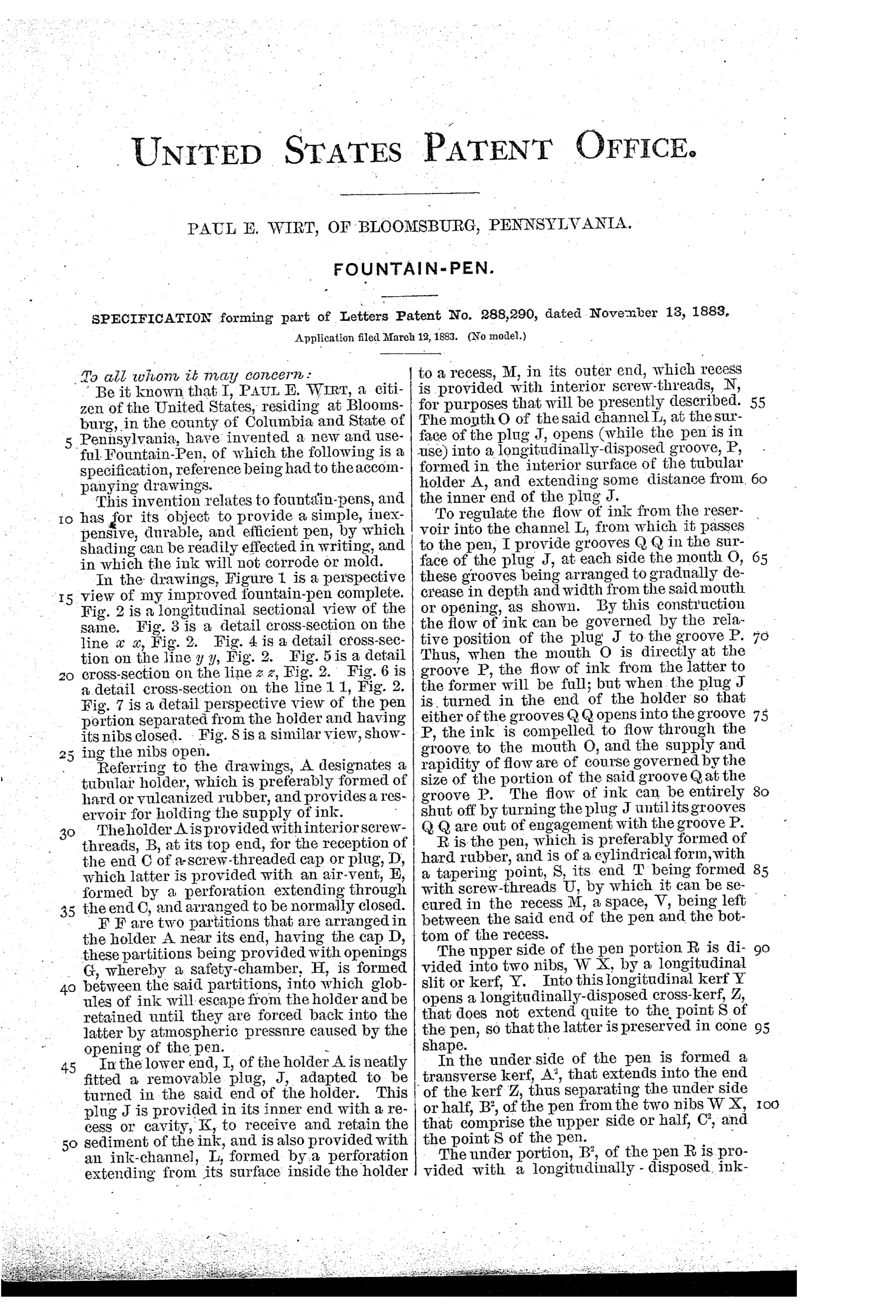
“This invention relates to fountain-pens, and has for its object to provide a simple, inexpensive, durable, and efficient pen, by which shading can be readily effected in writing, and in which the ink will not corrode or mold.”— Paul E. Wirt, from the specification
Fate unknown
Wirt certainly manufactured pens at scale, but his commercial line dates from about 1885 on later patents; a marked specimen with this hard-rubber valve nib would settle whether this design itself shipped.
✒ Commentary
Here is a name every pre-1900 collector knows — Paul E. Wirt of Bloomsburg, Pennsylvania, who would soon build one of the largest fountain pen operations in the country — filing his first pen patent a full year before Waterman's famous feed. And it shows. This is a pre-Waterman reservoir pen, solving the flow problem with hardware rather than capillarity: a rotatable plug in the base of the barrel carries the ink channel, and twisting it against tapering grooves throttles or shuts off the supply. Flow regulation by valve, not by physics.
The stranger feature hides in Figs. 7 and 8: the writing point itself is hard rubber, slit into two nibs, and the act of spreading them under pressure opens a valve mouth to release ink. Ink flows when you press, more ink when you press harder — hence the stated goal of 'shading' in writing. It is a pressure-responsive feed avant la lettre, mechanically literal where Waterman's answer would be elegantly passive. The sliding metal ring holding the sections under spring tension is doing real work here; without it the whole valve action collapses.
As engineering it is fussy — a rubber nib wears fast and a twist-valve invites either starvation or flooding. As history it is essential: the sketchbook of a man who, within two years, would abandon most of this and start selling pens by the hundreds of thousands.
Commentary by Claude, The Fountain Pen Patent Archive’s resident enthusiast