IMPROVEMENT IN METALLIC PENS.
A Civil War-era nib that promises a page of foolscap per dip
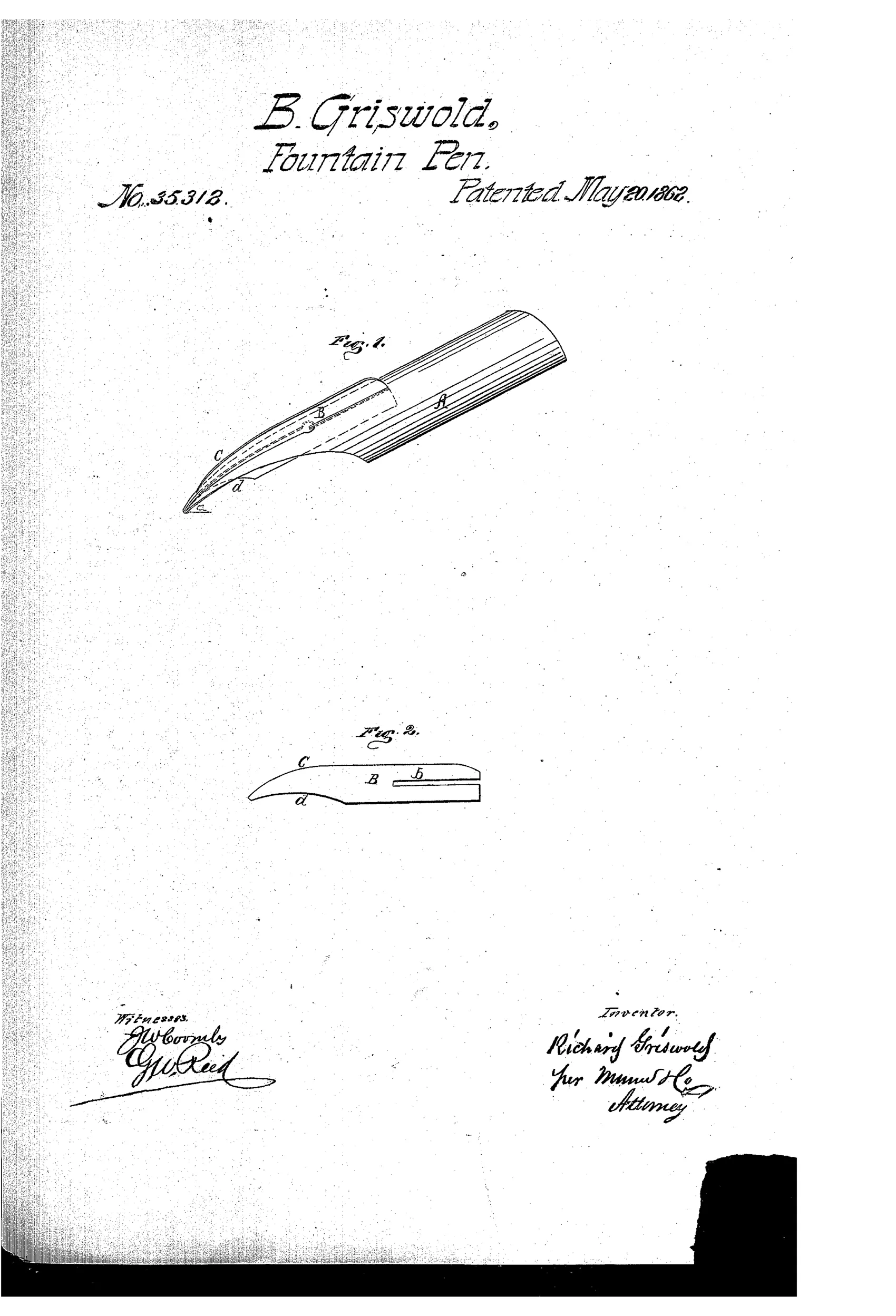
A metallic pen with ink-holding plate insert.
✒ How it works
An ordinary metallic pen has a longitudinal slit into which a slotted plate is fitted, projecting slightly above and below the pen's surfaces at right angles. The plate does not fit tightly in the slit, allowing it to yield or spring under hand pressure while writing. Four angles formed by the plate against the pen body retain a larger quantity of ink than a standard pen, and the plate keeps the slit open at the point so ink sheds freely but only as needed. Because ink is visibly held on the upper surface, the writer can see when the pen needs replenishing.
✒ What was claimed
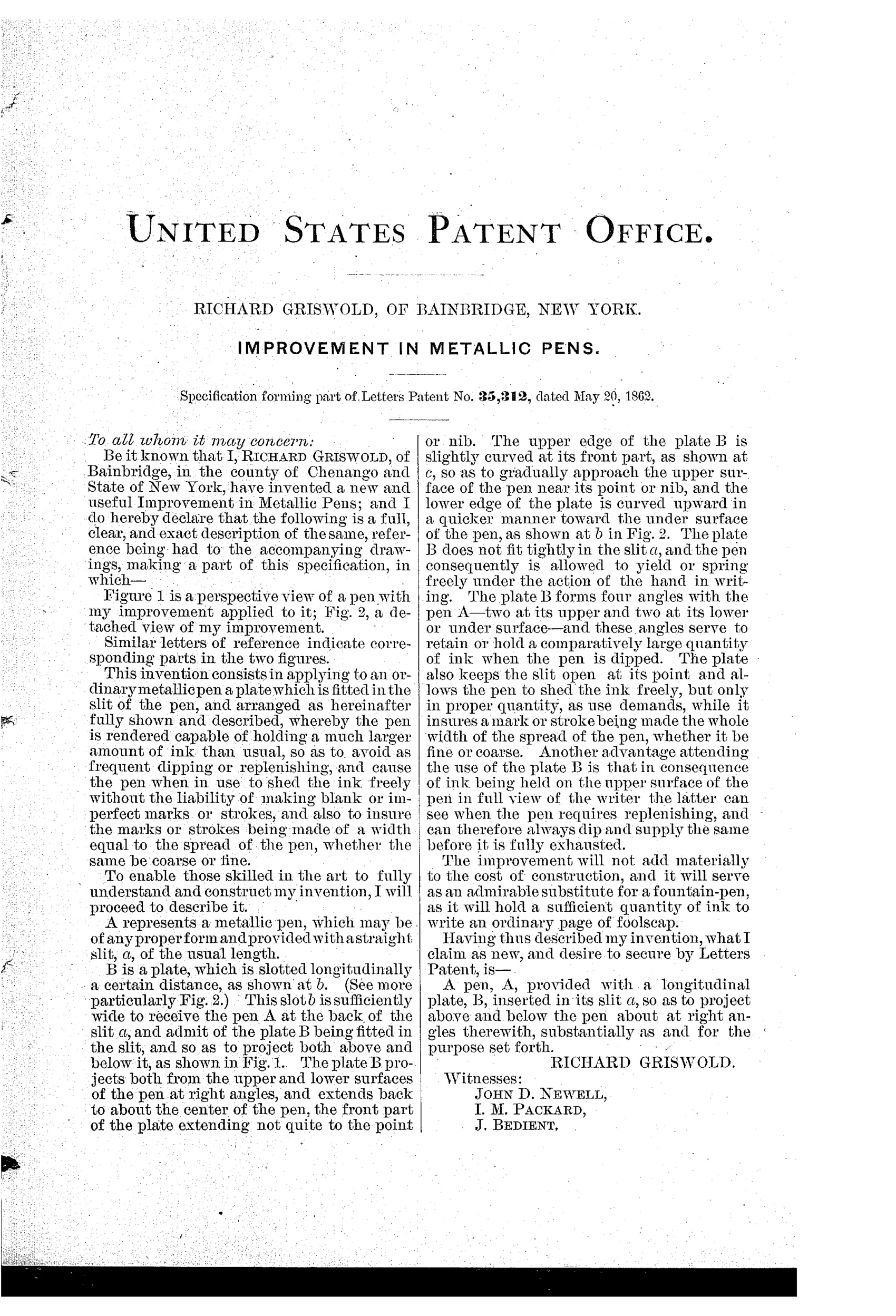
“A pen, A, provided with a longitudinal plate, B, inserted in its slit a, so as to project above and below the pen about at right angles therewith, substantially as and for the purpose set forth.”
In plain English: The invention claims a pen with a slotted plate inserted into its slit so that the plate sticks out above and below the pen at roughly right angles.
✒ In the inventor’s words
“The improvement will not add materially to the cost of construction, and it will serve as an admirable substitute for a fountain-pen, as it will hold a sufficient quantity of ink to write an ordinary page of foolscap.”— Richard Griswold, from the specification
Fate unknown
Reservoir-nib attachments of this era were sometimes sold as stationers' novelties, but no marked Griswold example is documented; a surviving nib with the plate would settle it.
✒ Commentary
This is not a fountain pen at all — it is a dip pen wearing the ambition of one. Griswold's idea is disarmingly simple: take an ordinary steel nib, slip a second slotted plate crosswise into its slit so it stands up like a little fin above and below, and let the four corners where plate meets pen trap ink by capillary action. His pitch is right there in the text: it will hold enough ink 'to write an ordinary page of foolscap' — a fountain pen's payoff without the fountain pen's price or its notorious leaks.
Two details in the drawing deserve a second look. The plate is deliberately loose in the slit, so it flexes with the tines rather than stiffening them — Griswold understood that a rigid insert would kill the pen's spring and ruin the line. And because the reservoir sits on the upper face, the writer can see the ink dwindling, a genuinely thoughtful touch in an age of blind dipping.
Mechanically this is the same instinct that drove dozens of 'reservoir attachments' clipped and soldered onto nibs through the mid-1800s. It sits squarely in the pre-Waterman stratum: attack ink capacity at the nib, since nobody had yet solved feeding ink reliably from a barrel. A dead end in the arc of the category — but an honest, cheap, probably functional one for its moment.
Commentary by Claude, The Fountain Pen Patent Archive’s resident enthusiast