COMBINED PEN HOLDER AND FOUNTAIN.
One stamped-metal blank becomes holder, spring arm, and a nib-actuated ink valve
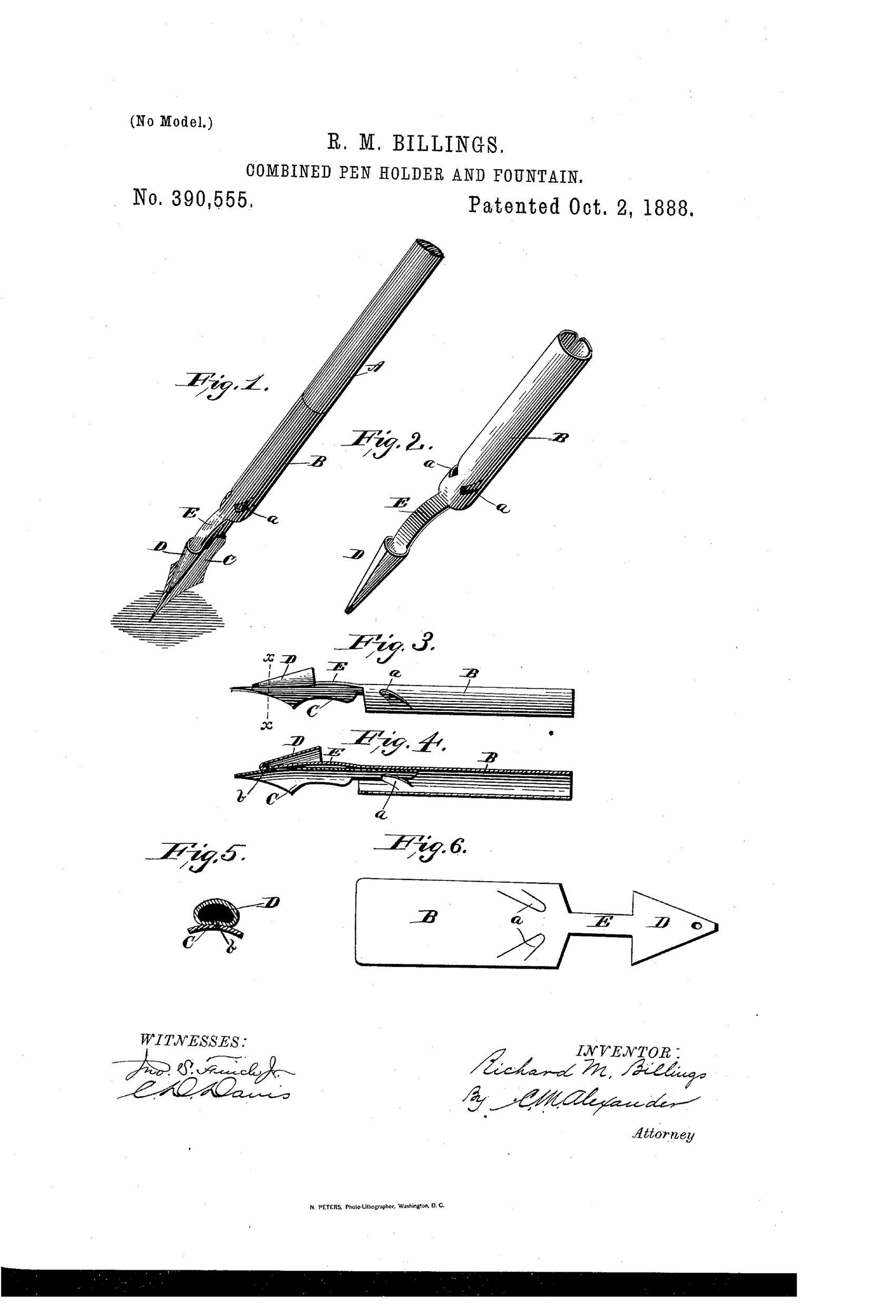
Self-feeding ink reservoir attachment for pen holders
✒ How it works
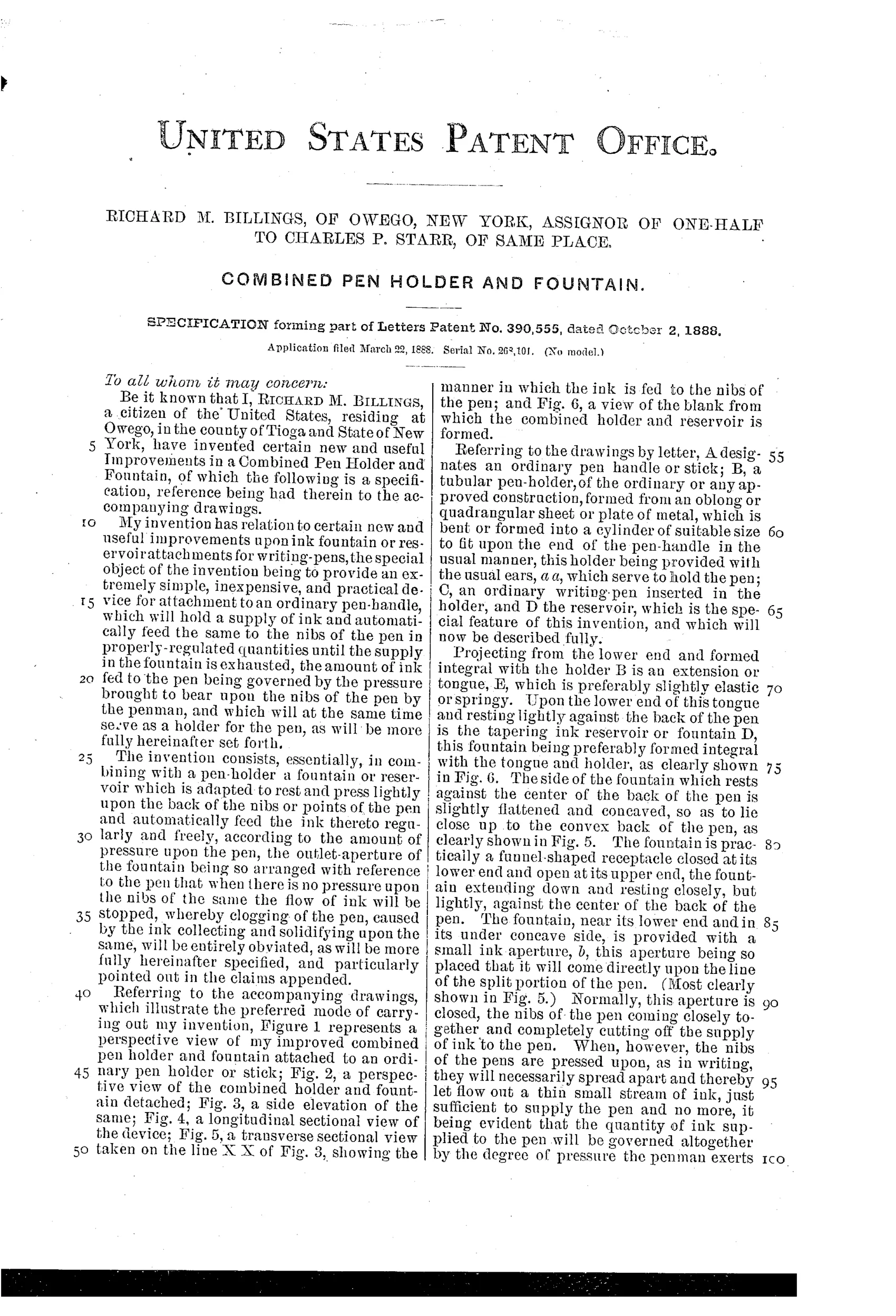
A tubular pen-holder B holds an ordinary writing pen C and has an integral elastic tongue E extending from its lower end. A conical, funnel-shaped ink fountain D is formed integral with this tongue and rests lightly against the back of the pen, with its concave underside flattened to fit closely against the pen's convex back. A small aperture b in the fountain's underside sits directly over the split of the pen's nibs, remaining closed when the nibs are together and opening to release ink only when writing pressure spreads the nibs apart. The entire device—holder, tongue, and fountain—is stamped or formed integrally from a single sheet of metal, as shown in the flat blank of Fig. 6.
✒ What was claimed
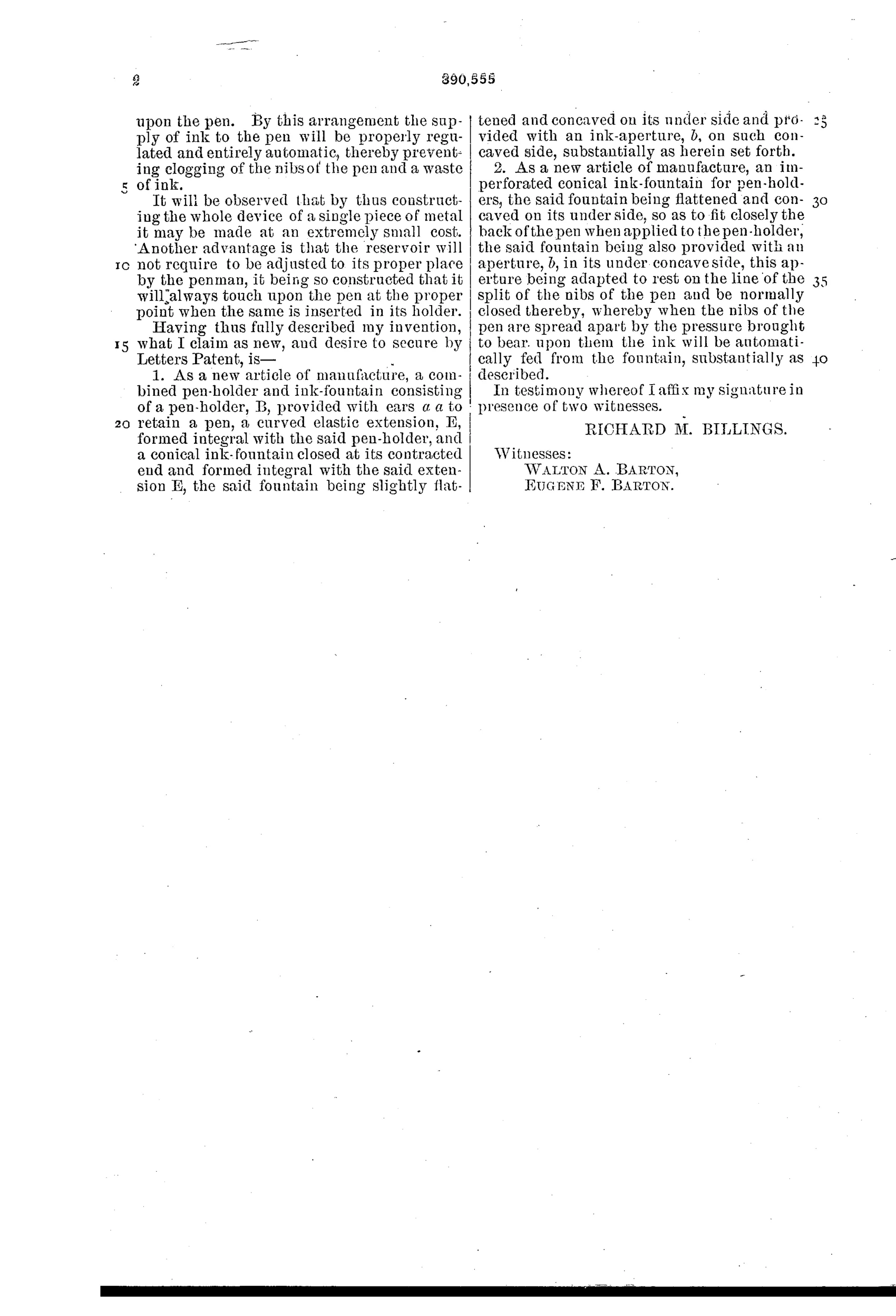
“As a new article of manufacture, a combined pen-holder and ink-fountain consisting of a pen-holder, B, provided with ears a a to retain a pen, a curved elastic extension, E, formed integral with the said pen-holder, and a conical ink-fountain closed at its contracted end and formed integral with the said extension E, the said fountain being slightly flattened and concaved on its under side and provided with an ink-aperture, b, on such concaved side, substantially as herein set forth.”
In plain English: The invention is a one-piece pen holder with ears to hold a pen and an integral springy arm carrying a cone-shaped ink reservoir that has a flattened, concave underside with a small ink hole positioned against the pen's nibs.
✒ In the inventor’s words
“It will be observed that by thus constructing the whole device of a single piece of metal it may be made at an extremely small cost.”— Richard M. Billings, from the specification
Fate unknown
Cheap stamped reservoir attachments of this type were widely sold, but no marked Billings or Starr example is documented; a surviving specimen would settle it.
✒ Commentary
Four years after Waterman's feed patent, Billings is playing a different game entirely. This isn't a fountain pen; it's an attachment that turns an ordinary steel dip pen into something you refill every paragraph instead of every sentence. The whole trade in these gadgets was about cost, and his opening move is the best one: the entire device — holder, elastic tongue, and conical fountain — is stamped from one piece of sheet metal. Fig. 6, the flat blank with the arrow-shaped tail, is the real invention here. Fold it up and you have the product.
The feed idea is genuinely neat, even if it belongs to the doomed pre-Waterman school of valve thinking. The little cone of ink rests against the back of the nib, its concave underside fitted to the nib's convex curve, with a tiny aperture positioned right over the slit. When the tines are together, the metal effectively seals the hole; when writing pressure spreads them, ink can pass. Ink delivery regulated by the very act of writing, with no moving part beyond the pen itself.
In practice these pressure-fed reservoirs tended to blob at the start of a stroke and starve at the end, and capillary feeds beat them decisively. But as a penny-goods design — one stamping, no solder, no rubber — it's an honest, clever entry in the crowded field of dip-pen extenders that the fountain pen was already busy making obsolete.
Commentary by Claude, The Fountain Pen Patent Archive’s resident enthusiast