CLOTH-DOTTER.
The drawing says fountain pen; the specification says dye applicator. Both are right.
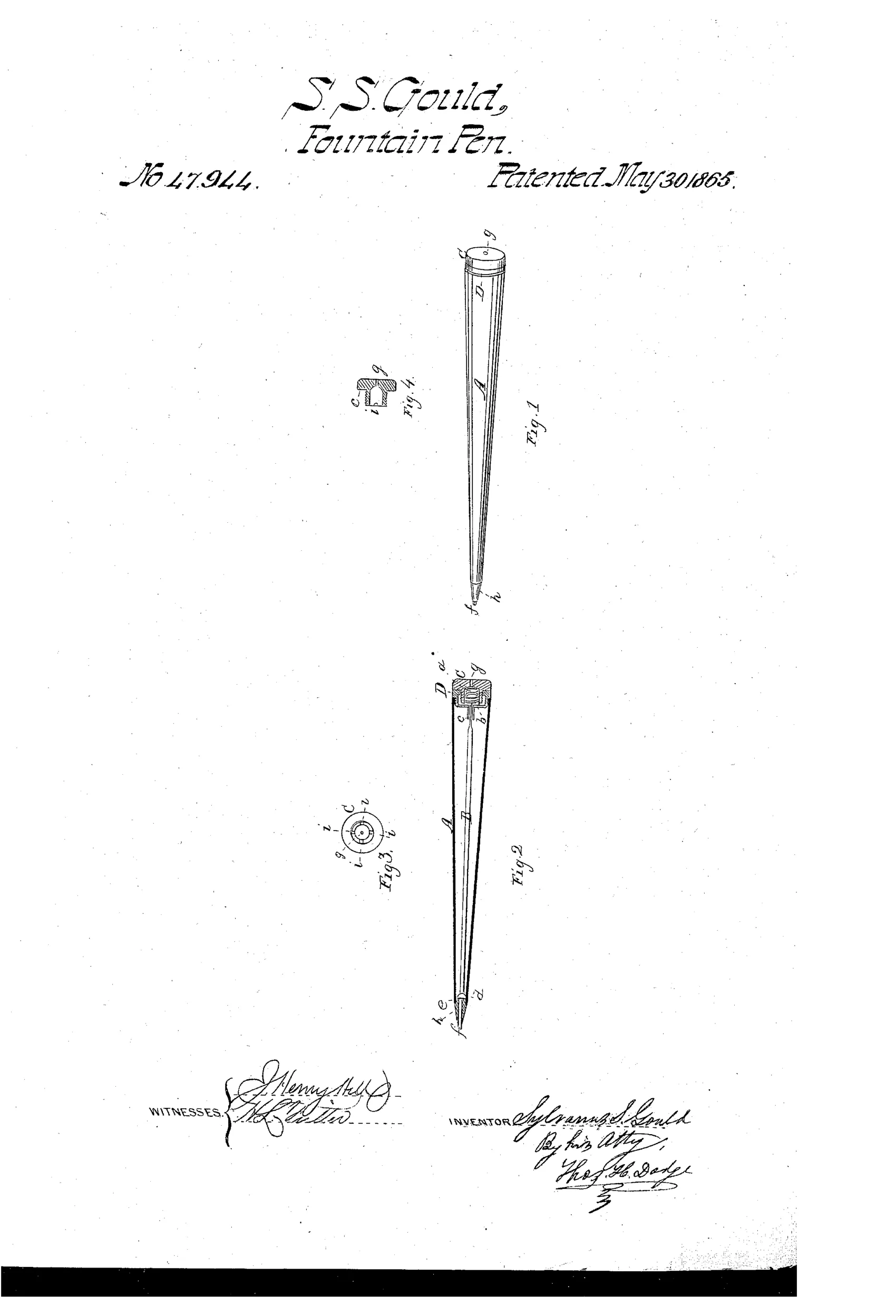
A hand tool for dyeing cloth spots.
✒ How it works
The dotter consists of a hollow body A holding liquid dye, sealed at top by screw-caps C and D and fitted with an internal valve-rod B held up by a spiral spring a. Pressing the pointed tip h against a cloth spot pushes the rod upward, opening a valve d at the bottom so dye flows down grooves f onto the fabric. Lifting the tool releases the spring, forcing the rod back down and reseating the valve to stop the flow. The screw-caps also admit air through a hole g and packing b to keep the dye flowing smoothly and to prevent leakage when the tool is set aside.
✒ What was claimed
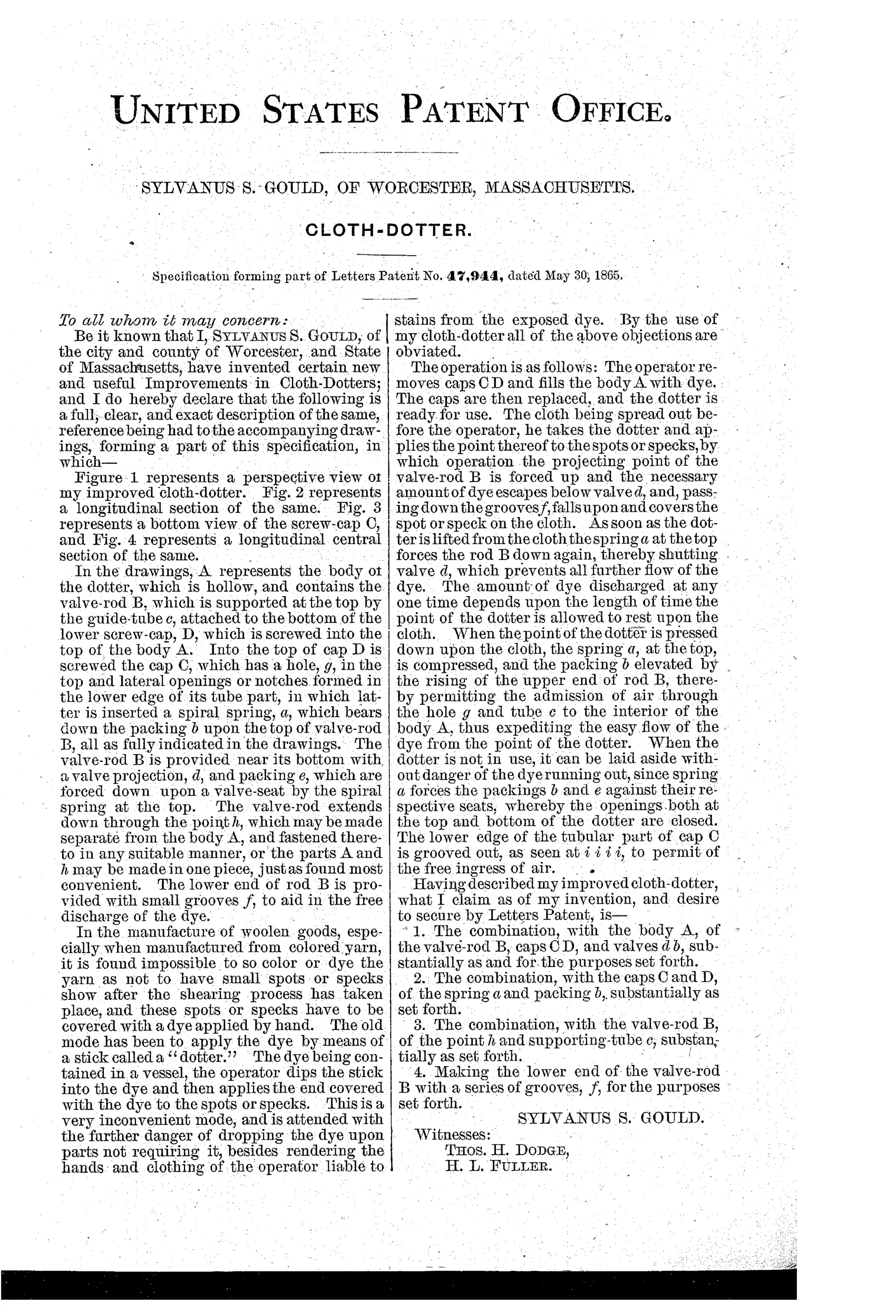
“The combination, with the body A, of the valve-rod B, caps C D, and valves d b, substantially as and for the purposes set forth.”
In plain English: The main claim covers the combined body, internal valve rod, top and bottom screw caps, and two valves that together control the release of dye.
✒ In the inventor’s words
“This is a very inconvenient mode, and is attended with the further danger of dropping the dye upon parts not requiring it, besides rendering the hands and clothing of the operator liable to stains from the exposed dye.”— Sylvanus S. Gould, from the specification
Fate unknown
No documented Gould cloth-dotter survives to my knowledge; a marked specimen or trade listing from Worcester textile suppliers would settle it.
✒ Commentary
Here is a genuine oddity of the pre-Waterman era: the draftsman lettered "Fountain Pen" across the top of the sheet, while Gould's specification describes a "cloth-dotter" for applying dye to fabric spots. The confusion is understandable, because mechanically this is a fountain pen in everything but purpose — a hollow tapered reservoir, a screw cap with an air hole, and a pointed writing tip. Gould was solving the identical problem the pen inventors were: controlled release of liquid from a hand-held reservoir without drips or stained fingers.
His answer is the valve-on-demand approach. A spring-loaded rod runs the length of the body; pressing the tip against the cloth pushes the rod up and unseats a valve at the bottom, letting dye run down grooves to the point. Lift the tool and the spring snaps the valve shut. Notice the packing at the top cap — Gould understood that the air inlet was as likely to leak as the tip, a lesson pen makers relearned for decades.
This tip-actuated valve is essentially the stylographic pen principle, patented here in 1865 — well before the stylographic craze of the late 1870s — just aimed at dyers instead of writers. As a dead end it is a remarkably prescient one: the mechanism works, and its descendants sold in the millions under other names.
Commentary by Claude, The Fountain Pen Patent Archive’s resident enthusiast