TWIN-POINTED PEN.
A folded sheet-metal nib that holds its own ink between the layers
A twin-pointed metal pen nib
✒ How it works
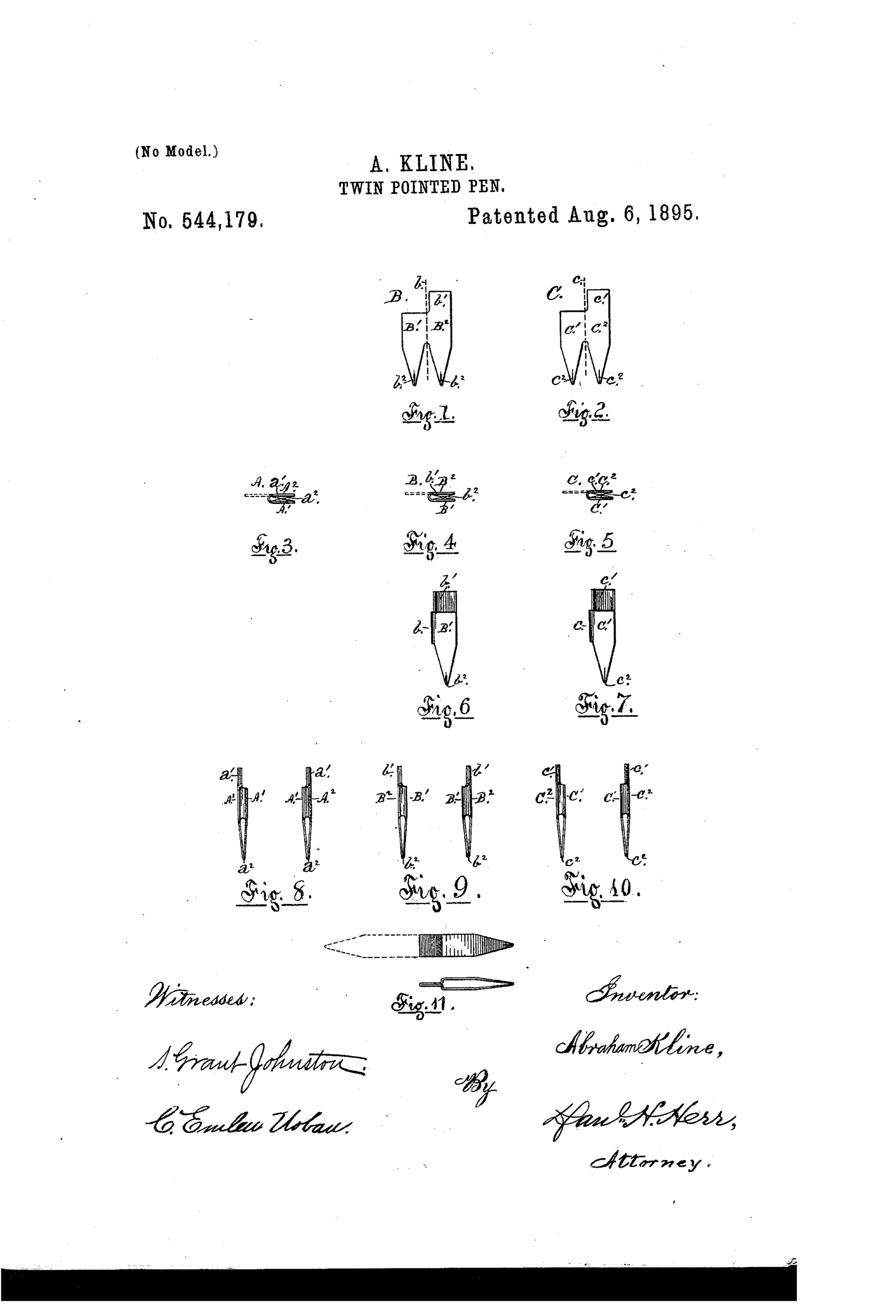
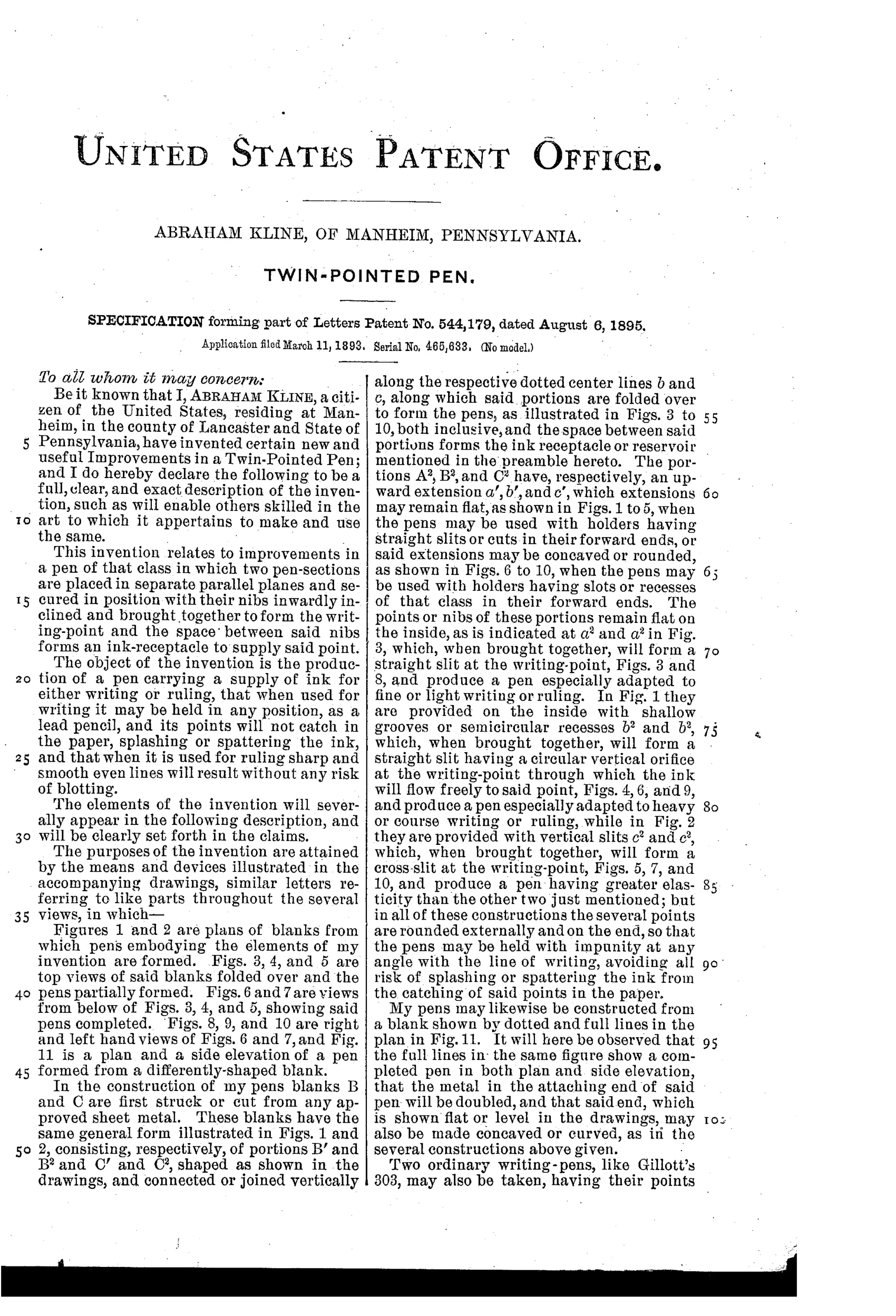
Two V-shaped pen sections (B and C) are stamped from sheet metal and folded over on parallel planes so their nibs incline inward and meet at a central point. The space left between the two folded portions forms an ink reservoir that feeds ink to the writing point by capillary action. The nib ends can be formed with a straight slit, a circular orifice, or a cross-slit, and are rounded externally so the pen can be held at any angle without catching the paper or splattering ink. An upward extension on the blank fits into either a straight-slit or slotted pen holder for attachment.
✒ What was claimed
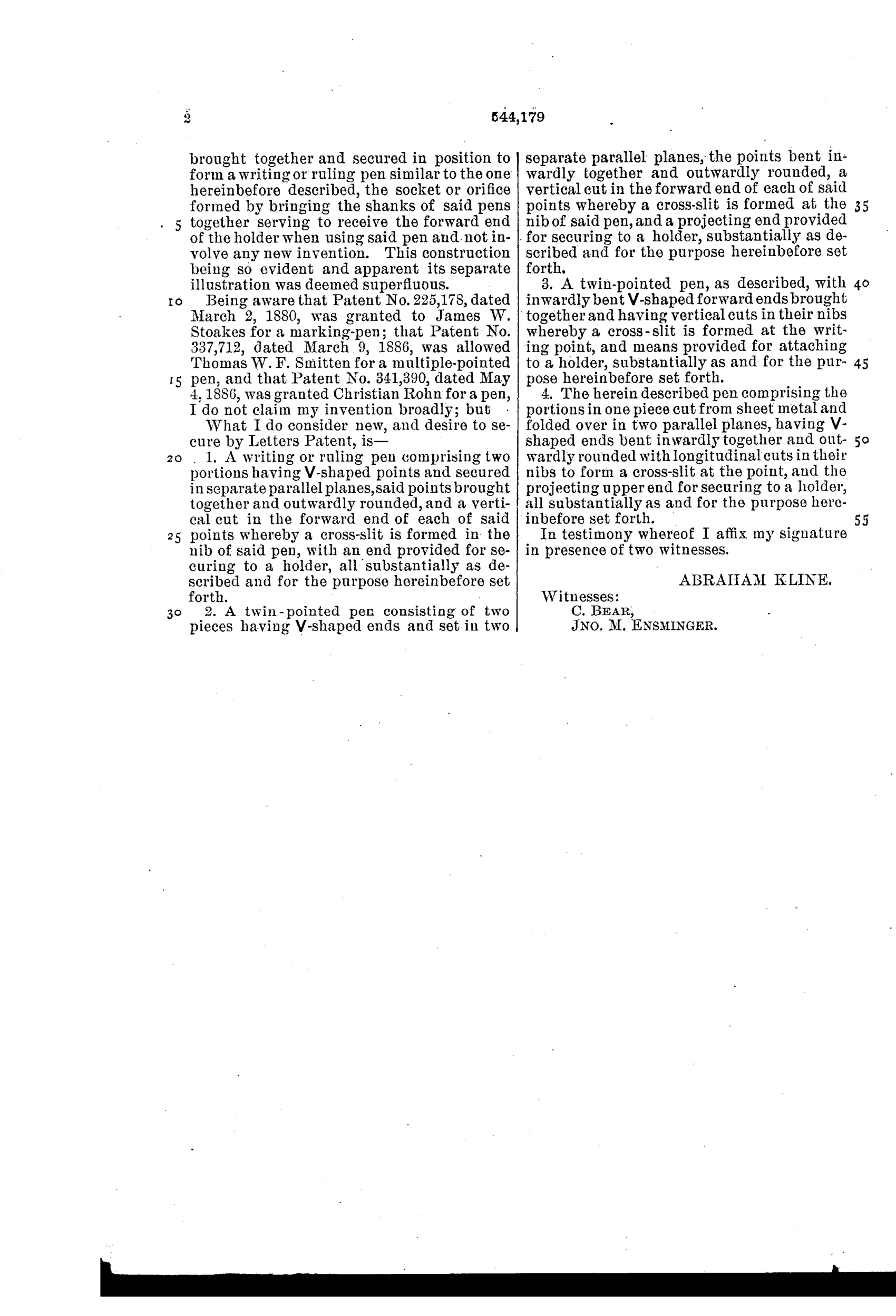
“1. A writing or ruling pen comprising two portions having V-shaped points and secured in separate parallel planes, said points brought together and outwardly rounded, and a vertical cut in the forward end of each of said points whereby a cross-slit is formed in the nib of said pen, with an end provided for securing to a holder, all substantially as described and for the purpose hereinbefore set forth.”
In plain English: The pen is made of two V-shaped metal sections held in parallel planes, brought together with rounded tips and a small vertical cut at each tip so their meeting forms a cross-slit at the writing point, with an end for attaching to a holder.
✒ In the inventor’s words
“The object of the invention is the production of a pen carrying a supply of ink for either writing or ruling, that when used for writing it may be held in any position, as a lead pencil, and its points will not catch in the paper, splashing or spattering the ink, and that when it is used for ruling sharp and smooth even lines will result without any risk of blotting.”— Abraham Kline, from the specification
Paper patent — likely never produced
No maker's line or surviving marked example of this folded twin-point nib is known to me, and the design left no trace in the trade; a stamped specimen would overturn this.
✒ Commentary
Kline's idea is a dip pen that cheats: stamp a blank with two V-shaped points, fold it over on itself so the points meet, and let the gap between the two layers act as an ink reservoir feeding the tip by capillarity. It's the same physics Waterman had formalized eleven years earlier for feeds, applied here to the nib itself. No hard rubber, no barrel — just one piece of folded metal you'd stick in an ordinary holder.
The drawing sheet rewards a close look. Figures 1 and 2 show the flat blanks with their symmetrical V-points, and Figures 3 through 5 show the folding in progress — you can see this is really a manufacturing patent as much as a pen patent, designed around what a stamping press and a folding die can do cheaply. The three tip variants (straight slit, round orifice, cross-slit) are Kline hedging on how ink actually behaves at the point; the cross-slit formed by the two meeting halves is the claim he leads with.
The promise of writing 'as a lead pencil,' held at any angle without catching, is the tell: this is aimed at people who found steel dip nibs scratchy and directional. The rounded, doubled point plausibly delivers that, at the cost of any line variation. As a ruling pen it makes real sense — draftsman's ruling pens already worked on exactly this two-blade capillary principle. As a writing pen, it's a clever dead end in a market about to be swallowed by true fountain pens.
Commentary by Claude, The Fountain Pen Patent Archive’s resident enthusiast