MARKING AND SHADING PEN.
Two inks, one downstroke: a sign-writer's dip pen that blends its own colors
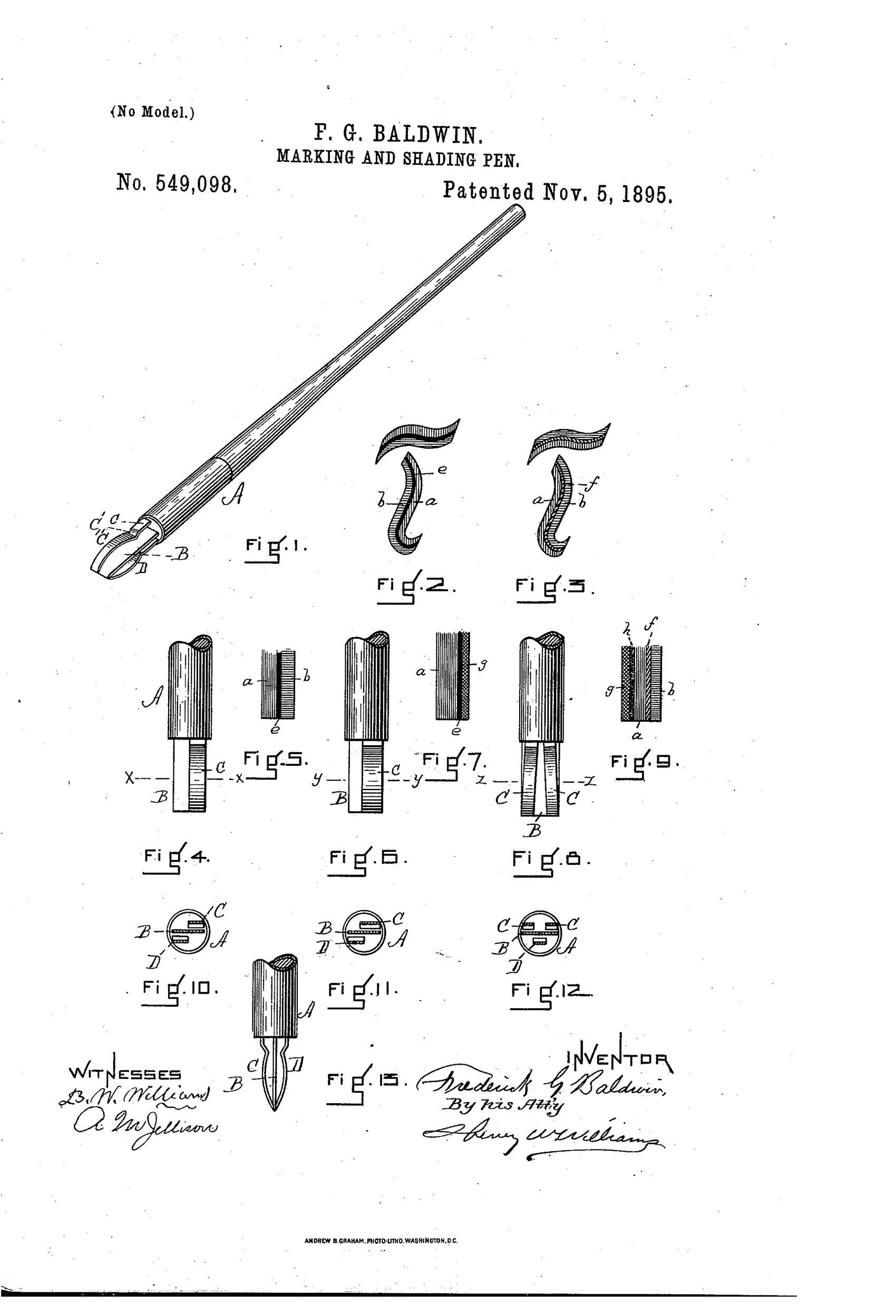
Multi-blade pen for shading in multiple colors
✒ How it works
The pen has a handle with a broad flat central blade extending from its lower end. One or more outer blades or nibs extend from the handle on each side of the central blade, contacting it at their outer ends and then spreading apart to form spaces for holding different colored coloring-matter. As the pen is drawn across the paper, each outer blade deposits its own color, and the inner edges of the outer blades bleed and blend their colors along the central line, producing shaded, multi-colored marks in a single downstroke.
✒ What was claimed
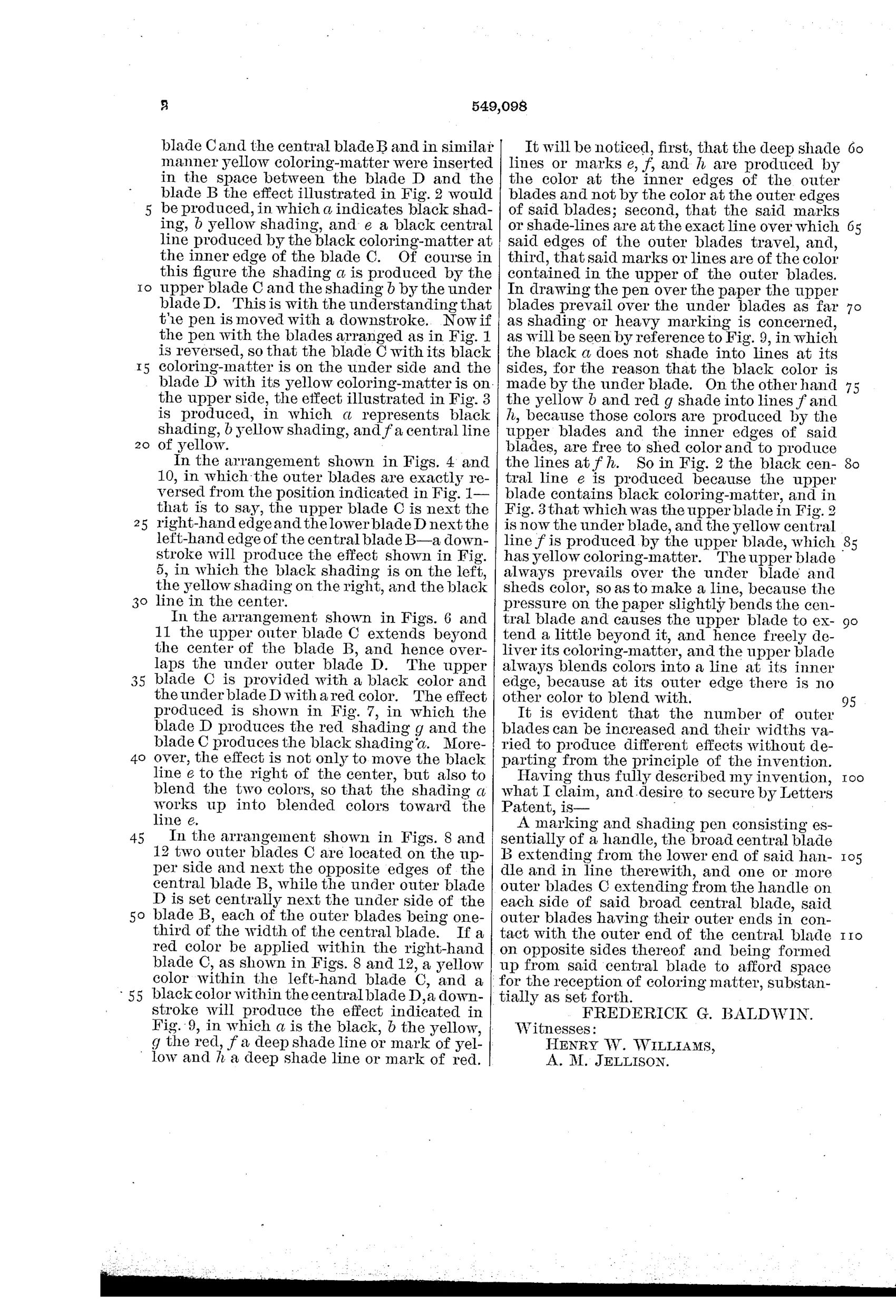
“A marking and shading pen consisting essentially of a handle, the broad central blade B extending from the lower end of said handle and in line therewith, and one or more outer blades C extending from the handle on each side of said broad central blade, said outer blades having their outer ends in contact with the outer end of the central blade on opposite sides thereof and being formed up from said central blade to afford space for the reception of coloring matter, substantially as set forth.”
In plain English: The pen has a handle, a broad flat central blade, and one or more side blades that touch the central blade at their tips but curve away from it elsewhere, creating pockets that hold different colors of ink.
✒ In the inventor’s words
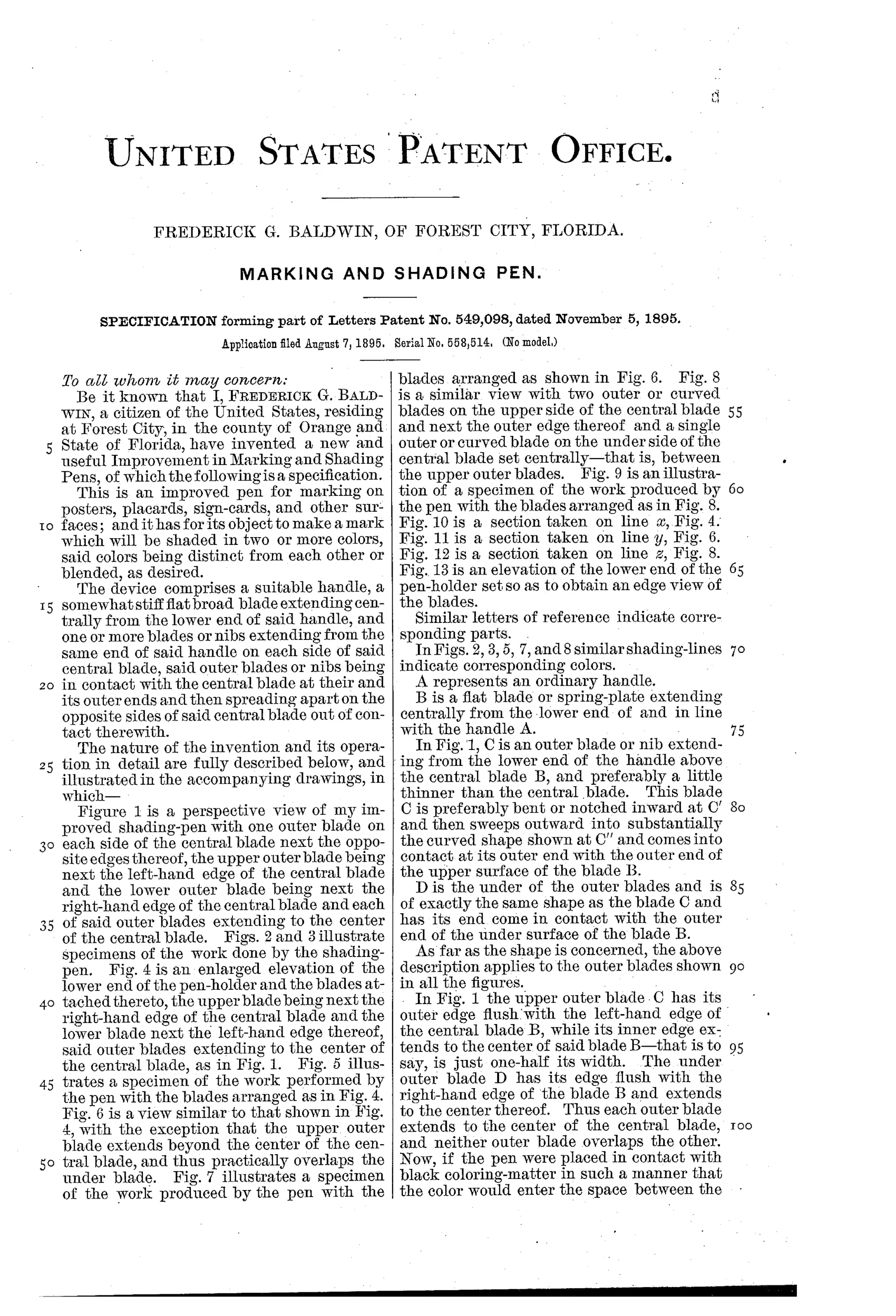
“It has for its object to make a mark which will be shaded in two or more colors, said colors being distinct from each other or blended, as desired.”— Frederick G. Baldwin, from the specification
Fate unknown
Shading pens of this general type were sold to sign-writers, but no Baldwin-marked example is documented; a surviving specimen or trade-catalog listing would settle it.
✒ Commentary
This isn't a fountain pen at all — it's a sign-writer's shading pen, cousin to the 'automatic' lettering pens of the 1890s. But it earns its place here because Baldwin is wrestling with the same fundamental problem as every feed inventor of the decade: how to get ink to hold in a metal assembly by capillarity and release it evenly under the drag of the tip. His answer is a broad flat central blade with curved outer blades that touch it only at the very point, leaving wedge-shaped pockets behind the tip. Load each pocket with a different color, and the pen lays down a band with distinct edges that bleed together along the center line.
The drawing sheet is unusually generous: Figs. 2, 3, 5, 7 and 9 are actual specimens of work, showing the shaded strokes you'd get from each blade arrangement. Patent draftsmen rarely bothered to illustrate output, and it makes the claim instantly legible — you can see the black-and-yellow flourish the thing was built to produce.
Mechanically it's plausible. Broad-nib shading pens of this general family were real trade tools for show-card writers, and the multi-pocket idea is a modest, sensible extension. Whether two loaded colors would stay in their lanes rather than wicking together before you finished the stroke is the practical question the specimens conveniently answer in Baldwin's favor. A workmanlike entry, but the blended-color claim is a genuinely distinct twist on a crowded lettering-pen field.
Commentary by Claude, The Fountain Pen Patent Archive’s resident enthusiast