WRITING-PEN.
Tuning a steel nib's spring with an S-bend, eighteen years before Waterman
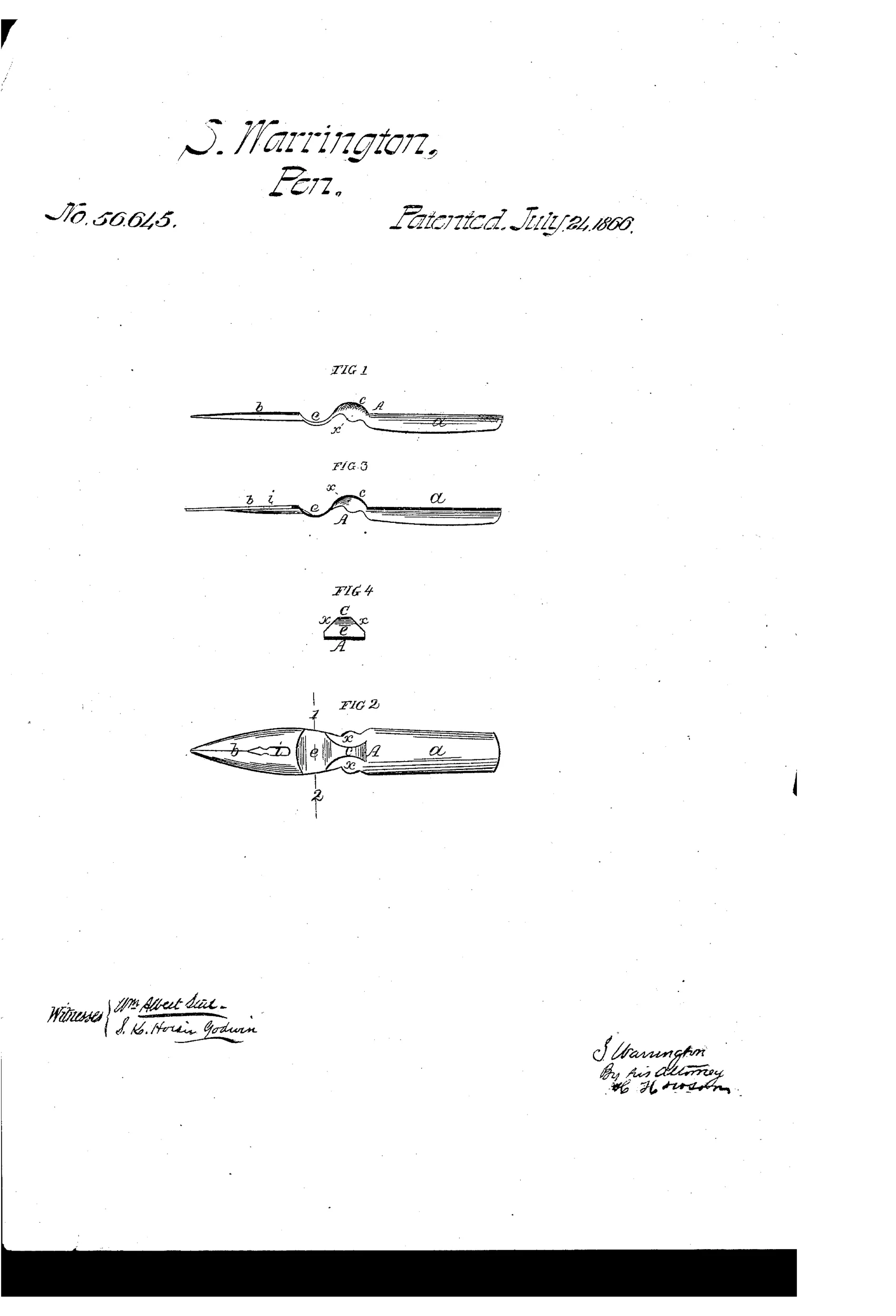
An improved metal writing pen nib
✒ How it works
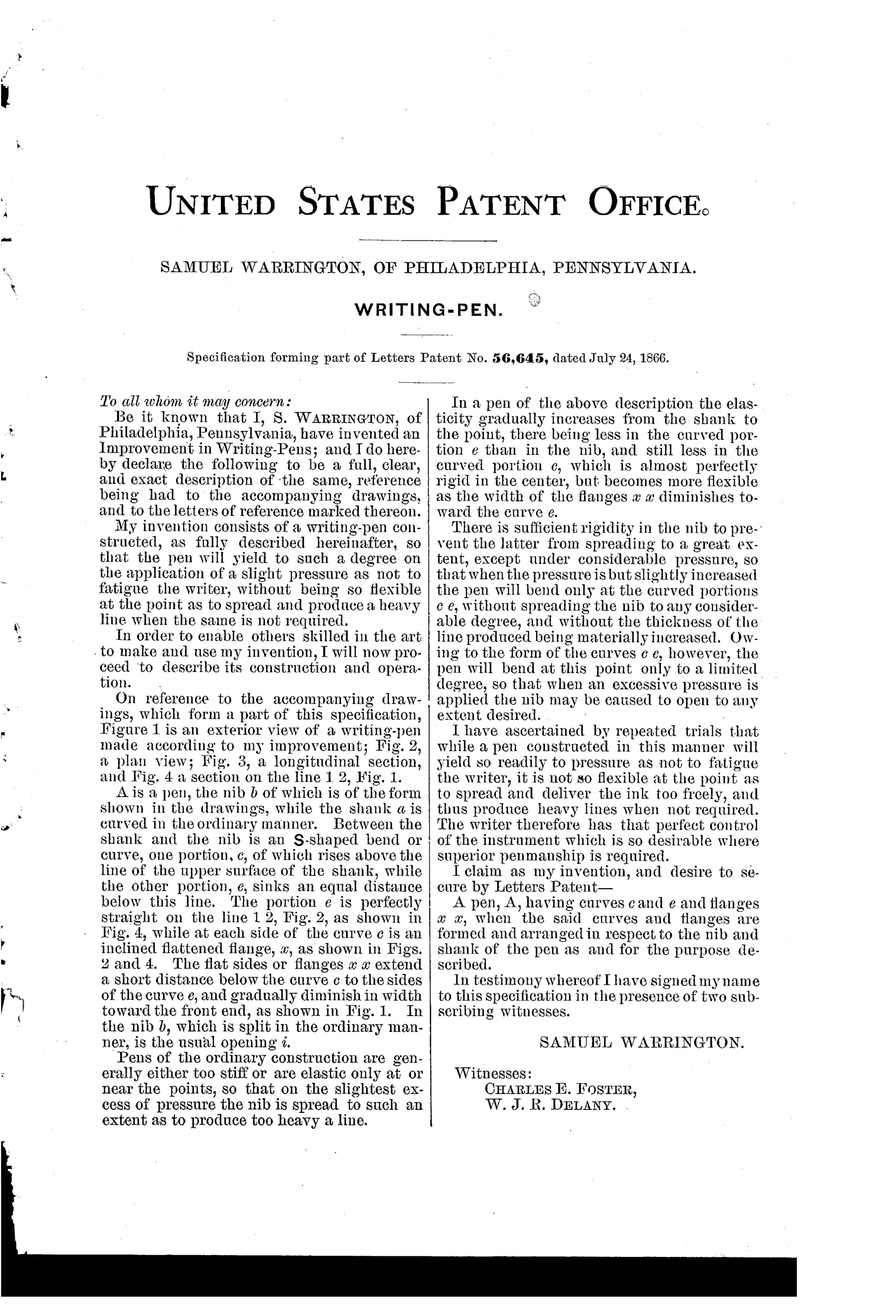
The pen A has an S-shaped bend between the shank and nib, with one portion c rising above the shank surface and the other portion e sinking below it. Flattened inclined flanges x x flank the curve c and taper in width toward the front of the pen. This graduated construction makes elasticity increase gradually from shank to point, being least at curve e, nearly rigid at curve c, and more flexible as the flanges narrow. The nib remains rigid enough to resist spreading under light pressure but opens under greater pressure, giving the writer controlled variation in line thickness.
✒ What was claimed
“A pen, A, having curves c and e and flanges x x, when the said curves and flanges are formed and arranged in respect to the nib and shank of the pen as and for the purpose described.”
In plain English: The claim covers a pen nib with two S-curves and tapering side flanges arranged relative to the nib and shank to control flexibility as described.
✒ In the inventor’s words
“The writer therefore has that perfect control of the instrument which is so desirable where superior penmanship is required.”— Samuel Warrington, from the specification
Fate unknown
Steel nibs of this era rarely carry patent markings and Warrington isn't a documented maker; a stamped specimen or trade listing would settle it.
✒ Commentary
This is not a fountain pen at all — it's a dip nib, from the long era when 'writing-pen' meant a stamped steel blade you dipped every few words. Warrington's contribution is a piece of spring engineering: an S-shaped kink between shank and point, with the upper curve c standing proud and the lower curve e recessed, flanked by inclined flanges that taper toward the tip. The result is a nib whose stiffness is graded along its length — nearly rigid where the flanges are widest, progressively softer as they narrow toward the point.
What he's chasing is the calligrapher's holy grail of that century: a nib that stays closed under normal writing pressure but spreads controllably when you bear down, so line variation is deliberate rather than accidental. Most makers got there with pierced holes, side slits, or cheap luck in the tempering. Warrington instead shapes the metal itself into a variable-rate spring — Figure 4's cross-section is the tell, showing the raised curve as a stiffening rib the way a crease stiffens a folded paper.
It sits well outside the reservoir-pen story, but it matters as background: this obsession with graduated flex is exactly what gold fountain pen nibs later inherited. As dip-nib patents go, this is a thoughtful one — mechanically literate, cheap to stamp, and honest about what it promises.
Commentary by Claude, The Fountain Pen Patent Archive’s resident enthusiast