METALLIC PEN.
An 1848 oblique nib, plus gold points riveted to a silver body
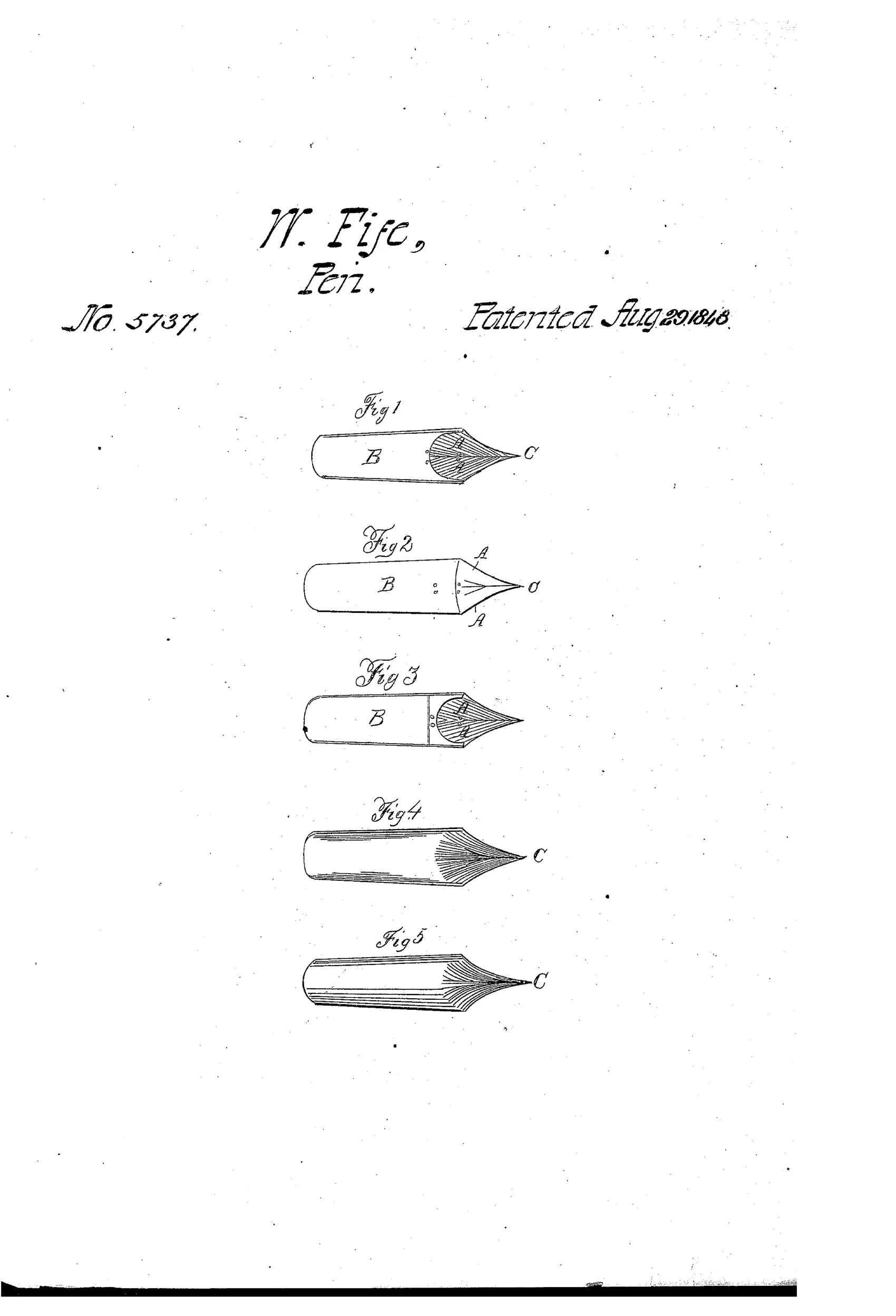
Metallic pen with curved nib points
✒ How it works
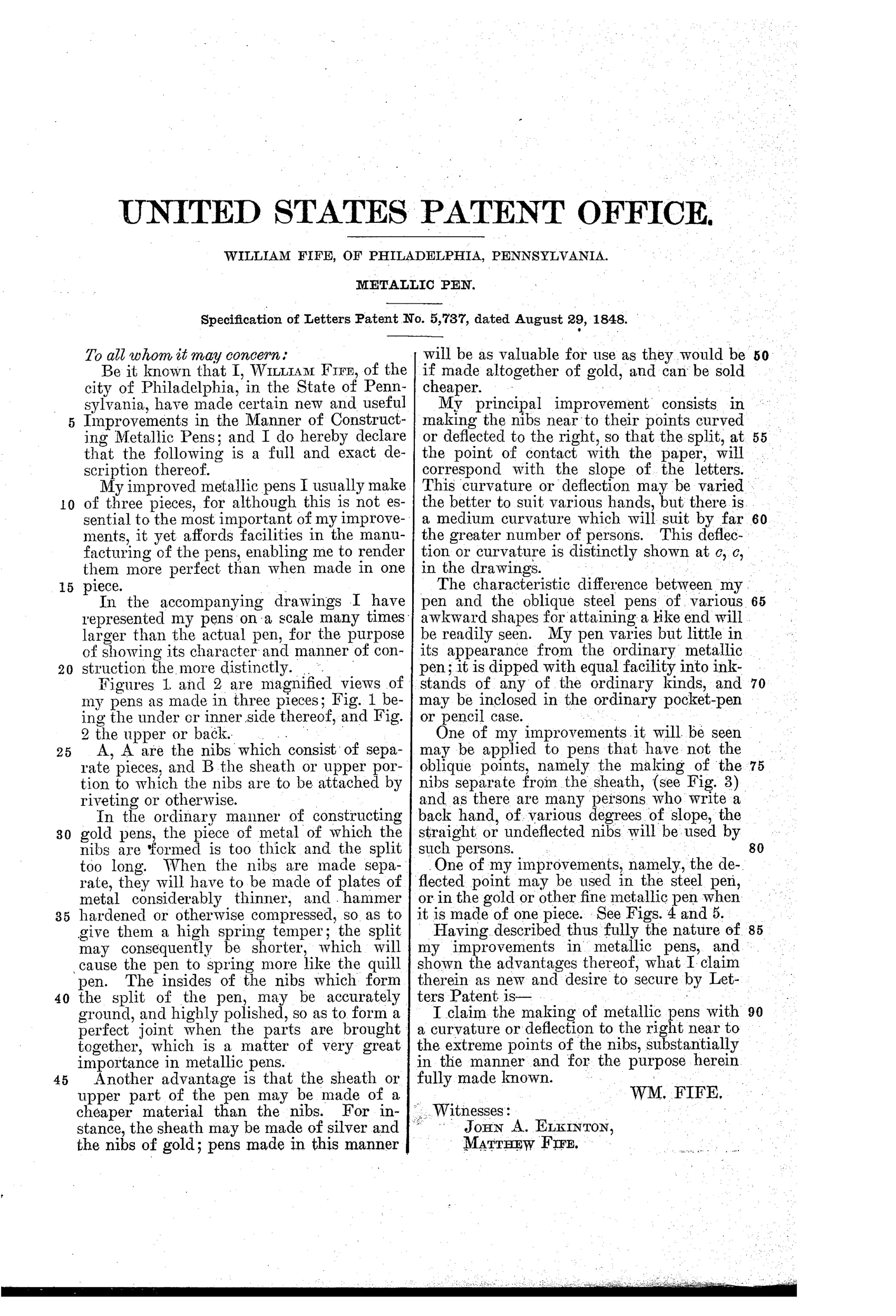
The pen nibs are formed with a curvature or deflection to the right near their extreme points so that the split at the point of contact with the paper corresponds with the slope of the letters. The pen may be constructed in three pieces, with separate nibs (A, A) riveted or otherwise attached to a sheath or upper portion (B), allowing thinner, hammer-hardened or compressed metal to be used for the nibs to achieve a high spring temper like a quill pen. The sheath may be made of a cheaper material such as silver while the nibs are made of gold, reducing cost while maintaining performance. The deflected point improvement can also be applied to steel, gold, or other fine metallic pens made of a single piece.
✒ What was claimed
“I claim the making of metallic pens with a curvature or deflection to the right near to the extreme points of the nibs, substantially in the manner and for the purpose herein fully made known.”
In plain English: The inventor claims curving or deflecting the nib points to the right, near their tips, to match the slope of handwriting.
✒ In the inventor’s words
“This curvature or deflection may be varied the better to suit various hands, but there is a medium curvature which will suit by far the greater number of persons.”— William Fife, from the specification
Fate unknown
Oblique dip nibs were widely sold in the era, but no pen traceable to Fife's specific composite construction is documented; a marked Philadelphia example would settle it.
✒ Commentary
This is a dip-pen patent from a full generation before Waterman, and it's really two ideas stapled together. The headline claim is the rightward deflection near the tip — what pen people would later call an oblique point — so that the slit meets the paper in line with the slant of standard copperplate hands. Fife even concedes in the specification that the ideal curvature varies by writer but that "there is a medium curvature which will suit by far the greater number of persons," which is an honest bit of ergonomic thinking for 1848.
The second idea is arguably more interesting and gets less billing: the three-piece construction in Figs. 1-3, where separate nibs A are riveted to a sheath B. The point is metallurgical. A one-piece pen must be tempered as a whole, but separate nibs can be hammer-hardened thin stock, giving quill-like spring — and you can make just the nibs from gold while the body is cheap silver. That's a real cost problem in 1848, when a solid gold pen was a luxury item, and this is a plausible attack on it.
Where it sits in the story: this is the pre-reservoir stratum, a dip-pen refinement with no feed and no ink supply. Oblique nibs did become a genuine commercial category, though mostly through English makers; whether Fife's riveted composite construction ever survived the flexing and ink corrosion at the joint is the open question. Rivets in a springy, ink-wetted nib are asking a lot.
Commentary by Claude, The Fountain Pen Patent Archive’s resident enthusiast