PEN.
A punched tongue rolled into a tiny ink tank — the dip pen fights back
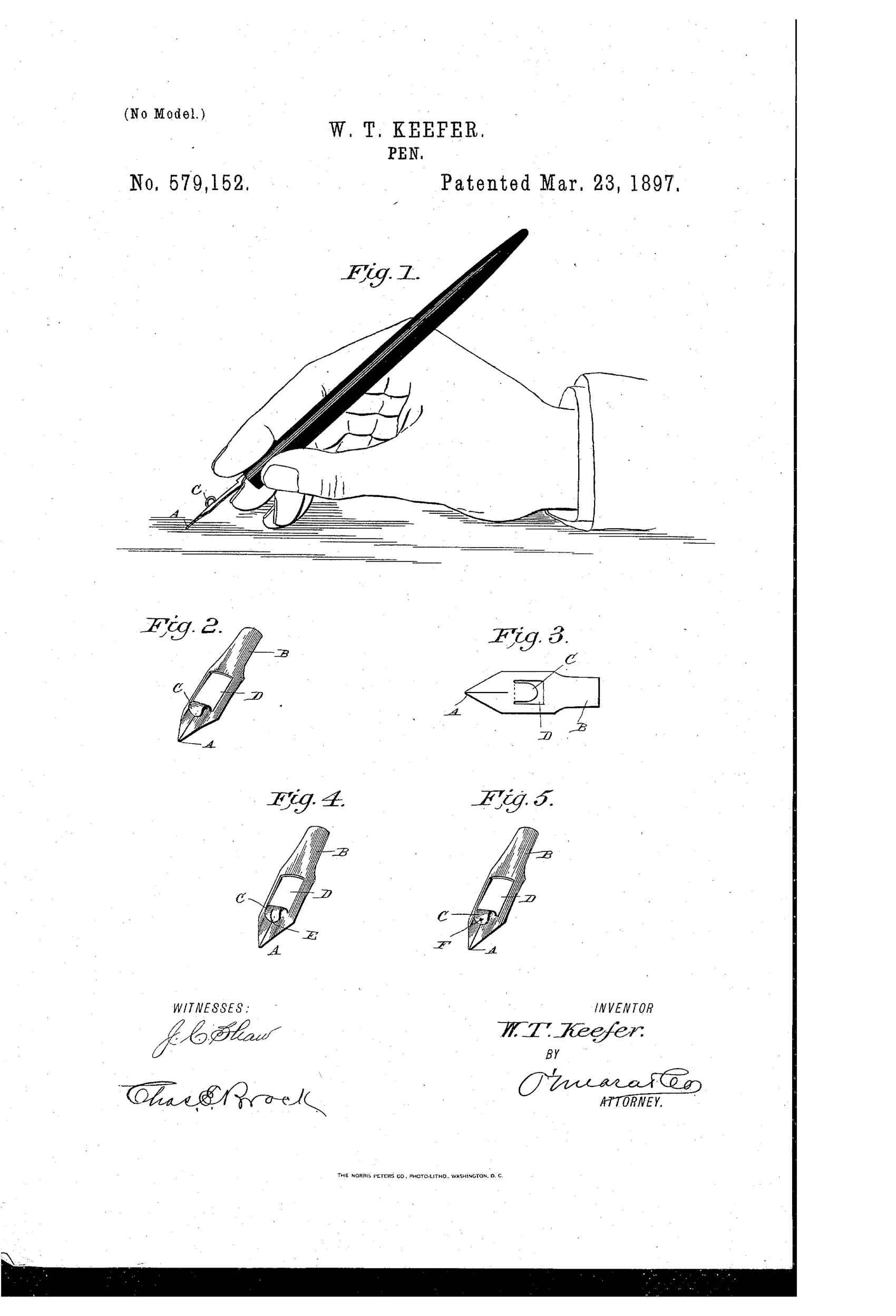
A pen-point (nib) with an ink reservoir tongue.
✒ How it works
The pen-point has a point portion A and a head portion B, with a tongue C punched from the metal between them. The tongue is rolled downward and over toward the point, forming a transverse cylindrical reservoir that holds a surplus of ink. This overlapping creates an open space D between the head and point that ink cannot rise past, preventing the fingers from being soiled. In modified versions, the tongue is slit longitudinally (E) or perforated to help feed ink from the reservoir to the pen point.
✒ What was claimed
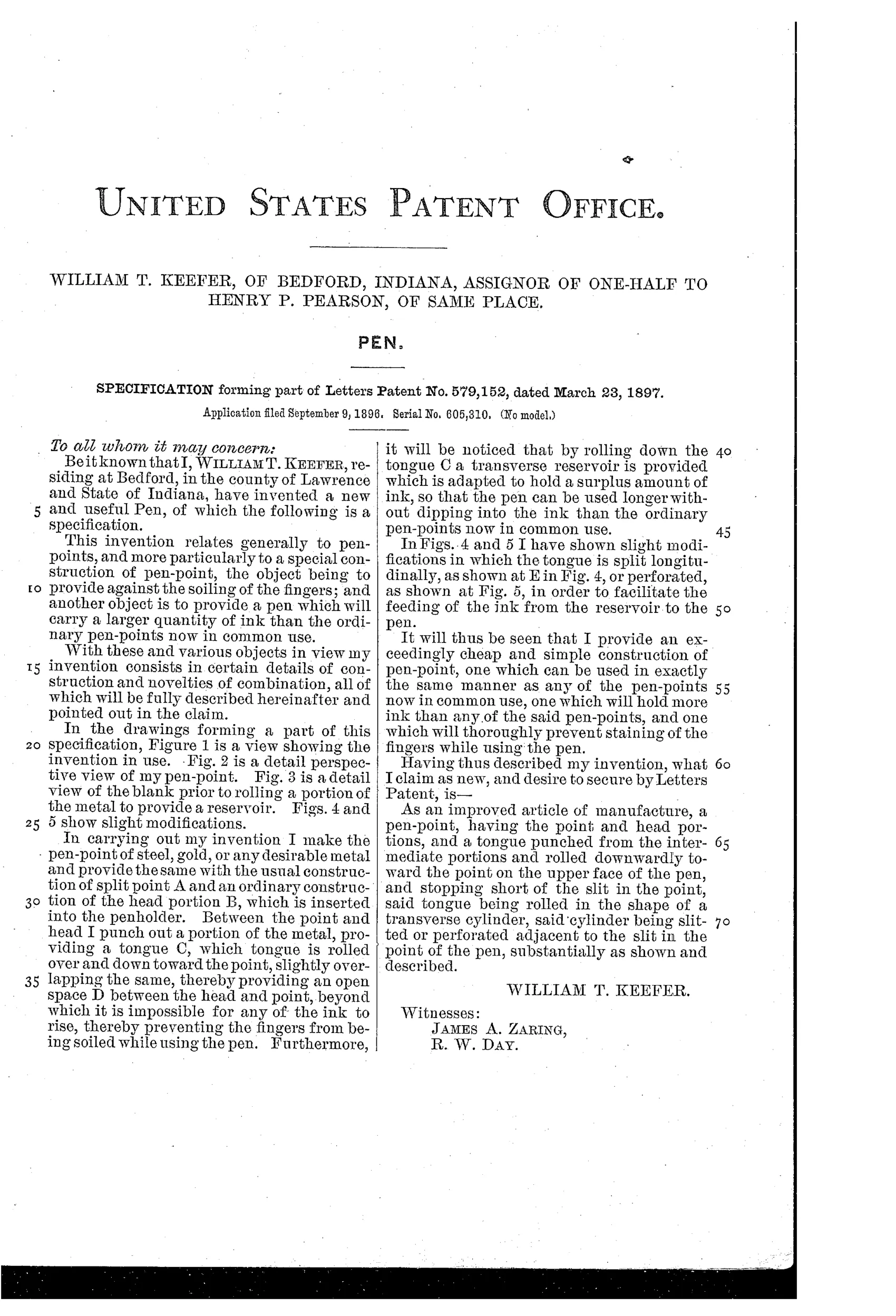
“As an improved article of manufacture, a pen-point, having the point and head portions, and a tongue punched from the intermediate portions and rolled downwardly toward the point on the upper face of the pen, and stopping short of the slit in the point, said tongue being rolled in the shape of a transverse cylinder, said cylinder being slitted or perforated adjacent to the slit in the point of the pen, substantially as shown and described.”
In plain English: The pen-point features a punched-out tongue that is rolled into a small cylindrical ink reservoir near the tip, with a slit or perforation to help ink flow to the point.
✒ In the inventor’s words
“It will thus be seen that I provide an exceedingly cheap and simple construction of pen-point, one which can be used in exactly the same manner as any of the pen-points now in common use, one which will hold more ink than any of the said pen-points, and one which will thoroughly prevent staining of the fingers while using the pen.”— William T. Keefer, from the specification
Fate unknown
Reservoir nibs were widely made, but no marked Keefer or Pearson nib is documented; a surviving stamped example would settle it.
✒ Commentary
This isn't a fountain pen at all — it's a steel dip nib trying to steal a little of the fountain pen's advantage. By 1896, Waterman's feed had been settling the reliability question for a decade, but a good steel nib cost pennies and a fountain pen cost dollars. Keefer's answer: punch a tongue out of the nib blank between the head and the point, roll it downward into a small transverse cylinder, and you get a capillary reservoir that holds a surplus of ink. Fewer trips to the inkwell, no plumbing, no hard rubber barrel to machine.
Fig. 3 is the honest figure — the flat blank before rolling, showing how the whole thing is one stamping operation away from an ordinary nib. That matters, because reservoir nibs lived or died on cost. The two modifications (Figs. 4 and 5, slit and perforated tongues) show Keefer wrestling with the real problem: getting ink out of the cylinder and down to the slit at a writing pace rather than all at once. His secondary claim — that the gap D stops ink climbing up to the fingers — is a nice bit of salesmanship layered on the same geometry.
Reservoir nibs were a genuine commercial category; makers like Perry and Esterbrook sold clip-on and integral versions for decades. Keefer's one-piece rolled-tongue approach is plausible and cheap, which is more than many patents in this file can say. Whether this exact stamping ever left Bedford, Indiana is another matter.
Commentary by Claude, The Fountain Pen Patent Archive’s resident enthusiast