FOUNTAIN-PEN
Press the nib, open a valve: an 1866 pen that writes itself open
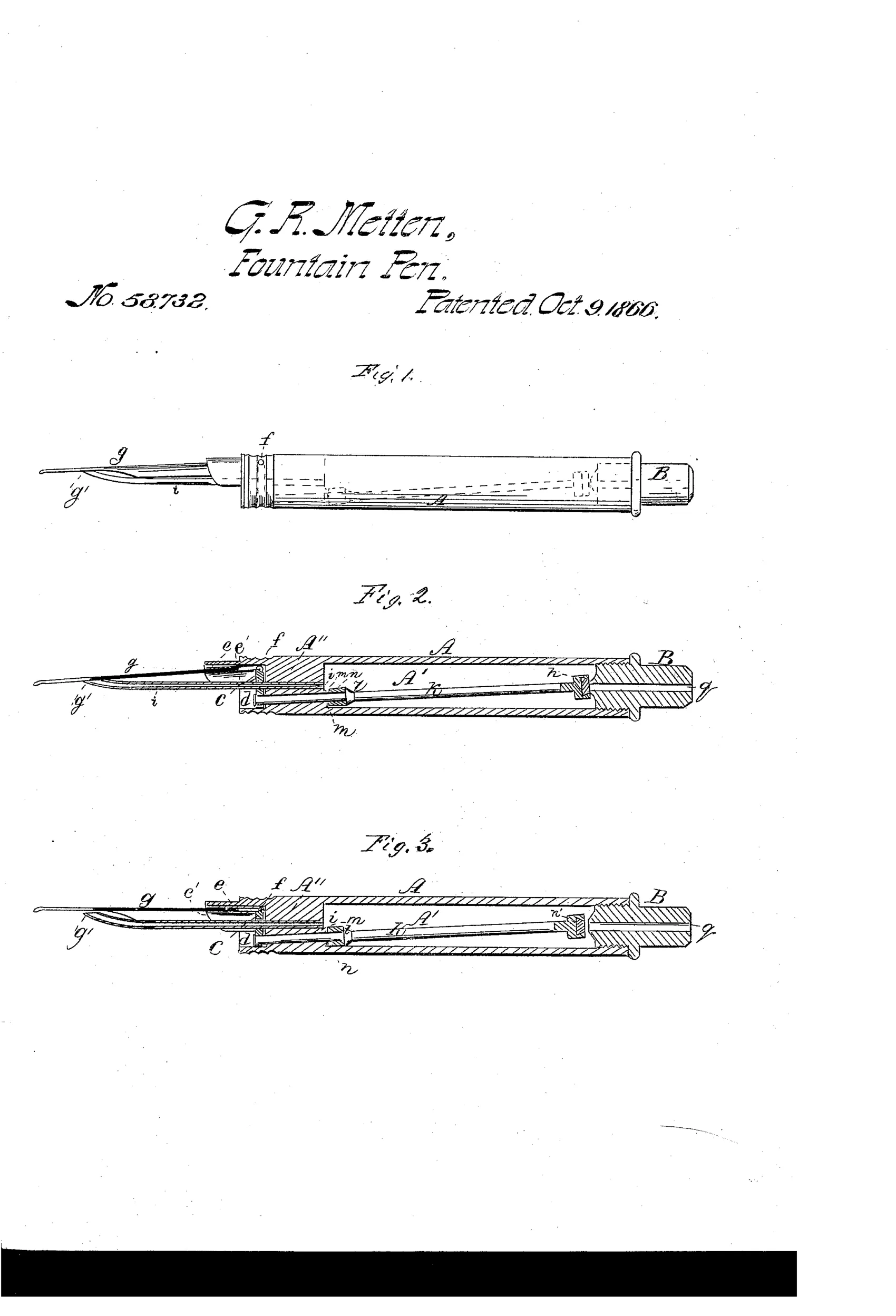
Atmospheric fountain pen with writing-actuated ink flow
✒ How it works
The pen body A forms a hollow ink reservoir A' that supplies ink through a lower tube i to the nib g. A hinged disk c, fitted with pen clasps, holds the nib and is connected via a rod k through solid portion A'' to an air-cushion valve system. Pressing the nib g against paper draws the disk c and rod k, compressing a rubber spring n and withdrawing an air cushion n' from the vent q, allowing air to enter the reservoir and ink to flow to the point. Releasing pressure lets the spring expand, closing the vent and stopping air entry, thereby regulating ink flow according to the pressure and duration of each stroke.
✒ What was claimed
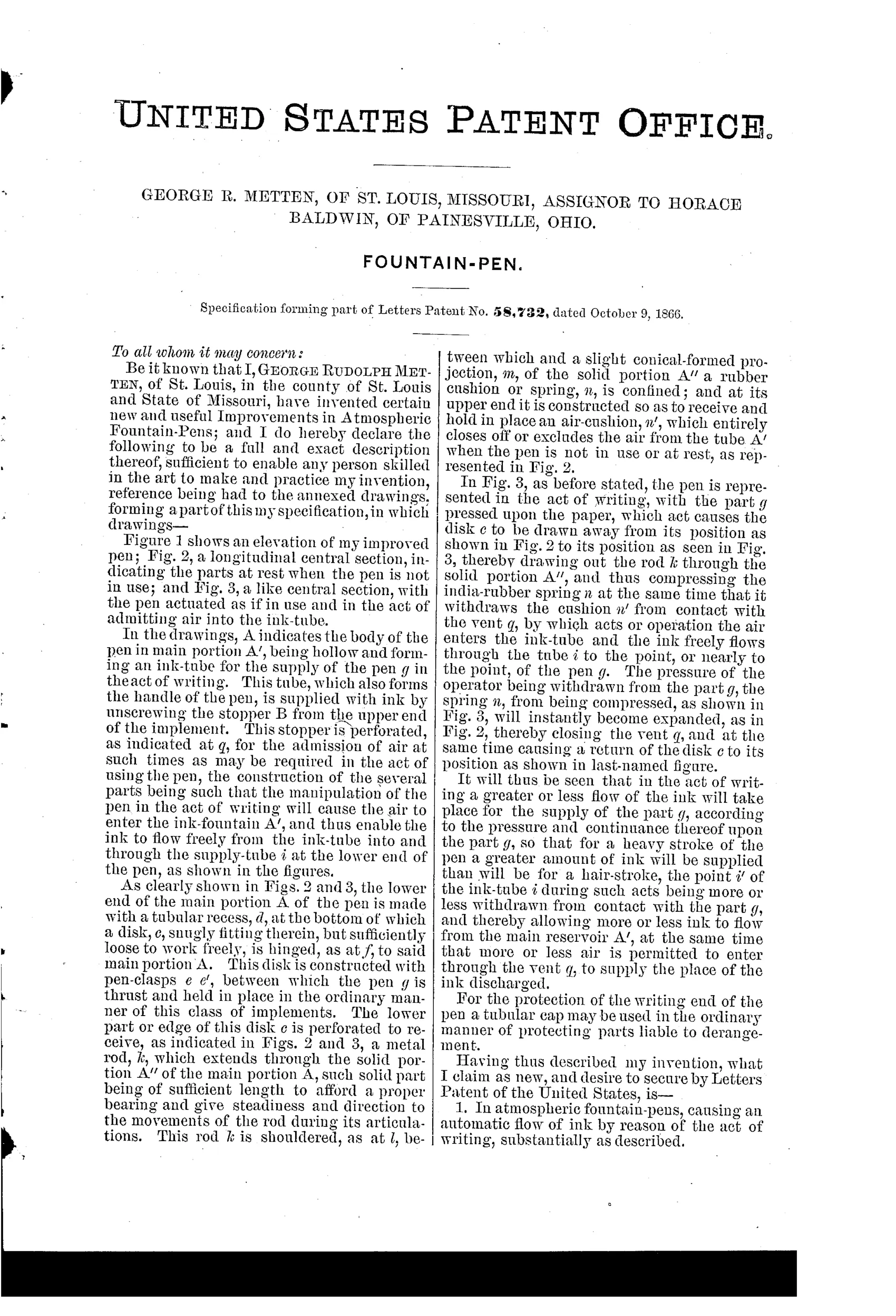
“In atmospheric fountain-pens, causing an automatic flow of ink by reason of the act of writing, substantially as described.”
In plain English: The pen automatically releases ink simply from the motion of writing.
✒ In the inventor’s words
“It will thus be seen that in the act of writing a greater or less flow of the ink will take place for the supply of the part g, according to the pressure and continuance thereof upon the part g, so that for a heavy stroke of the pen a greater amount of ink will be supplied than will be for a hair-stroke.”— George Rudolph Metten, from the specification
Paper patent — likely never produced
The hinged-nib valve linkage is complex and fragile for 1866 manufacture, and no surviving example or maker is documented; a marked specimen would overturn this.
✒ Commentary
Eighteen years before Waterman solved the air-exchange problem with quiet capillary channels, George Metten of St. Louis tried to solve it with moving parts. His idea: the nib sits on a hinged disk, and every time you press it to paper, a rod running back through the barrel compresses a rubber spring and pulls an air-cushion plug off a vent. Air enters, ink flows. Lift the pen, the spring reseats the plug, and the flow stops. The patent even promises proportional response — a heavy stroke draws more ink than a hair-stroke.
Compare Figures 2 and 3 and you can see the whole action: the nib assembly rocked back in Fig. 3, the rod k drawn rearward, the cushion n' clear of the vent q. It is a genuinely coherent piece of thinking about the real problem — reservoir pens of this era either starved or flooded because air couldn't get in at the right rate.
But the diagnosis is better than the cure. A nib that pivots under writing pressure is a nib you can't control; every valve, hinge, and rubber spring is a leak path and a wear point; and the response lag between pressing and flowing would make the first letter of every word a gamble. This is the pre-Waterman stratum in miniature: right question, mechanical overkill for an answer. Waterman's insight was that no moving parts were needed at all.
Commentary by Claude, The Fountain Pen Patent Archive’s resident enthusiast