ATTACHING DEVICE.
A stylographic pen's spring-valve trick, upsized to spare your tongue from stamp glue
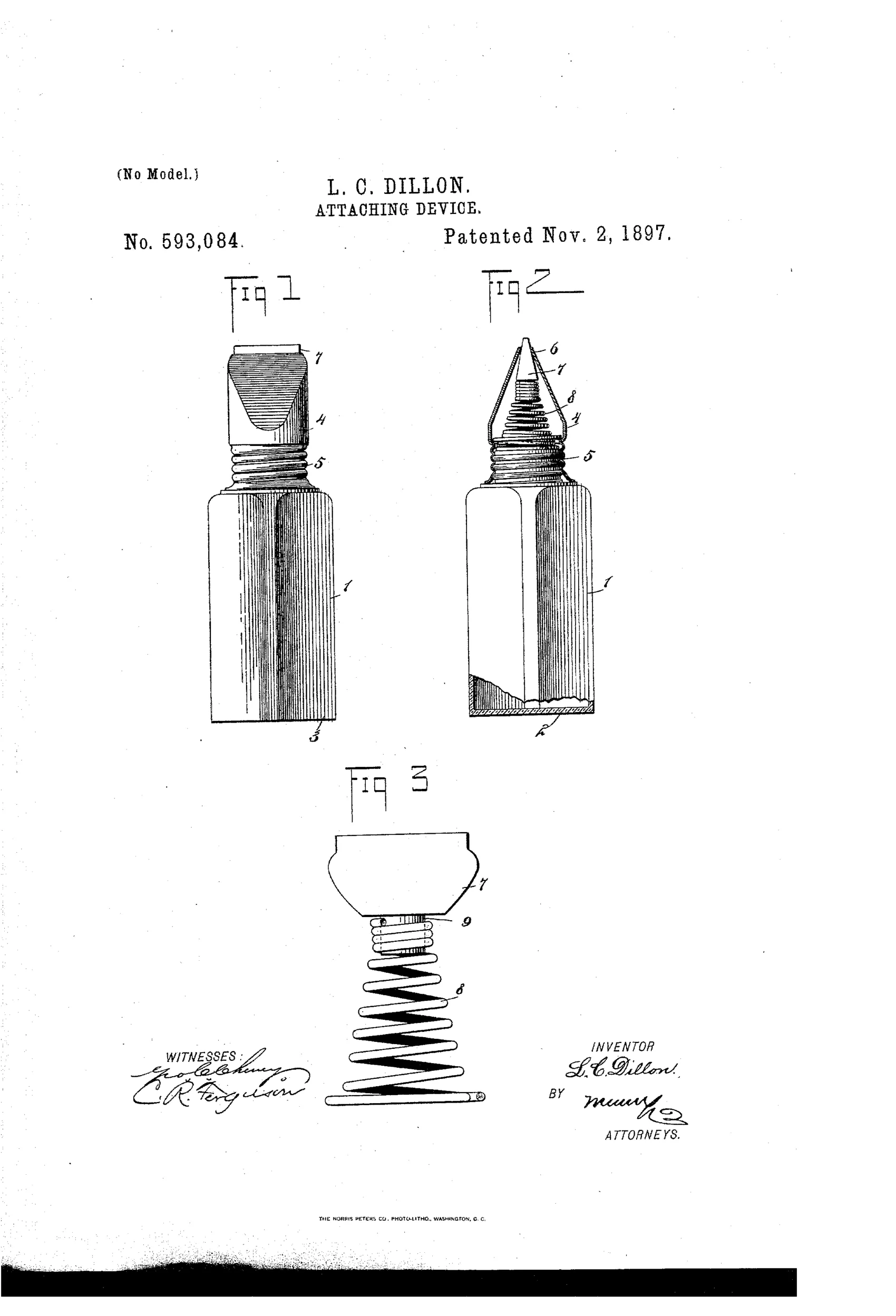
Spring-valve liquid dispenser for moistening stamps or applying mucilage
✒ How it works
A bottle-shaped container holds liquid such as water or mucilage and is fitted with a removable, wedge-shaped screw-on cap having a longitudinal slot at its apex. A tapered plug-valve seats in this slot and is held closed by a conically-coiled spring engaged around a downward lug on the valve, with the spring's lower end resting on the neck of the bottle. Pressing the valve tip against a gummed surface pushes the valve inward against the spring, releasing a controlled amount of liquid, and releasing the pressure lets the spring snap the valve shut again. The container also has a flat bottom with straight edges so it can be pressed evenly onto stamps and used to cut or separate perforated stamps.
✒ What was claimed
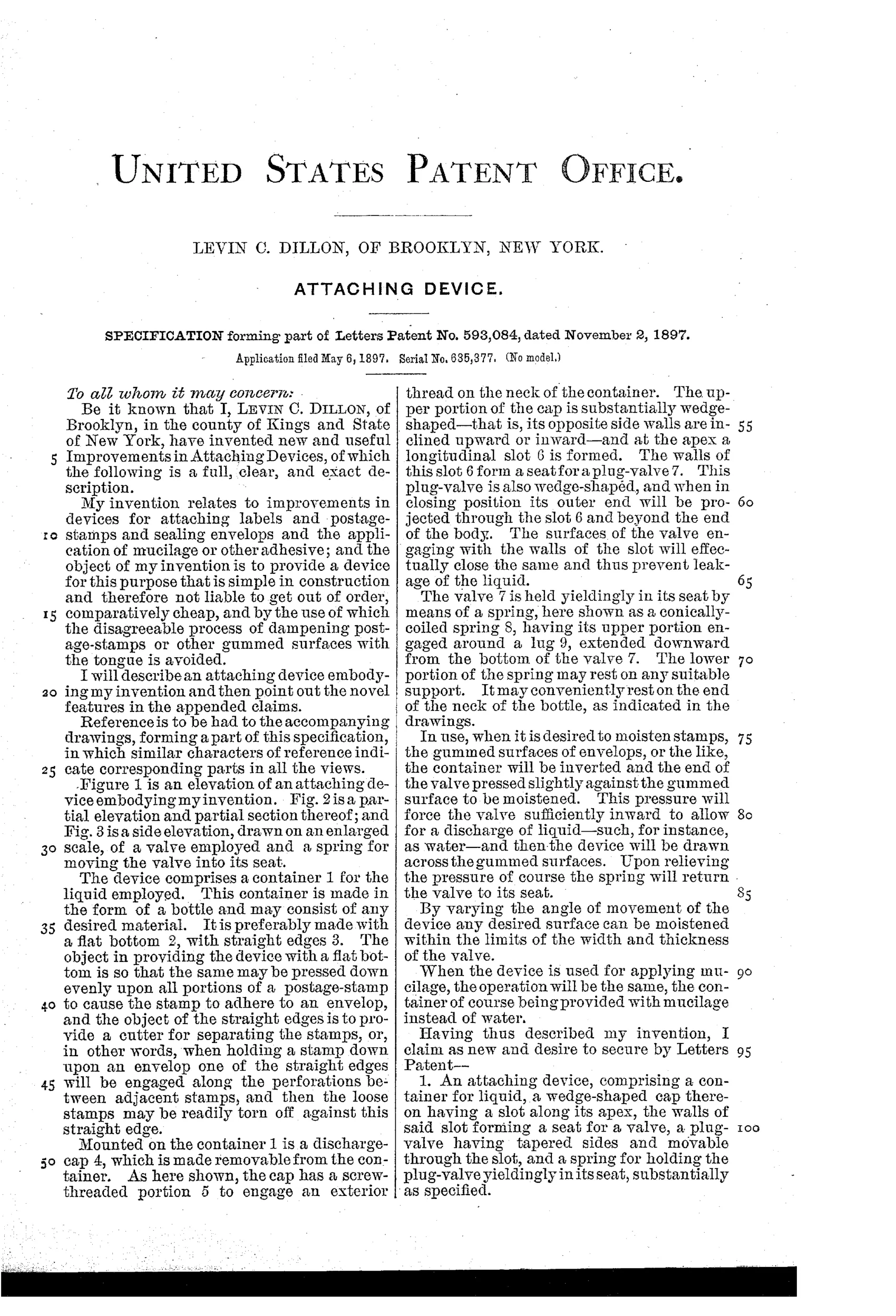
“An attaching device, comprising a container for liquid, a wedge-shaped cap thereon having a slot along its apex, the walls of said slot forming a seat for a valve, a plug-valve having tapered sides and movable through the slot, and a spring for holding the plug-valve yieldingly in its seat, substantially as specified.”
In plain English: A liquid container with a wedge-shaped cap has a slotted opening at its tip holding a tapered valve that a spring keeps closed until pressed open.
✒ In the inventor’s words
“the disagreeable process of dampening postage-stamps or other gummed surfaces with the tongue is avoided.”— Levin C. Dillon, from the specification
Fate unknown
The valve principle was proven in stylographic pens, but no maker or marked example of this stamp-moistener is documented; a surviving specimen would settle it.
✒ Commentary
Dillon's "attaching device" isn't a pen, but it belongs on these pages because its heart is pure stylograph. The tapered plug-valve held in its seat by a coiled spring, opening only when the tip is pressed against the work surface — that is exactly the needle-valve principle Cross and MacKinnon had been fighting over in stylographic pens since the late 1870s. Dillon simply scaled it up, swapped ink for water or mucilage, and stretched the point into a wedge with a longitudinal slot, so the valve dispenses along a line rather than at a point. That wedge is the genuinely thoughtful part: a stamp is wider than a pen stroke, and a slot-valve wets its whole gummed back in one press.
Fig. 3 rewards a close look. The spring is conically coiled, wide end resting on the bottle's neck, narrow end hooked over a lug on the valve. A conical spring collapses nearly flat, which lets the valve travel a useful distance inside a short cap — a small piece of packaging cleverness the claims barely mention.
The patent even suggests using the container's flat, straight-edged bottom to tear stamps along their perforations, which tells you Dillon was designing a complete desk tool, not just a valve. As a mechanism it would plainly work; the same architecture worked in thousands of stylographic pens. Whether anyone tooled up a bottle around it is another matter.
Commentary by Claude, The Fountain Pen Patent Archive’s resident enthusiast