FOUNTAIN-PEN
The other Waterman: A.A.'s piston pump, six years before self-fillers got fashionable
Self-filling fountain pen with internal pump
✒ How it works
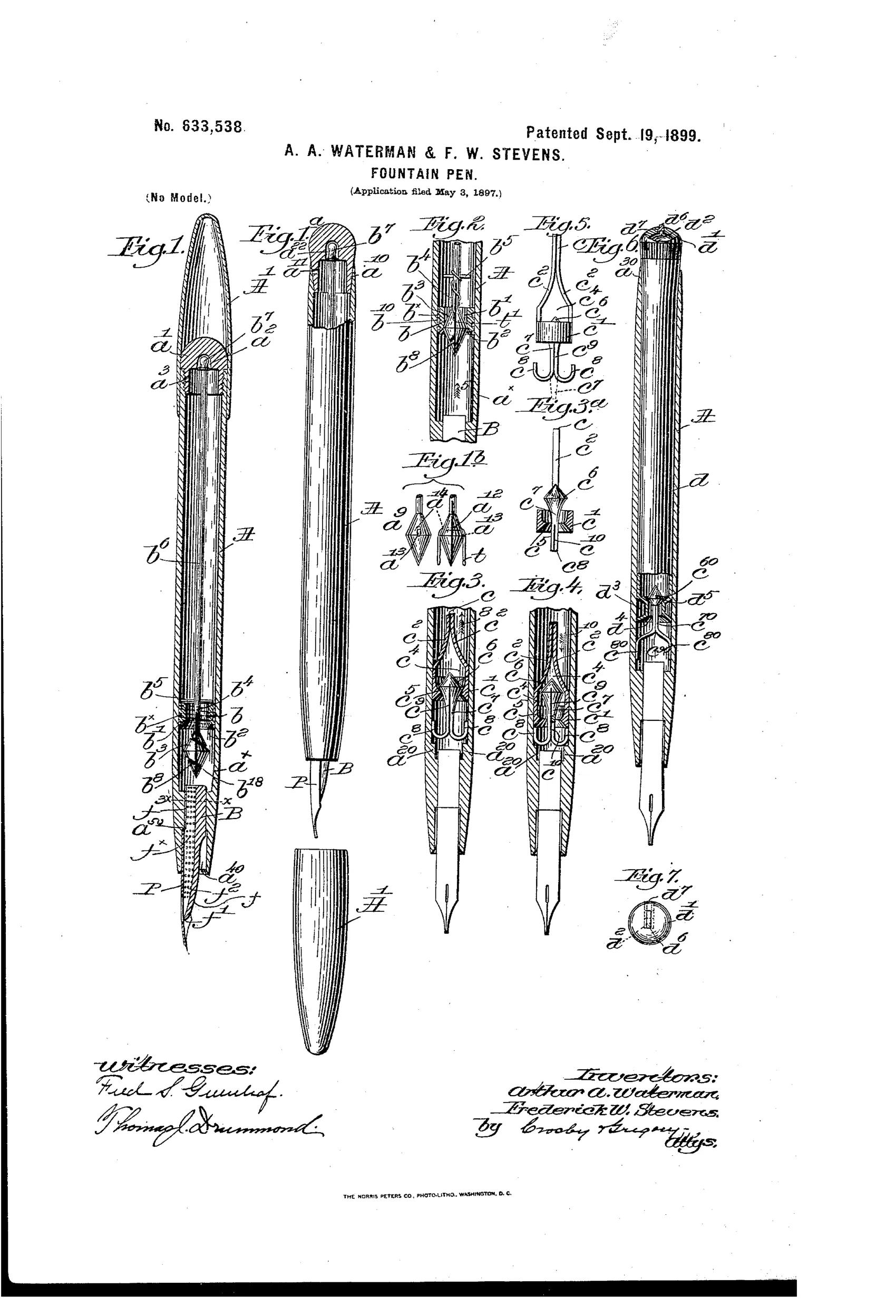
A piston-and-valve pump is fitted to slide within the pen's ink-barrel, actuated by a manually-withdrawn spindle to draw ink in through the open feed end. The valve seats itself on the outward filling stroke and unseats on the inward stroke to allow ink to pass into the reservoir. A spiral groove or fissured valve-stem provides a continuous capillary ink path between the upper and lower reservoir chambers so the valve is kept moist and can be reopened automatically whenever the pump is not in use, even after the pen is closed with its end plug. Alternate versions use a tubular actuator that telescopes into the barrel and itself serves as an auxiliary ink reservoir, closed by a vent and slide.
✒ What was claimed
“In a fountain-pen, the combination with a barrel or reservoir, of a pumping device adapted to operate therein to fill the same with ink; and comprising as operating parts a piston and cooperating valve and means in the path of the pumping device to positively engage one of the operating parts thereof and insure separation of said parts when near the forward end of said path, substantially as described.”
In plain English: A fountain pen with an internal pump made of a piston and valve, plus a mechanical stop that automatically opens the valve when the pump reaches the end of its travel.
✒ In the inventor’s words
“It is well known that if a small tube closed at one end and filled with a liquid, like ink, be held with open end down the liquid will not run out, because the elastic skin, which theoretically is regarded as forming the surface of the liquid, resists the action of gravity in its attempt to pull down the liquid from the tube.”— Arthur A. Waterman & Frederick W. Stevens, from the specification
Manufactured and sold
A.A. Waterman & Co.'s earliest production pens (circa 1897-1903) were pump fillers built on this patent family, before the firm moved to its better-known twist filler.
✒ Commentary
This is Arthur A. Waterman — no relation to Lewis Edson, a coincidence he would spend years litigating and profiting from. In 1897 he and Stevens were attacking the era's real problem: the eyedropper fill. Their answer is a miniature pump living inside the barrel: dip the nib, pull the spindle, and a piston draws ink up through the open feed end. The valve seats on the outward stroke and unseats on the return, and Claim 1's cleverest detail is a mechanical stop that positively pries the valve open at the end of travel — no relying on suction or luck to reset the mechanism.
The subtler engineering is in the valve stem. A spiral groove keeps a capillary thread of ink bridging the chambers above and below the valve, so the seat stays wet and won't glue itself shut with dried ink after the pen sits capped for a week. That's a working inventor's fix, not a draftsman's flourish — dried ink killed more clever fillers than bad geometry ever did. Fig. 6 even reimagines the actuator as a telescoping tube that doubles as a spare reservoir.
This sits at the very front of the self-filler wars, filed a decade before Sheaffer's lever. The pump route was ultimately a dead end — too many sliding seals in hard rubber — but A.A. Waterman built his first pens on exactly this kind of mechanism, and the automatic valve-opening stop shows real anticipation of how users actually mistreat pens.
Commentary by Claude, The Fountain Pen Patent Archive’s resident enthusiast