IMPROVEMENT IN INK-FOUNTAINS
In 1849, the pen itself was the valve — writing pressure metered the ink.
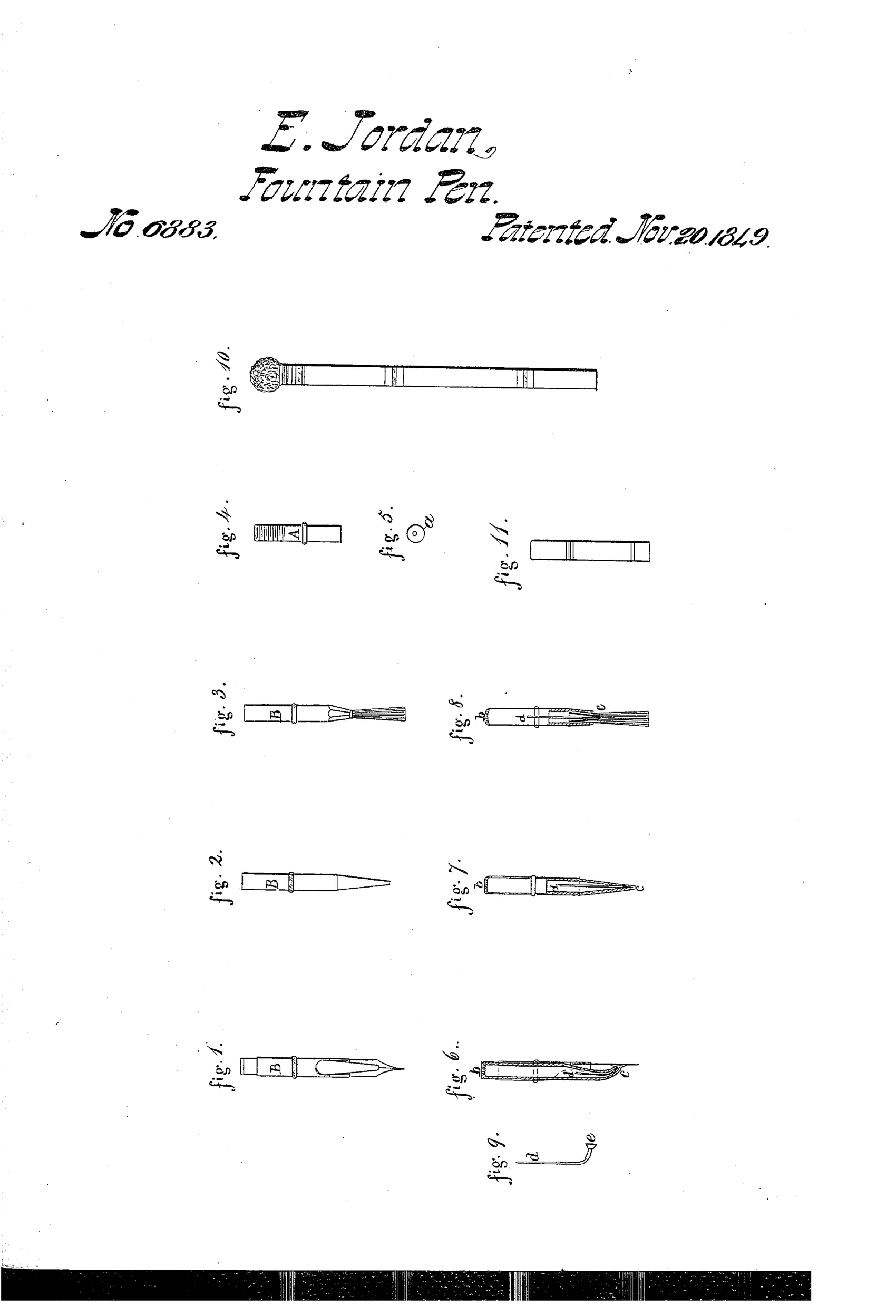
Self-regulating ink fountain reservoir for pens and hair-pencils
✒ How it works
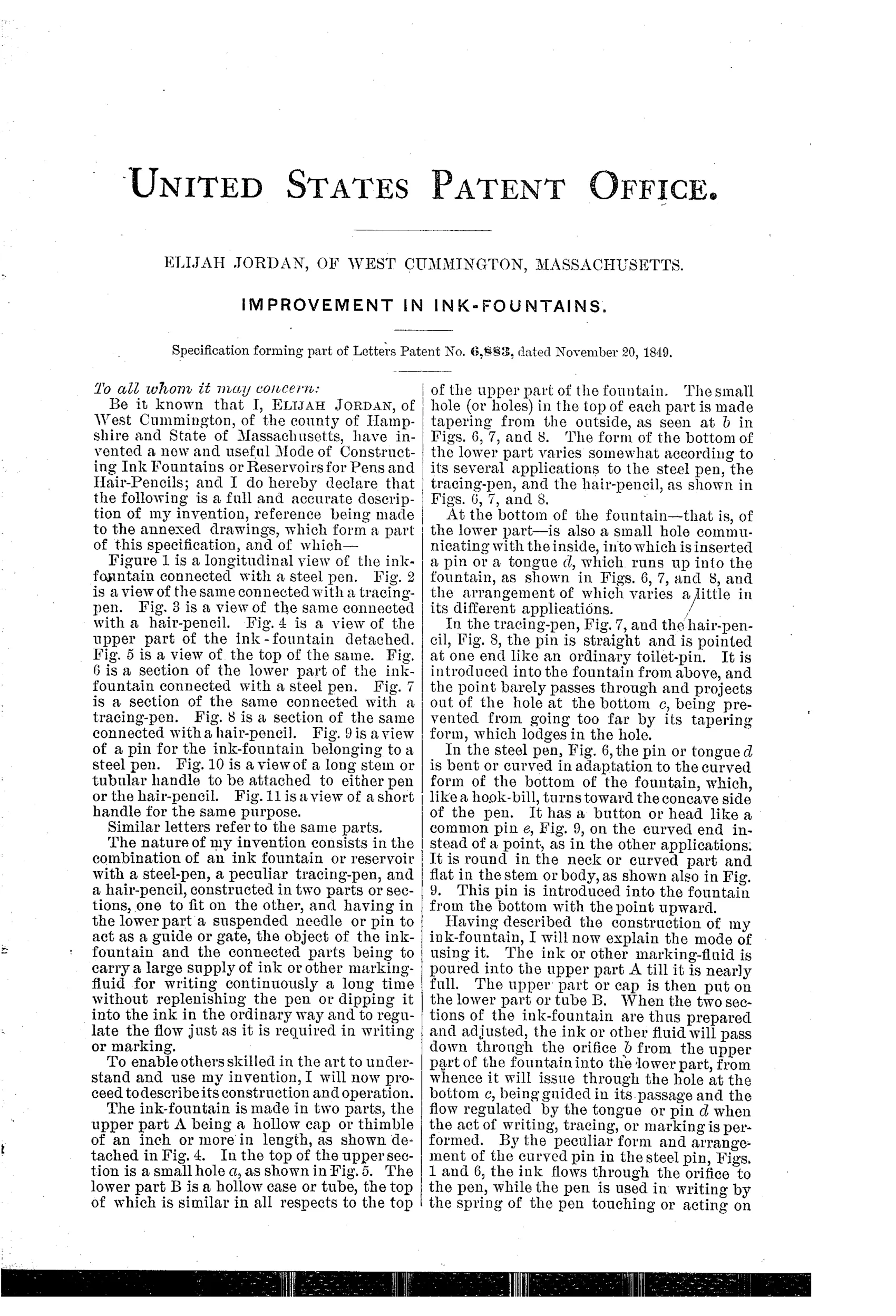
The ink fountain is made in two telescoping parts: an upper hollow cap (A) that holds a supply of ink and a lower hollow tube (B) that connects to the pen, tracing-pen, or hair-pencil. Ink passes from the upper section through a small tapering orifice into the lower section, then out through a bottom hole guided by a suspended pin or tongue. The pin's motion during writing or marking opens the orifice slightly to let ink ooze out by capillary action, while at rest the pin reseats and closes off the flow. A small air hole in the top of the upper cap admits atmospheric pressure, which is necessary to sustain the ink flow.
✒ What was claimed
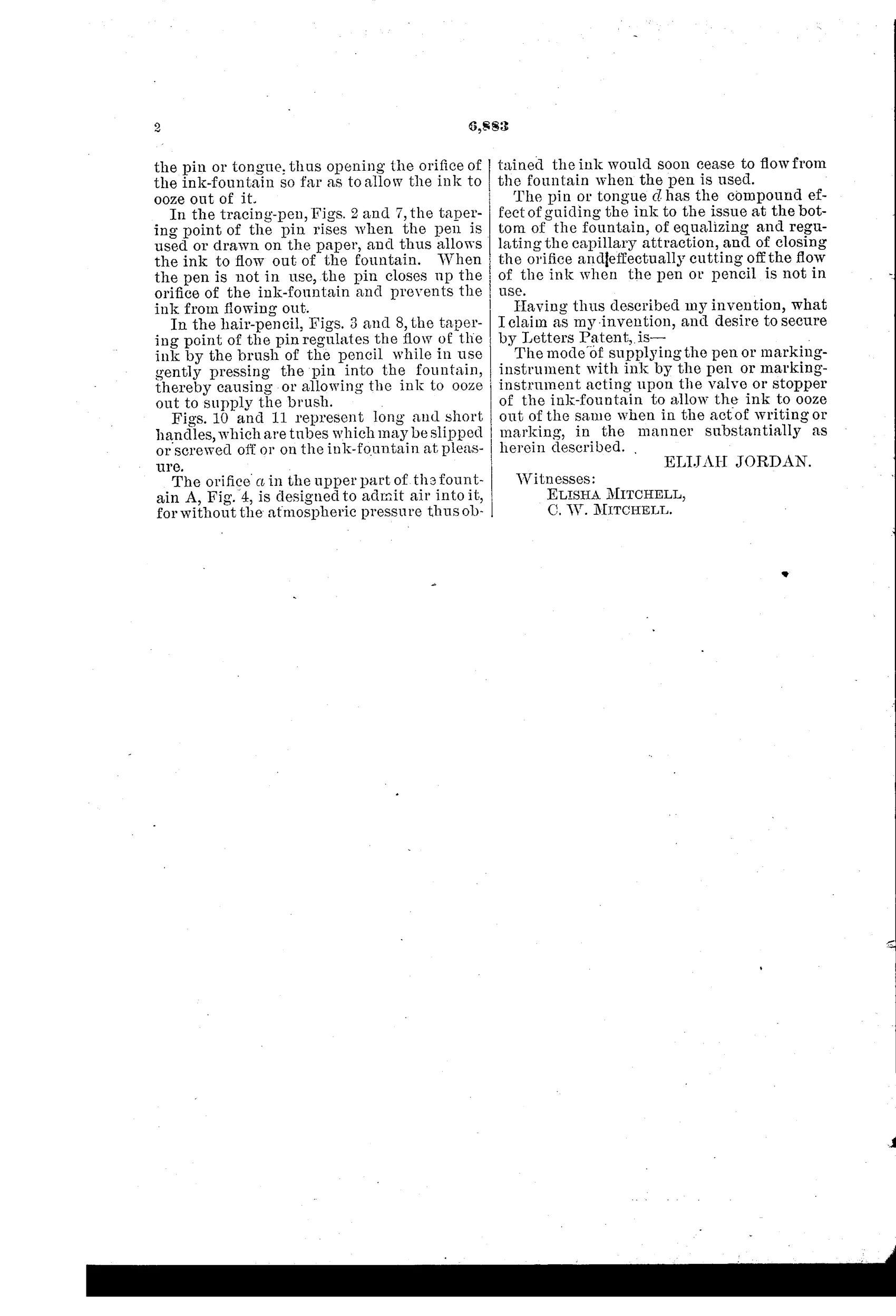
“The mode of supplying the pen or marking-instrument with ink by the pen or marking-instrument acting upon the valve or stopper of the ink-fountain to allow the ink to ooze out of the same when in the act of writing or marking, in the manner substantially as herein described.”
In plain English: The invention claims a method where the act of writing itself operates a valve to release ink from the fountain, stopping automatically when writing ceases.
✒ In the inventor’s words
“The pin or tongue d has the compound effect of guiding the ink to the issue at the bottom of the fountain, of equalizing and regulating the capillary attraction, and of closing the orifice and effectually cutting off the flow of the ink when the pen or pencil is not in use.”— Elijah Jordan, from the specification
Paper patent — likely never produced
No maker or surviving marked example of this 1849 vibration-valve fountain is known, and its hand-fitted pin seat argues against practical production.
✒ Commentary
Thirty-five years before Waterman solved the feed problem with capillary channels, Elijah Jordan of West Cummington tried to solve it with a moving part. His fountain is two telescoping sections: an ink cap up top and a delivery tube below, with a suspended pin hanging through the exit orifice. The trick is in the claim — the pen or brush, jostled by the act of writing, nudges that pin off its seat and lets ink ooze past by capillary attraction. Stop writing, the pin reseats, the flow cuts off. The single best sentence in the specification credits the pin with three jobs at once: guiding the ink, regulating capillarity, and sealing the hole.
Note what a casual reader misses in the drawings: Figs. 1 through 3 show the same reservoir feeding a steel pen, a tracing pen, and a hair-pencil (a brush). Jordan wasn't building a pen; he was building a universal ink supply for the whole drafting table. He even understood that the air hole in the cap (Fig. 5) was 'necessary to sustain the flow' — a real, if partial, grasp of the pressure-exchange problem that would define the next half century.
Would it work? Fitfully. A valve that depends on vibration and a hand-fitted pin seat will drip on rough paper and starve on smooth. But as a pre-Waterman reservoir attempt, it's an honest and mechanically literate one — a dead end that at least identified the right enemy.
Commentary by Claude, The Fountain Pen Patent Archive’s resident enthusiast