IMPROVEMENT IN FOUNTAIN-PENS.
A stretchable rubber strip as ink valve, fourteen years before Waterman's feed
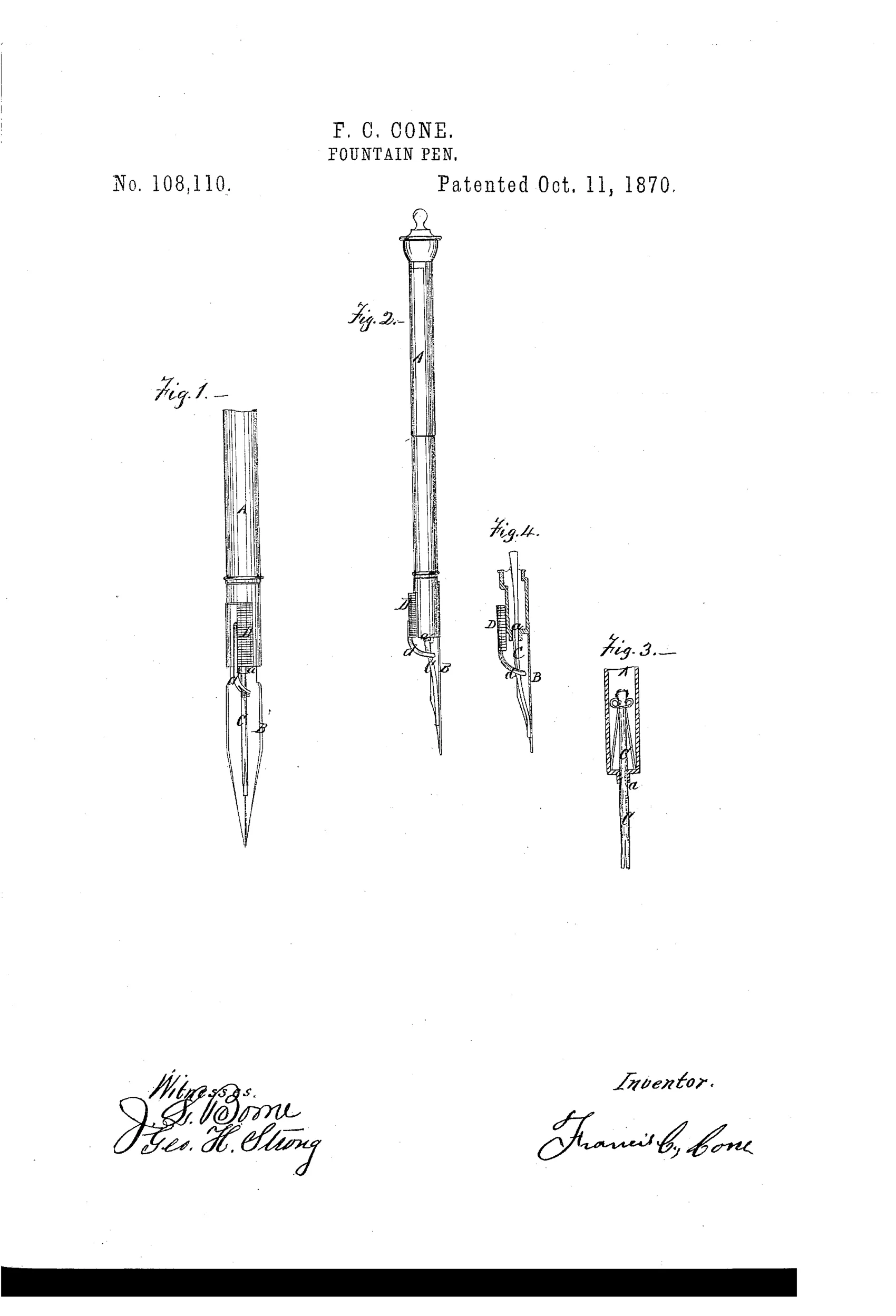
Self-regulating supply pen-holder valve
✒ How it works
The pen-holder A is hollow, with a small aperture a at its lower end near the pen nib. An elastic rubber strip C is fastened inside the holder and extends out through the aperture along the inside of the pen's curve near the nib, normally filling and sealing the hole. A roughened slide D on the outside of the holder, positioned where a finger naturally rests while writing, connects via a bent wire d that clasps the strip C just below the aperture. Pressing the slide down stretches and narrows the elastic strip, opening the passage a to let ink flow, and this motion also clears sediment from the aperture.
✒ What was claimed
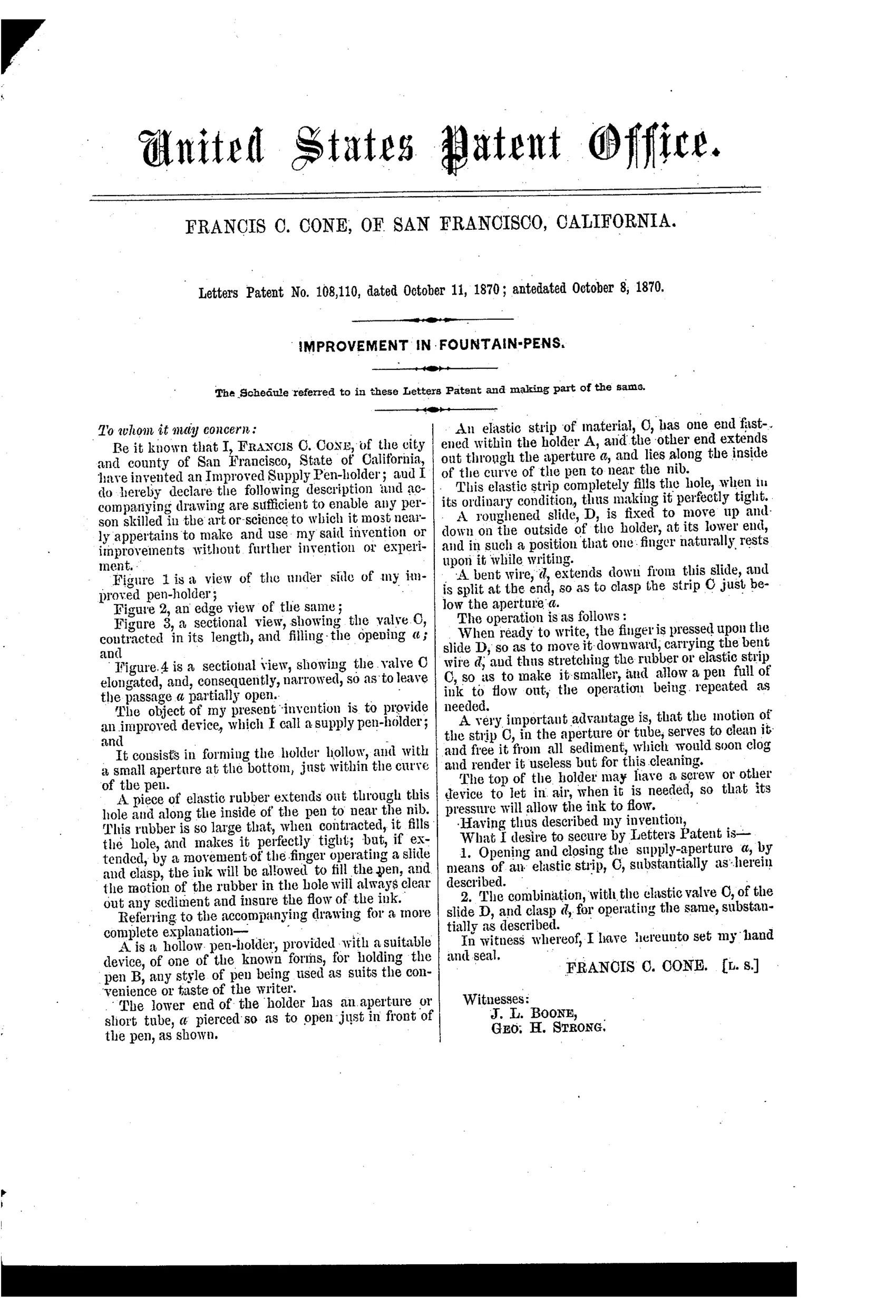
“1. Opening and closing the supply-aperture a, by means of an elastic strip, C, substantially as herein described. 2. The combination, with the elastic valve C, of the slide D, and clasp d, for operating the same, substantially as described.”
In plain English: The invention covers using a stretchable rubber strip to open and close the ink supply hole, combined with a sliding finger control and clasp to operate that strip.
✒ In the inventor’s words
“A very important advantage is, that the motion of the strip C, in the aperture or tube, serves to clean it and free it from all sediment, which would soon clog and render it useless but for this cleaning.”— Francis C. Cone, from the specification
Paper patent — likely never produced
No maker or surviving example of this slide-valve holder is known, and the perishable rubber valve with manual flow control makes commercial production implausible; a marked specimen would overturn this.
✒ Commentary
Francis Cone's problem was the one every reservoir pen faced before 1884: how do you get ink to the nib in a controlled trickle instead of a blot or nothing at all? His answer was a valve, not a feed — a strip of elastic rubber threaded through a small hole near the nib, sealing it by its own bulk. Slide a roughened button with your finger and a bent-wire clasp stretches the strip; rubber under tension gets thinner, the hole opens, ink flows. Release, and the strip fattens back and plugs the passage.
The sectional views in Figs. 3 and 4 are the whole invention: same aperture, same strip, contracted versus elongated. It's a genuinely elegant use of a material property — no hinge, no spring, no ground seat, just Poisson's ratio doing valve duty. And Cone spotted the era's real killer, sediment. Nineteenth-century inks were gritty, and he claims the strip's motion scrubs the hole clean each time. That's a shrewd observation even if the fix is optimistic.
As a writing instrument it's dubious. Modulating flow with a finger slide mid-word demands constant attention, early rubber took a set and lost its elasticity, and there's no air-exchange path — the problem Waterman's capillary channels finally solved. This is the pre-Waterman stratum in miniature: clever valving aimed at a problem that turned out to need a feed instead.
Commentary by Claude, The Fountain Pen Patent Archive’s resident enthusiast