IMPROVEMENT IN WRITING-PENS
A dip nib that writes two different hands, depending which side you flip up
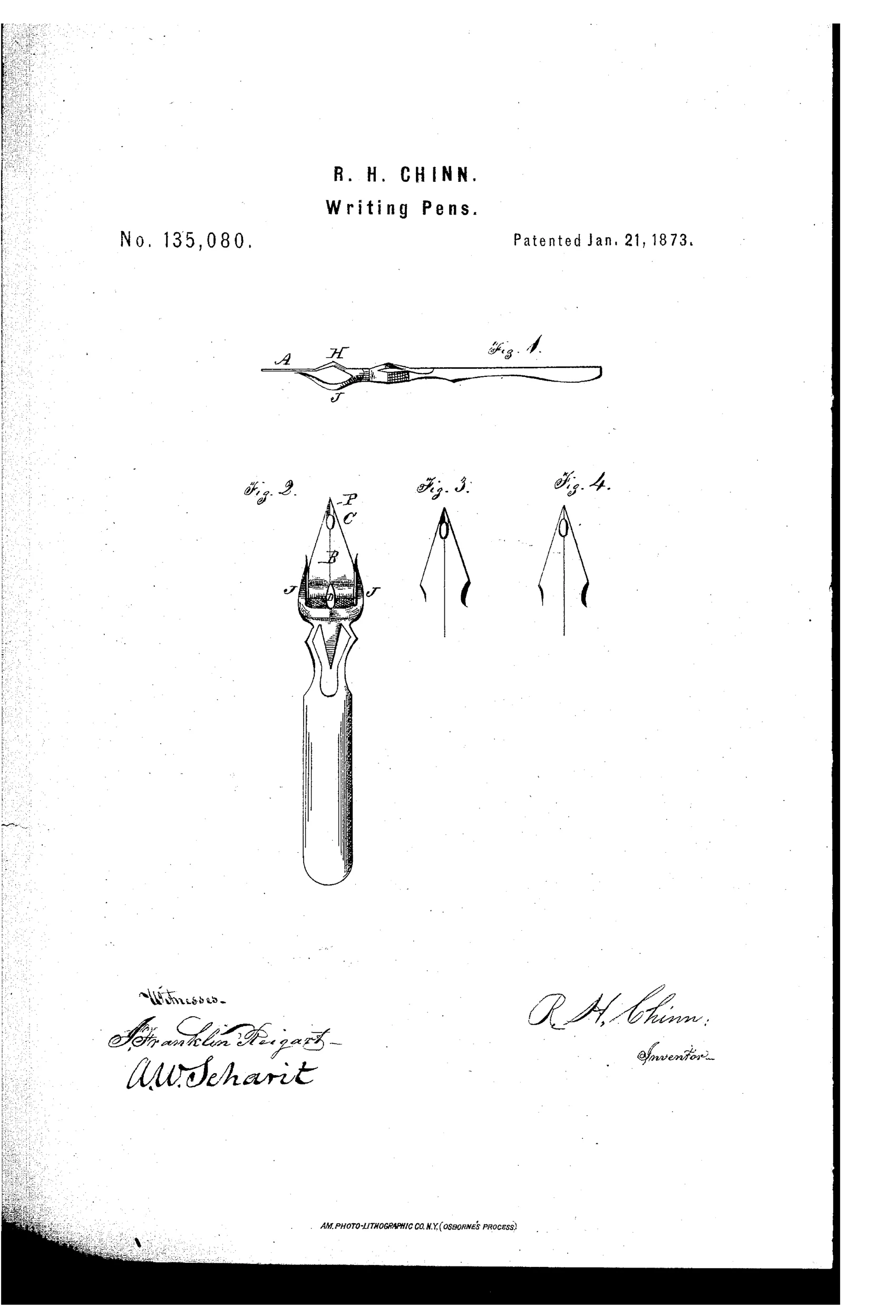
Reversible-point, double-sided writing pen
✒ How it works
The pen has a point A with a central slit B having two openings C and D at each end, an angular upright bend H across the point forming a double spring, and curved tongues J on each side forming a chamber to hold and agitate the ink. Angular bends L at each side and an elastic tongue N in the frame add further spring and elasticity to help ink flow freely to the point without clogging. A gutter or groove P on the back of the point channels ink from opening C to the tip, assisting flow when writing with the back side. Because both sides of the point can be used, the pen writes a heavy line with hairlines when used on its front point, or a uniform line unaffected by pressure when the back side is used.
✒ What was claimed
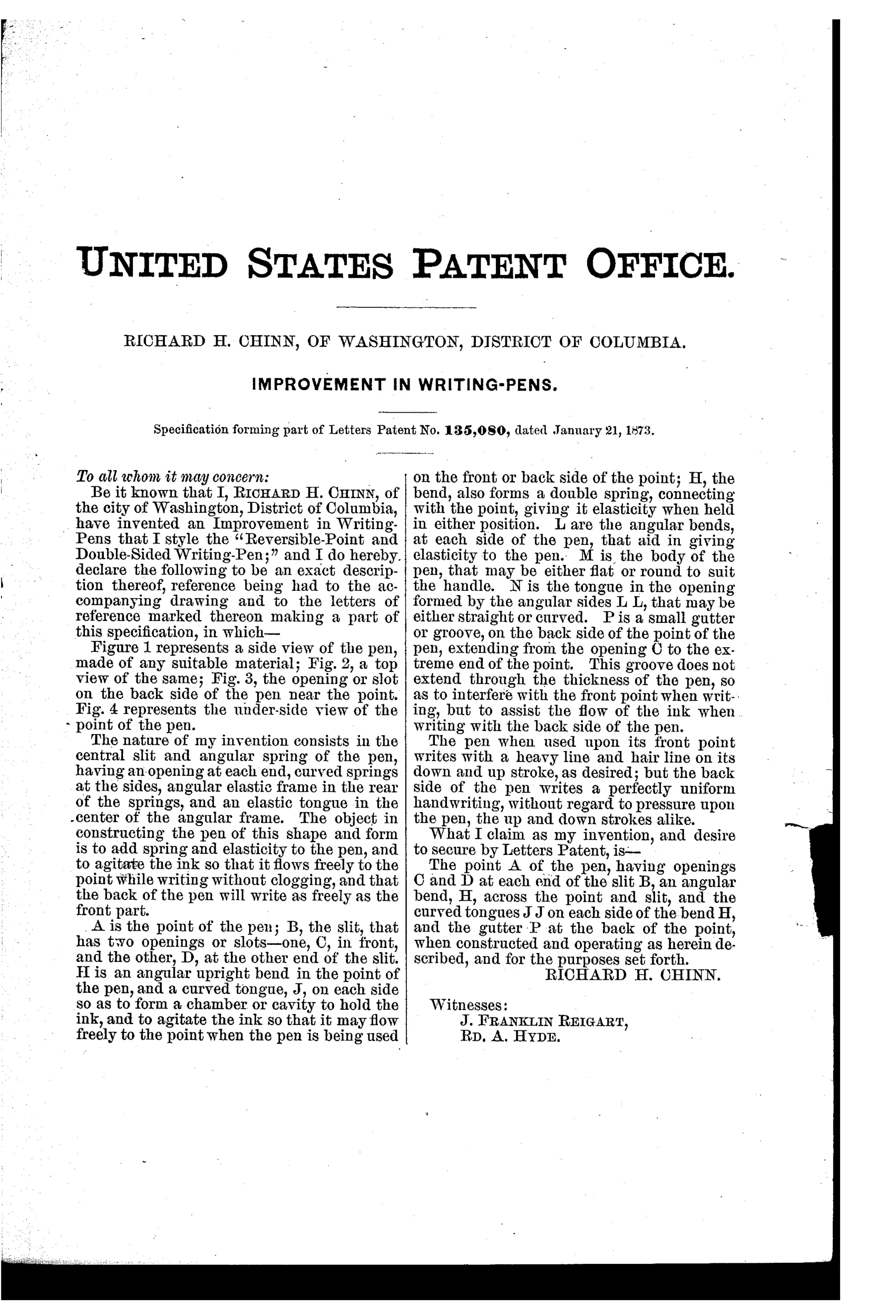
“The point A of the pen, having openings C and D at each end of the slit B, an angular bend, H, across the point and slit, and the curved tongues J J on each side of the bend H, and the gutter P at the back of the point, when constructed and operating as herein described, and for the purposes set forth.”
In plain English: The claim covers a pen point with a slit having openings at both ends, a bent spring section across the point with curved tongues on each side, and a back-side ink groove, all working together as described.
✒ In the inventor’s words
“The pen when used upon its front point writes a heavy line and hair line on its down and up stroke, as desired; but the back side of the pen writes a perfectly uniform handwriting, without regard to pressure upon the pen, the up and down strokes alike.”— Richard H. Chinn, from the specification
Fate unknown
Dip nibs of this era were stamped by many small makers, but no marked example of Chinn's design is documented; a surviving specimen would settle it.
✒ More by Richard H. Chinn
- IMPROVEMENT IN PENS (1870)
✒ Commentary
Eleven years before Waterman, Richard Chinn of Washington was already fighting the fountain-pen fight in miniature — not with a barrel of ink, but with a steel dip point engineered to hold a bit more and release it more evenly. His curved tongues J form a small chamber above the slit, essentially a spoonful of reservoir riding on the nib, and the angular bend H turns the whole point into a compound spring. It's a dip pen straining toward being something more.
The genuinely interesting move is reversibility. The slit B has an opening at each end, and a gutter P runs down the back of the point, so you can flip the pen over and write on the reverse side. Chinn's own description is precise: front side gives you shading — heavy downstrokes, hairline upstrokes — while the back side lays a uniform line regardless of pressure. That's two nibs in one stamping, a flexible point and a rigid one, which in 1873 was a real economy for anyone alternating between correspondence and ledger work.
Look at Fig. 2 and you'll see how busy this little piece of steel is: slit, twin openings, tongues, bends L, elastic tongue N. That's a lot of forming operations for a penny commodity, which is probably where designs like this ran aground. It sits squarely in the pre-Waterman stratum: clever capillary intuition, no theory of air exchange yet.
Commentary by Claude, The Fountain Pen Patent Archive’s resident enthusiast