IMPROVEMENT IN FOUNTAIN-PENS
A quill feed that swings sideways for cleaning, patented in 1857 Georgia
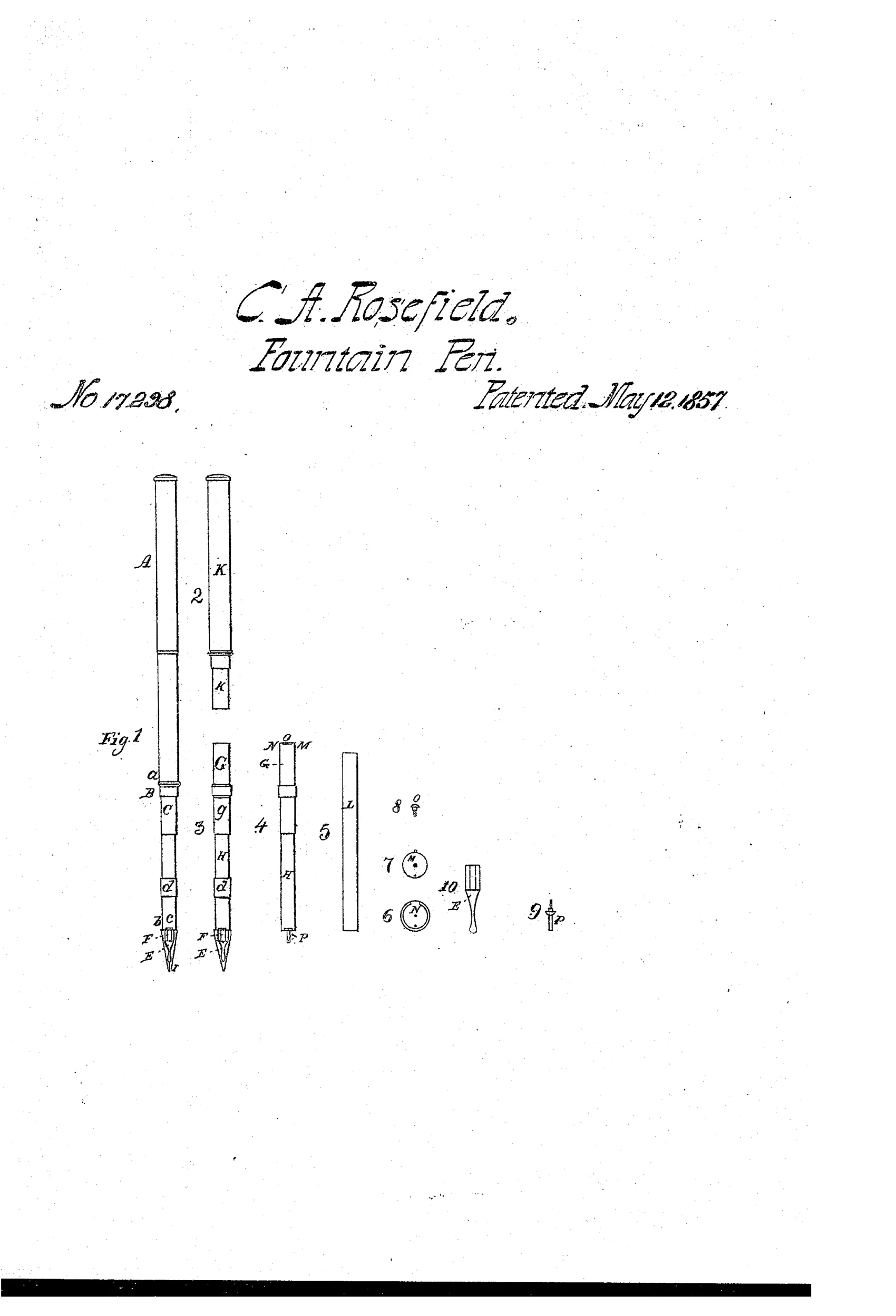
Detachable swiveling quill ink conductor for fountain pens
✒ How it works
The pen uses a quill cylinder inside a metal-tubed reservoir to hold ink without corrosion, fed through perforations at the bottom. A detachable quill conductor E carries ink from the reservoir to the nib, held by a metal head-piece or 'conductor-holder' that swivels freely on a center screw-pin P. A disk-and-valve arrangement with an air-hole and pivoted stop disk regulates filling of the reservoir by suction. The conductor can swing laterally out of the way for cleaning without removing or straining it, avoiding damage to the pen itself.
✒ What was claimed
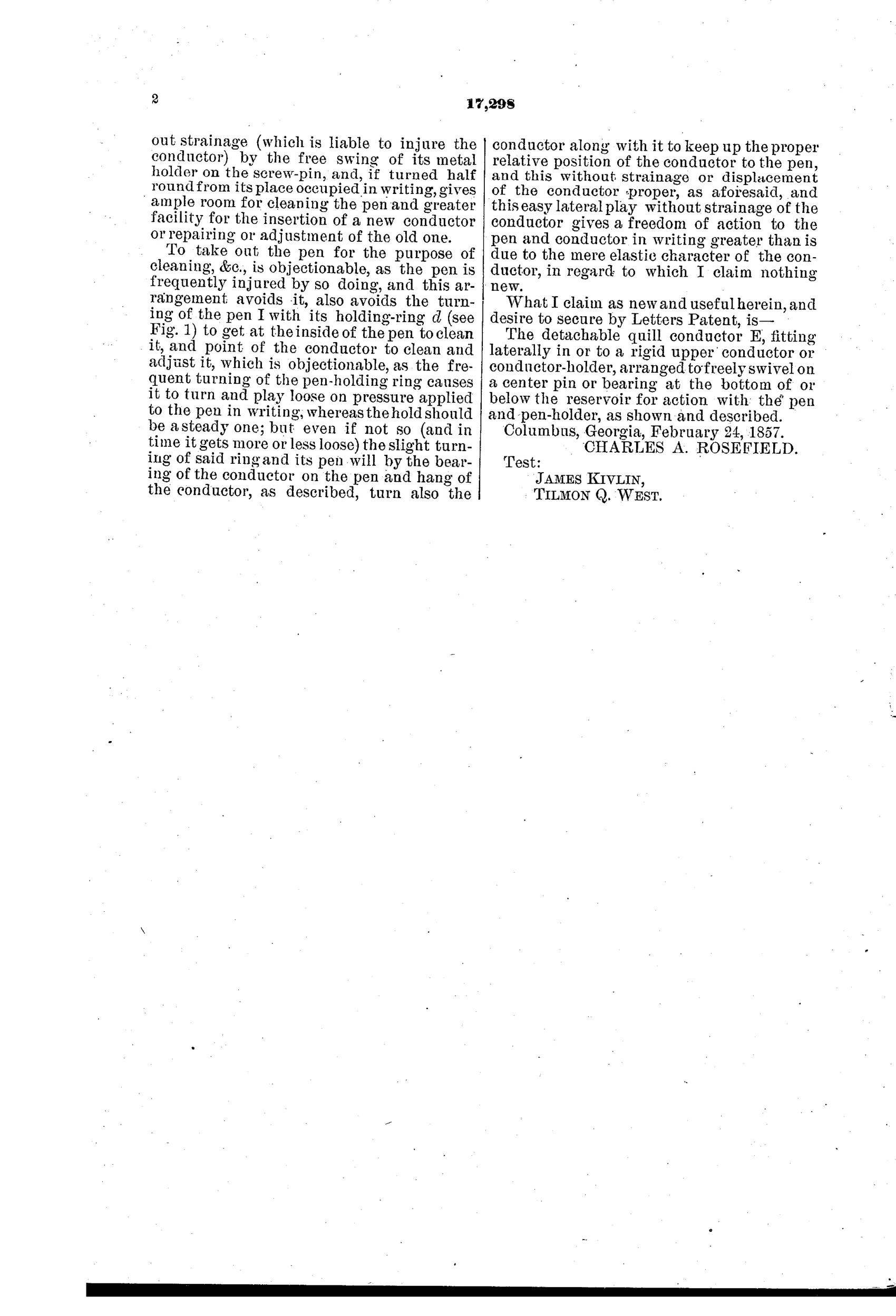
“The detachable quill conductor E, fitting laterally in or to a rigid upper conductor or conductor-holder, arranged to freely swivel on a center pin or bearing at the bottom of or below the reservoir for action with the pen and pen-holder, as shown and described.”
In plain English: The invention claims a removable quill ink-conductor that fits sideways into a holder which can freely pivot on a center pin beneath the ink reservoir, working together with the pen.
✒ In the inventor’s words
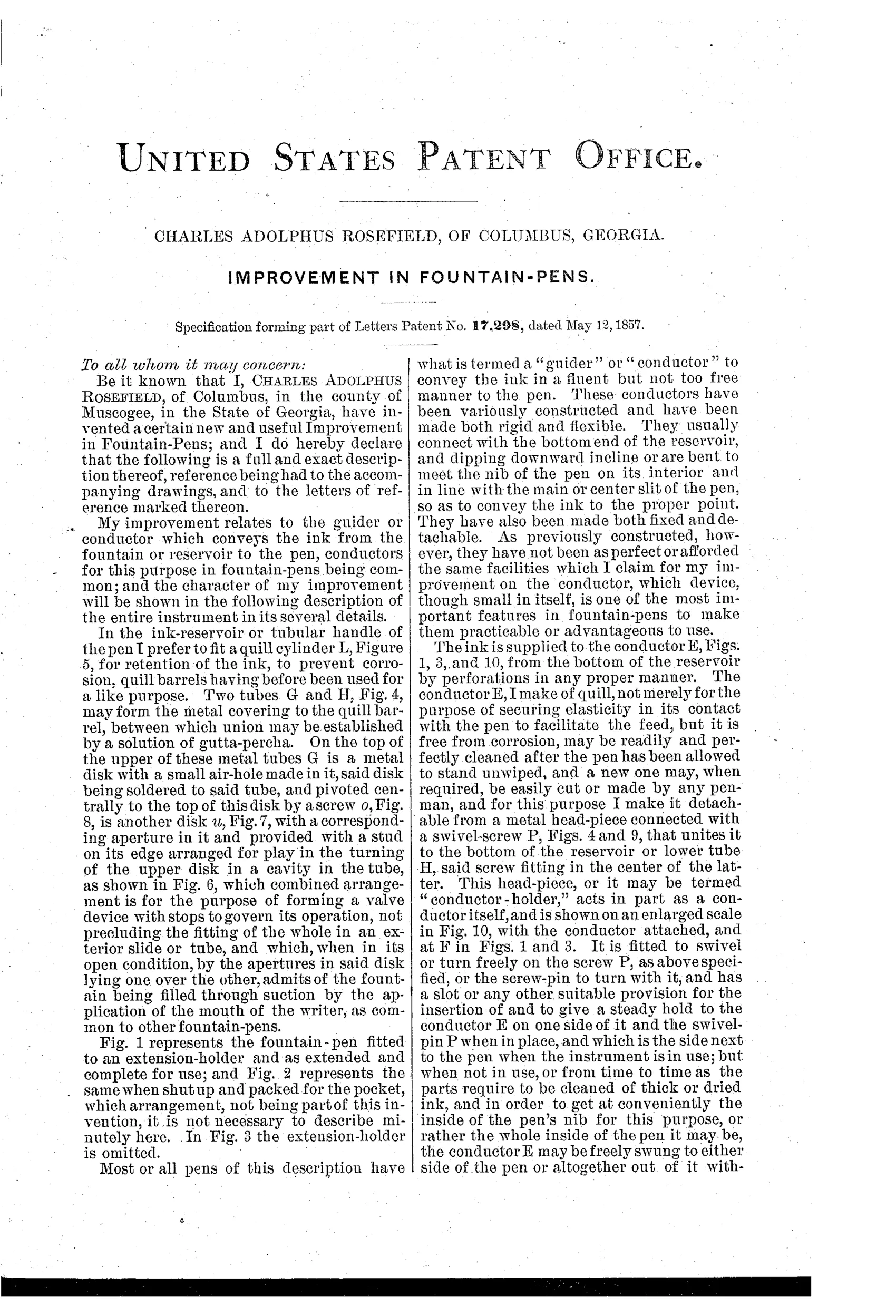
“These conductors have been variously constructed and have been made both rigid and flexible.”— Charles Adolphus Rosefield, from the specification
Fate unknown
No documented Rosefield pen survives to my knowledge; a marked specimen or period advertisement from Columbus, Georgia would settle it.
✒ Commentary
Twenty-seven years before Waterman solved the feed problem with capillary channels, Rosefield was wrestling with the same enemy — the conductor, the piece that carries ink from reservoir to nib — and his answer was organic. He uses actual quill: a quill cylinder lining the metal reservoir so the ink never touches corrodible brass, and a detachable quill conductor E doing the feeding. His own admission is telling: conductors 'have been variously constructed and have been made both rigid and flexible,' and none of them worked well. He knew he was in a crowded, frustrated field.
The genuinely clever bit is the swivel. The conductor holder pivots freely on a center screw-pin P (Fig. 9), so the whole feed swings laterally out of the way for cleaning without unscrewing or bending anything. Anyone who has snapped a fragile quill part trying to clean it will appreciate the point. The disk-and-valve filling arrangement (Figs. 6-8), with an air-hole and a pivoted stop disk regulating suction filling, is more elaborate than the era usually managed.
The drawing rewards a slow look: Figs. 1 and 2 show this is also a pocket extension pen, telescoping shut for carry — a form factor that would dominate stylographic and safety pens decades later. But quill parts and a wobbly pivoted feed were never going to hold a steady ink film against the nib. It is a thoughtful dead end from the pre-Waterman stratum, when clever mechanics kept substituting for the capillary insight nobody yet had.
Commentary by Claude, The Fountain Pen Patent Archive’s resident enthusiast