IMPROVEMENT IN FOUNTAIN-PENS
Five years before Waterman: a Paris valve pen that inks only under pressure
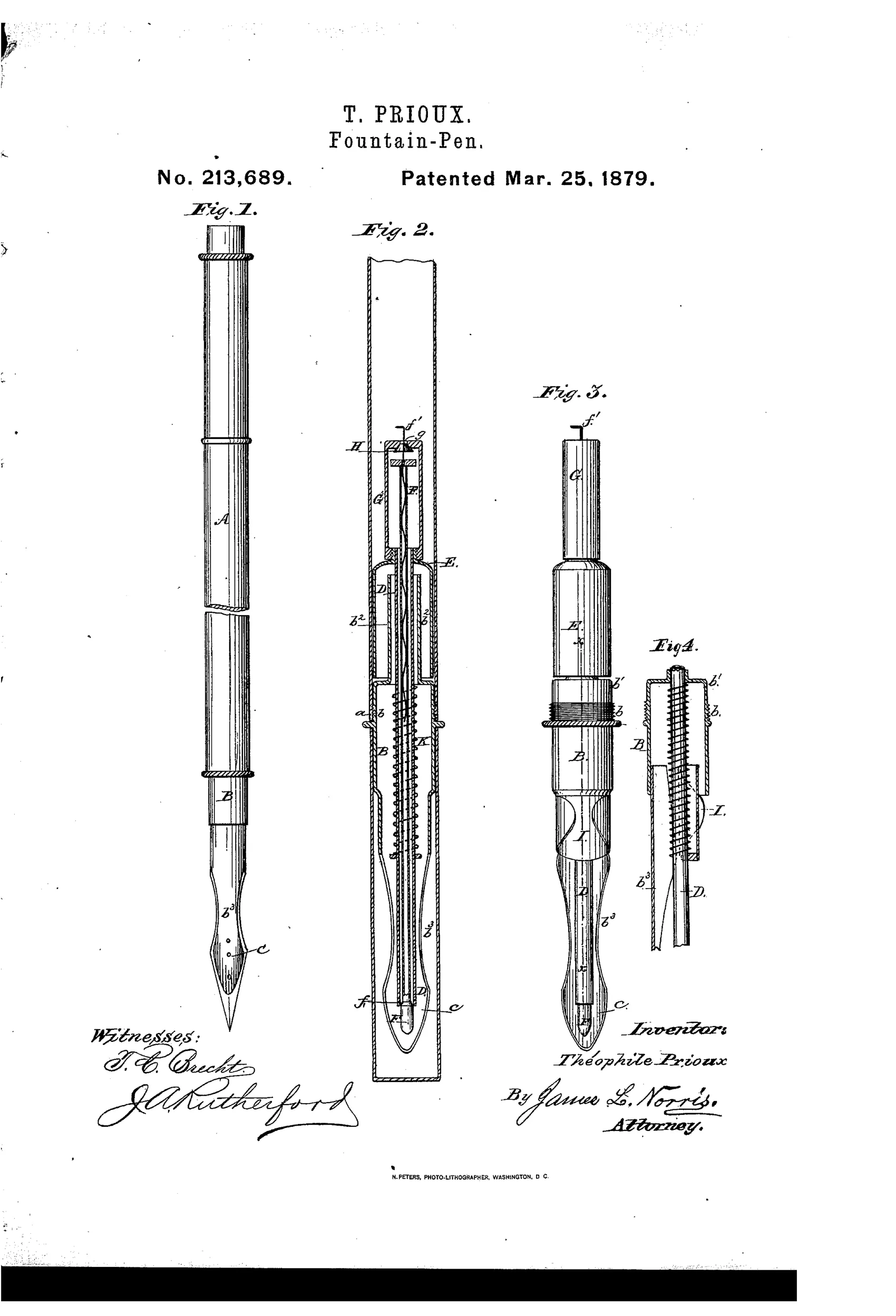
Self-inking fountain pen with automatic ink valve
✒ How it works
The pen's handle serves as an ink reservoir feeding a lower section through a valve system. Pressing the pen point raises a tube D, which lifts a conical valve H off its seat in cylinder G, letting ink descend through tube D into a spoon-like bowl feeding the nib. A surrounding spiral spring K keeps the tube D and valve in a normal closed position, and releasing pressure on the pen point closes the valve to stop ink flow.
✒ What was claimed
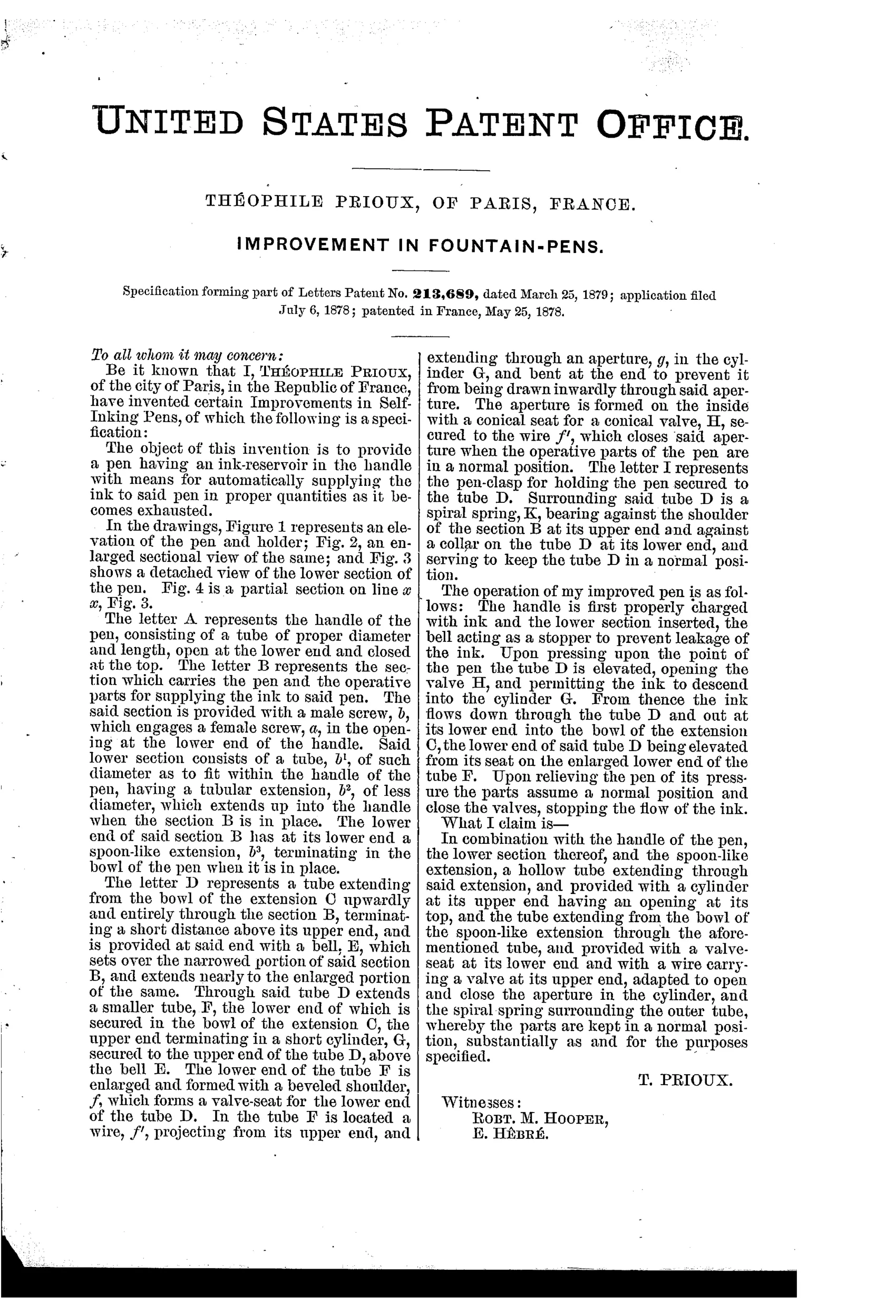
“In combination with the handle of the pen, the lower section thereof, and the spoon-like extension, a hollow tube extending through said extension, and provided with a cylinder at its upper end having an opening at its top, and the tube extending from the bowl of the spoon-like extension through the aforementioned tube, and provided with a valve-seat at its lower end and with a wire carrying a valve at its upper end, adapted to open and close the aperture in the cylinder, and the spiral spring surrounding the outer tube, whereby the parts are kept in a normal position, substantially as and for the purposes specified.”
In plain English: The claim covers a fountain pen combining a handle, a lower nib section with a spoon-shaped ink bowl, an outer tube with a valve opening, an inner tube with a wire-mounted valve that opens and closes that opening, and a spring that keeps everything normally closed until the pen point is pressed.
✒ In the inventor’s words
“Upon relieving the pen of its pressure the parts assume a normal position and close the valves, stopping the flow of the ink.”— Théophile Prioux, from the specification
Paper patent — likely never produced
The pressure-actuated valve train is fragile and fouling-prone, and no surviving marked example or maker connection is documented; a specimen would change the call.
✒ Commentary
Prioux's answer to the pre-Waterman problem — how to keep a reservoir pen from dribbling — was to make the ink ask permission. The barrel holds the ink, but nothing flows until you press the nib to paper. That pressure pushes tube D upward, which lifts a small conical valve H off its seat inside cylinder G; ink runs down the tube into a spoon-shaped bowl behind the nib. Lift the pen, and the coiled spring K (clearly visible in Fig. 2, wrapped around the tube like a screen-door closer) snaps the valve shut. As the patent puts it, releasing pressure means the parts 'assume a normal position and close the valves, stopping the flow of the ink.'
It's a genuinely thoughtful mechanism, and the spoon-bowl feed in Fig. 3 is the detail casual readers miss — a tiny reservoir metering ink to the point, which is exactly the intermediate-buffer idea Waterman would solve properly with capillary channels in 1884. Prioux got the diagnosis right and the cure wrong.
The trouble is the moving parts. A nib that must flex the whole feed assembly against a spring on every stroke means inconsistent flow, a mushy writing feel, and ink-crusted valve seats within a week. This is the pre-Waterman stratum in miniature: clever plumbing standing in for the physics of air exchange. A fascinating dead end, honestly drawn.
Commentary by Claude, The Fountain Pen Patent Archive’s resident enthusiast