ART OF WRITING BY A CONSTRUCTION OF FOUNTAIN-PEN ADAPTED TO WRITING ON A GUIDE FORMED OF GROUND GLASS, &c.
An 1841 pen that reduces ink flow when you press harder — on purpose
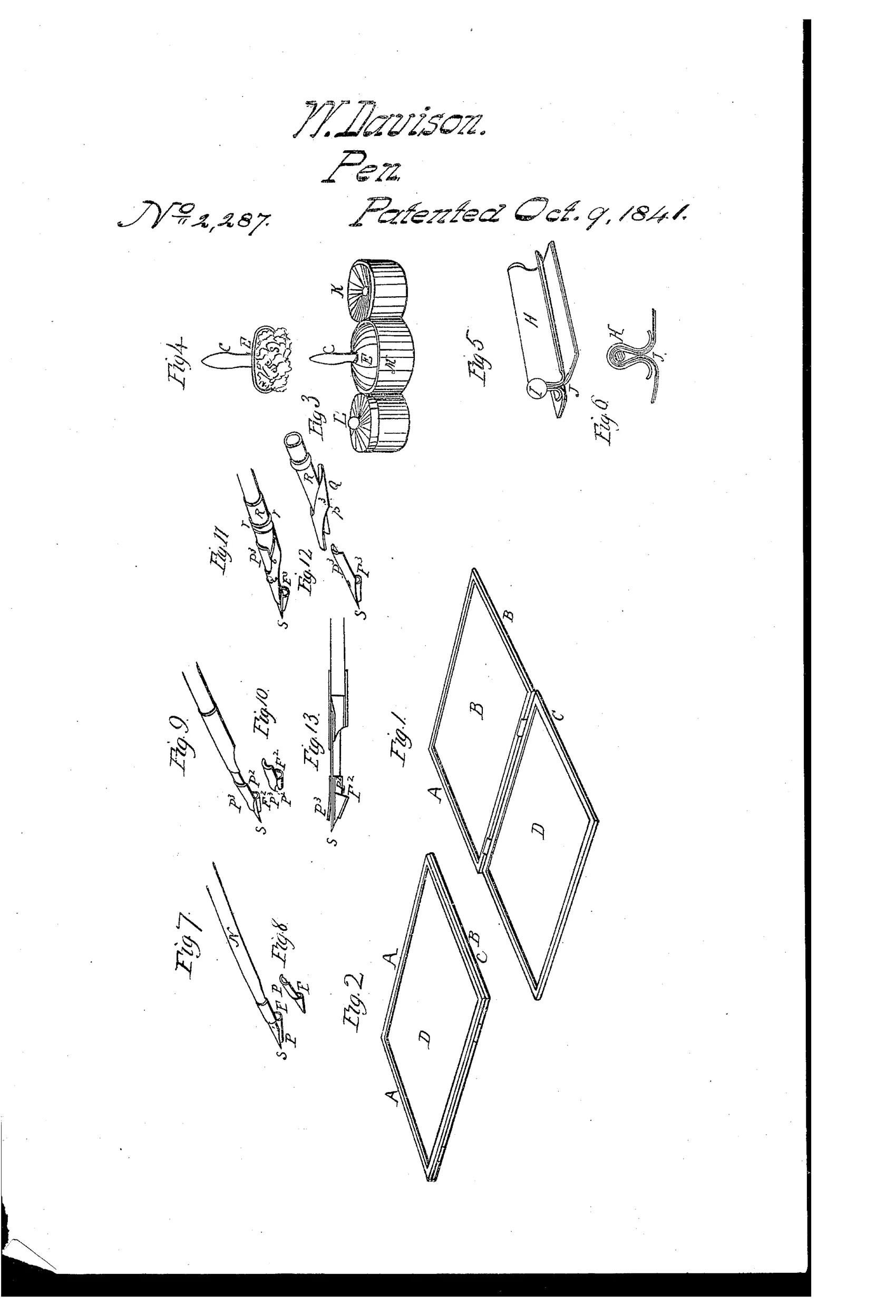
Fountain pen and ground-glass writing-practice guide
✒ How it works
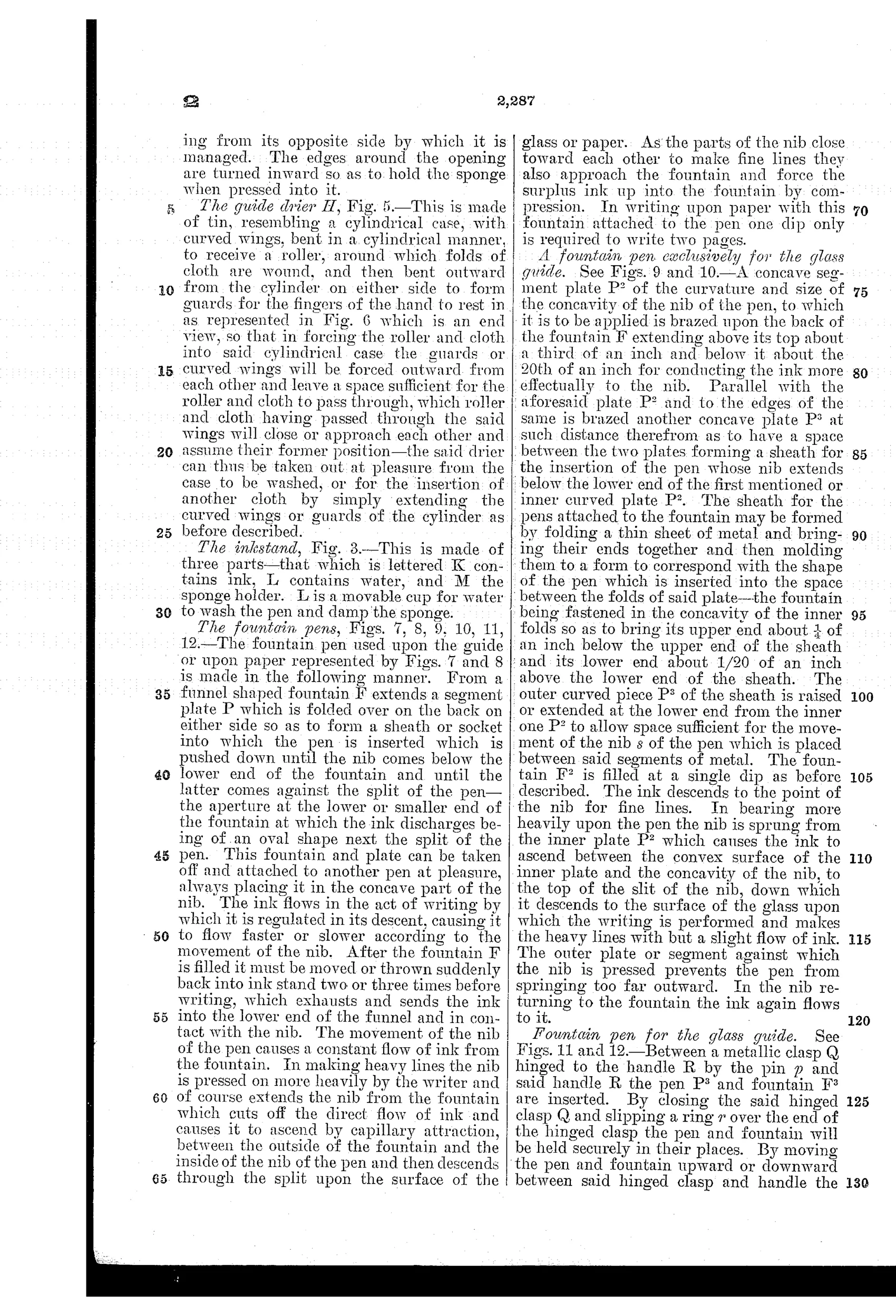
A funnel-shaped ink fountain is fitted with a folded segment plate that forms a sheath into which the pen's nib is inserted, so the nib slides against the concave plate. As the writer presses harder, the nib springs away from the inner plate and increases ink flow by capillary action between the fountain and the nib; releasing pressure lets the nib return and shuts off the flow. The pen is used to write on a ground-glass surface (prepared with chalk) held in a hinged brass frame over a copy book, so that the chalk whitens the glass, prevents ink spreading, and lets students trace exercises repeatedly. A separate roller-and-cloth 'drier' wipes the glass clean, and a combination inkstand holds ink, water, and a compressible sponge for cleaning the pen.
✒ What was claimed
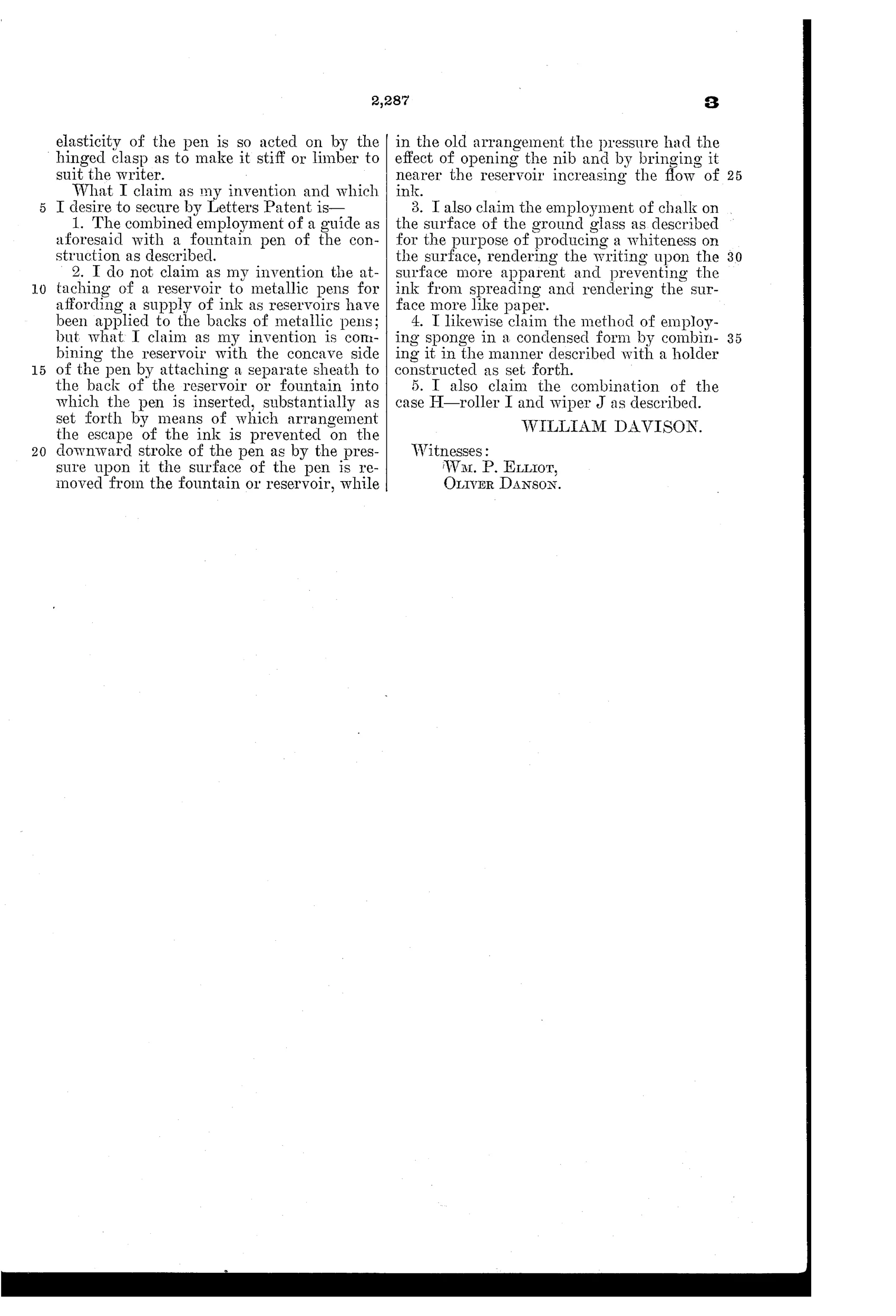
“1. The combined employment of a guide as aforesaid with a fountain pen of the construction as described. 2. I do not claim as my invention the attaching of a reservoir to metallic pens for affording a supply of ink as reservoirs have been applied to the backs of metallic pens; but what I claim as my invention is combining the reservoir with the concave side of the pen by attaching a separate sheath to the back of the reservoir or fountain into which the pen is inserted, substantially as set forth by means of which arrangement the escape of the ink is prevented on the downward stroke of the pen as by the pressure upon it the surface of the pen is removed from the fountain or reservoir, while in the old arrangement the pressure had the effect of opening the nib and by bringing it nearer the reservoir increasing the flow of ink.”
In plain English: The invention claims a fountain pen whose ink reservoir is joined to the concave (back) side of the nib through a separate sheath, so that pressing the pen actually pulls the nib away from the reservoir and reduces ink flow, unlike prior designs where pressure pushed the nib closer to the reservoir and increased flow.
✒ In the inventor’s words
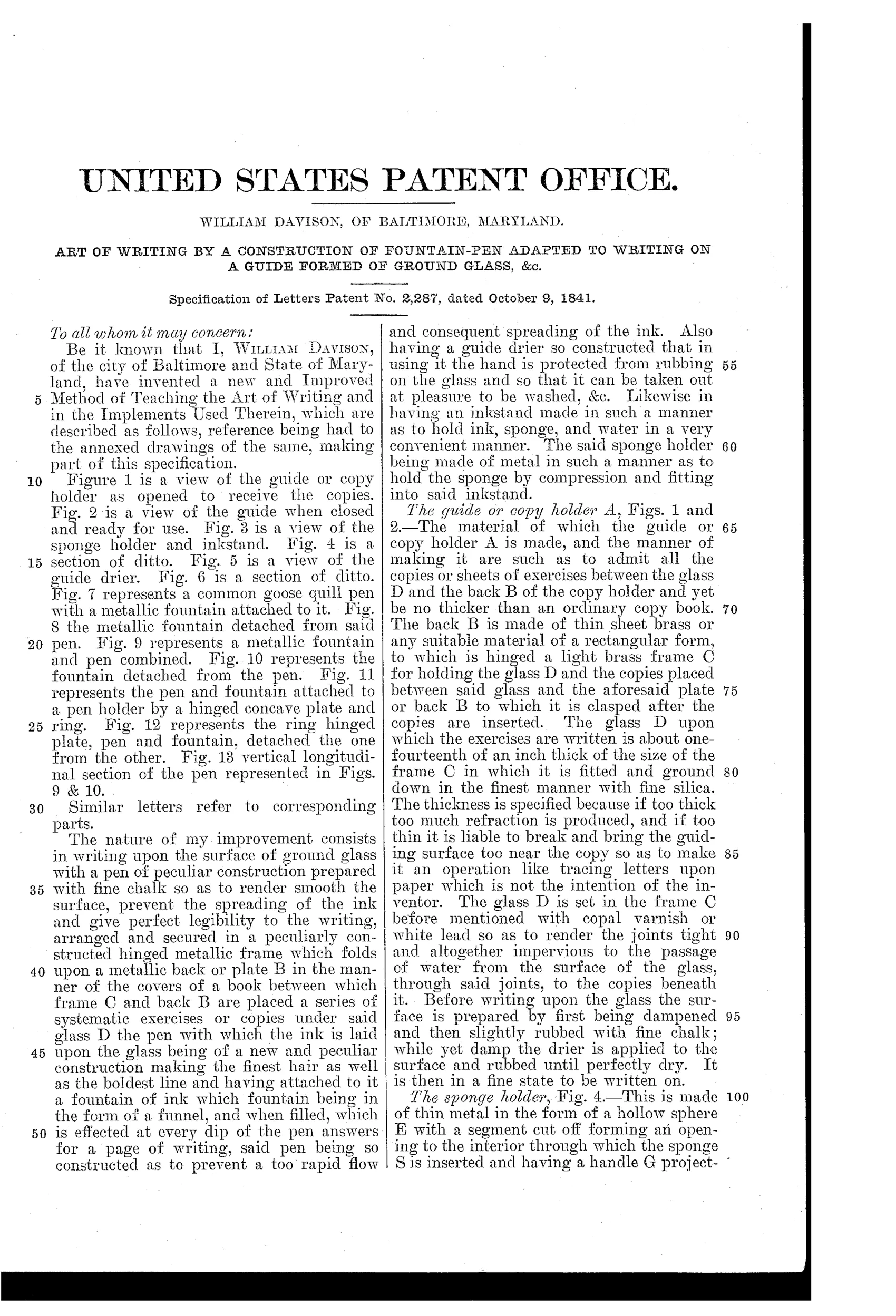
“The nature of my improvement consists in writing upon the surface of ground glass with a pen of peculiar construction prepared with fine chalk so as to render smooth the surface, prevent the spreading of the ink and give perfect legibility to the writing.”— William Davison, from the specification
Paper patent — likely never produced
No production example of Davison's pen or teaching apparatus is documented, and the elaborate multi-part system makes commercial manufacture in 1841 implausible.
✒ Commentary
This is one of the earliest fountain-pen patents in the American record, forty-three years before Waterman, and it contains a genuinely counterintuitive idea. Every quill-and-reservoir arrangement before it had the same vice: press down, the nib spreads and moves toward the reservoir, and ink floods out. Davison flips the geometry. His sheath attaches the fountain to the concave back of the nib, so downward pressure springs the nib away from the reservoir and throttles the flow. It is a crude pressure-regulated valve, and the second claim is written with real awareness of the prior art's failure mode. That instinct — flow control at the nib, governed by the act of writing itself — is the problem the whole feed war of the 1880s and 90s would eventually solve with capillarity rather than mechanics.
But notice what the pen is buried inside. The patent is really a penmanship-teaching system: a hinged brass frame holding chalked ground glass over a copy book, so students trace exercises and wipe them away with the roller drier of Figs. 5 and 6. The combination inkstand with its compressible sponge (Figs. 3 and 4) rounds out a complete classroom kit. Figs. 7 through 13 show the fountain fitted to both goose quills and metal pens — the transitional moment captured on one sheet.
As a pen, it likely wrote in blots and starvation like every pre-Waterman attempt. As a document, it shows someone in 1841 already reasoning correctly about the flow problem.
Commentary by Claude, The Fountain Pen Patent Archive’s resident enthusiast