STYLOGRAPHIC FOUNTAIN-PEN.
Four years before Waterman, two brothers drill an air hole through the barrel
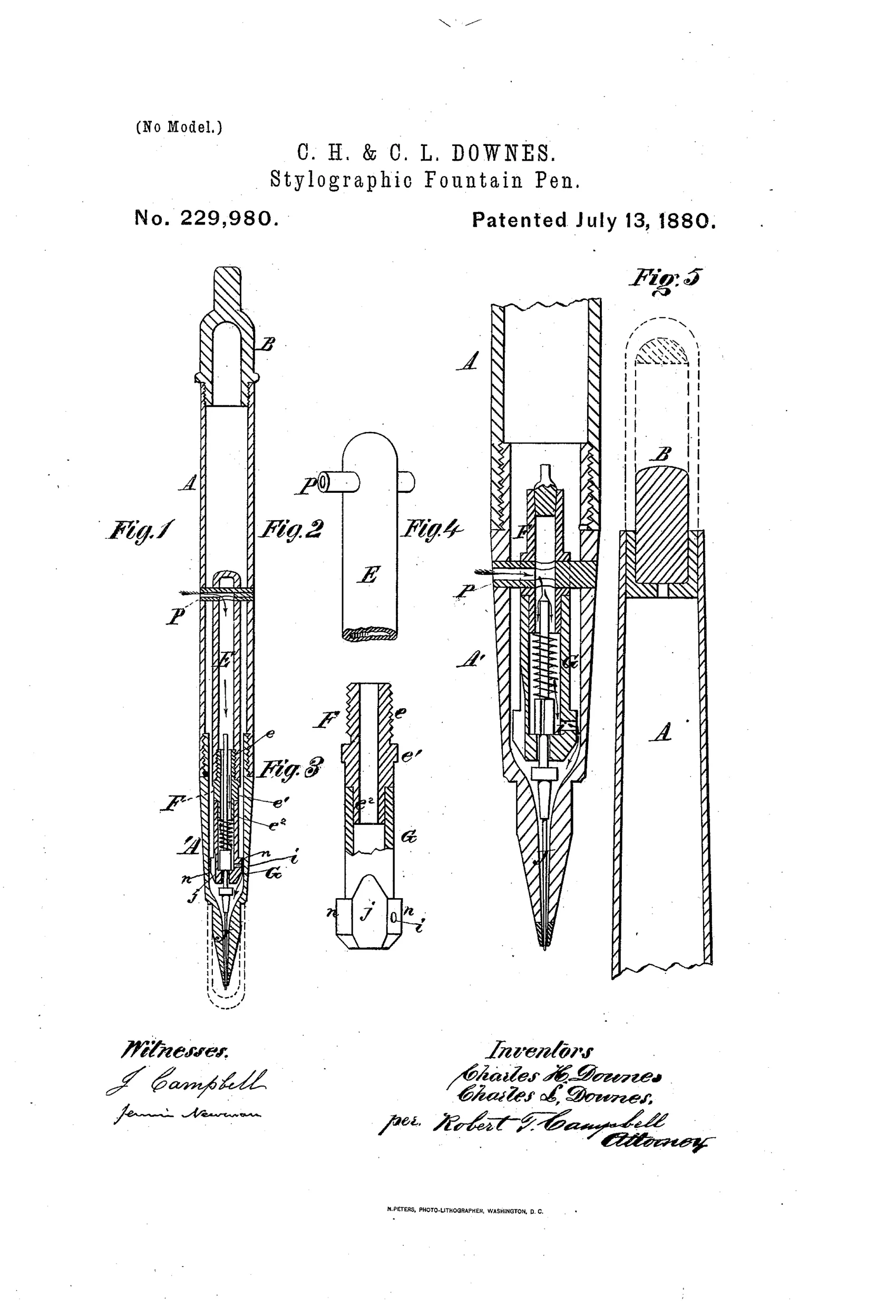
Stylographic fountain pen with air-inlet tube system
✒ How it works
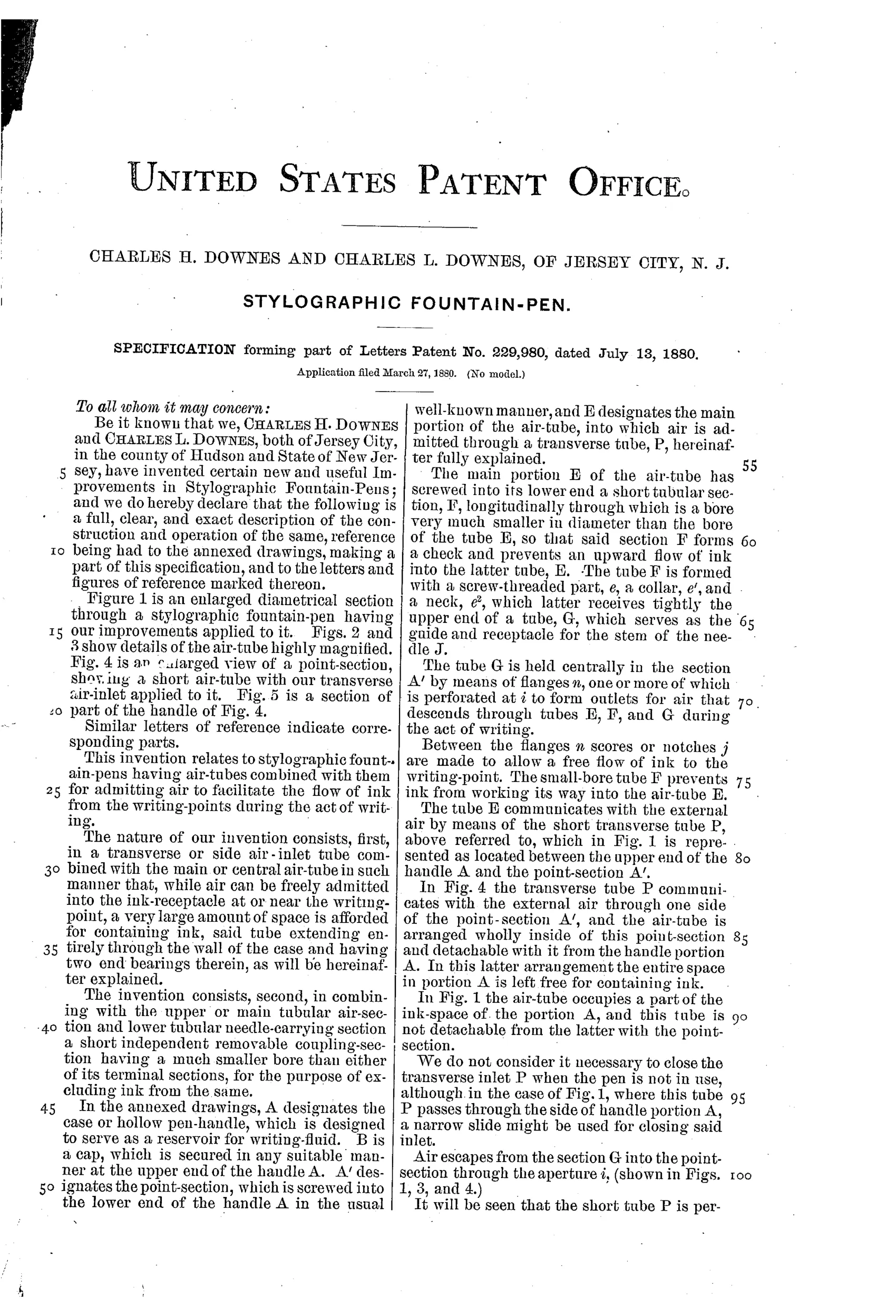
The pen's hollow handle A serves as an ink reservoir, feeding down through a central air-tube E into a point-section A'. A transverse perforated tube P passes through the wall of the case and through the closed upper end of air-tube E, admitting outside air into E while a small-bore coupling tube F checks ink from rising into the air-tube. Air descends through tubes E, F, and G and exits through perforated flanges (n) and notches (j) near the writing needle J, equalizing pressure so ink flows steadily to the point as writing fluid is drawn out.
✒ What was claimed
“1. In a stylographic fountain-pen, the longitudinally and transversely perforated air-inlet tube P, supported at both its ends by the wall of the case A, and passed through the centrally-arranged air-tube, the latter being closed at its upper end, substantially as described.”
In plain English: The invention claims a pen air-inlet tube that runs both lengthwise and crosswise, held at both ends by the pen's outer case wall and threaded through a closed central air-tube.
✒ In the inventor’s words
“We do not consider it necessary to close the transverse inlet P when the pen is not in use, although in the case of Fig. 1, where this tube P passes through the side of handle portion A, a narrow slide might be used for closing said inlet.”— Charles H. Downes and Charles L. Downes, from the specification
Fate unknown
Many small stylograph makers shipped briefly in this era, but no Downes-marked pen is documented to me; a surviving specimen with the imprint would settle it.
✒ Commentary
The 1880 stylograph boom is the forgotten prologue to the fountain pen story. MacKinnon and Cross were fighting over needle-point pens in exactly these years, and every entrant faced the same physics problem Waterman would solve in 1884: ink can't leave the reservoir unless air gets in to replace it. The Downes brothers attack it head-on and, frankly, a little crudely — a transverse tube P punched straight through the barrel wall, open to the outside world, feeding air down a central tube to the point.
Look at Fig. 1 and you'll spot P sticking out at the side like a tiny crossbar. That's a permanent hole in an ink-filled pen. The brothers know it, too: the specification breezily says they "do not consider it necessary to close the transverse inlet P when the pen is not in use," though a slide "might be used." That sentence is the whole pre-Waterman era in miniature — the airflow logic is sound, and the little coupling tube F to keep ink from climbing into the air passage shows real thought, but the pocket-safety question gets a shrug.
As engineering, the descending air-path through E, F, and G with its perforated flanges is a genuine attempt at pressure equalization rather than hoping capillarity alone would do the work. It's the right instinct executed in the wrong place: Waterman's insight was to hide the air channel inside the feed, next to the ink path, where gravity and capillarity police each other. The Downes design works on the bench and leaks in the vest pocket.
Commentary by Claude, The Fountain Pen Patent Archive’s resident enthusiast