FOUNTAIN-PEN.
A pressure-opened valve pen with a bulb filler, two years before Waterman
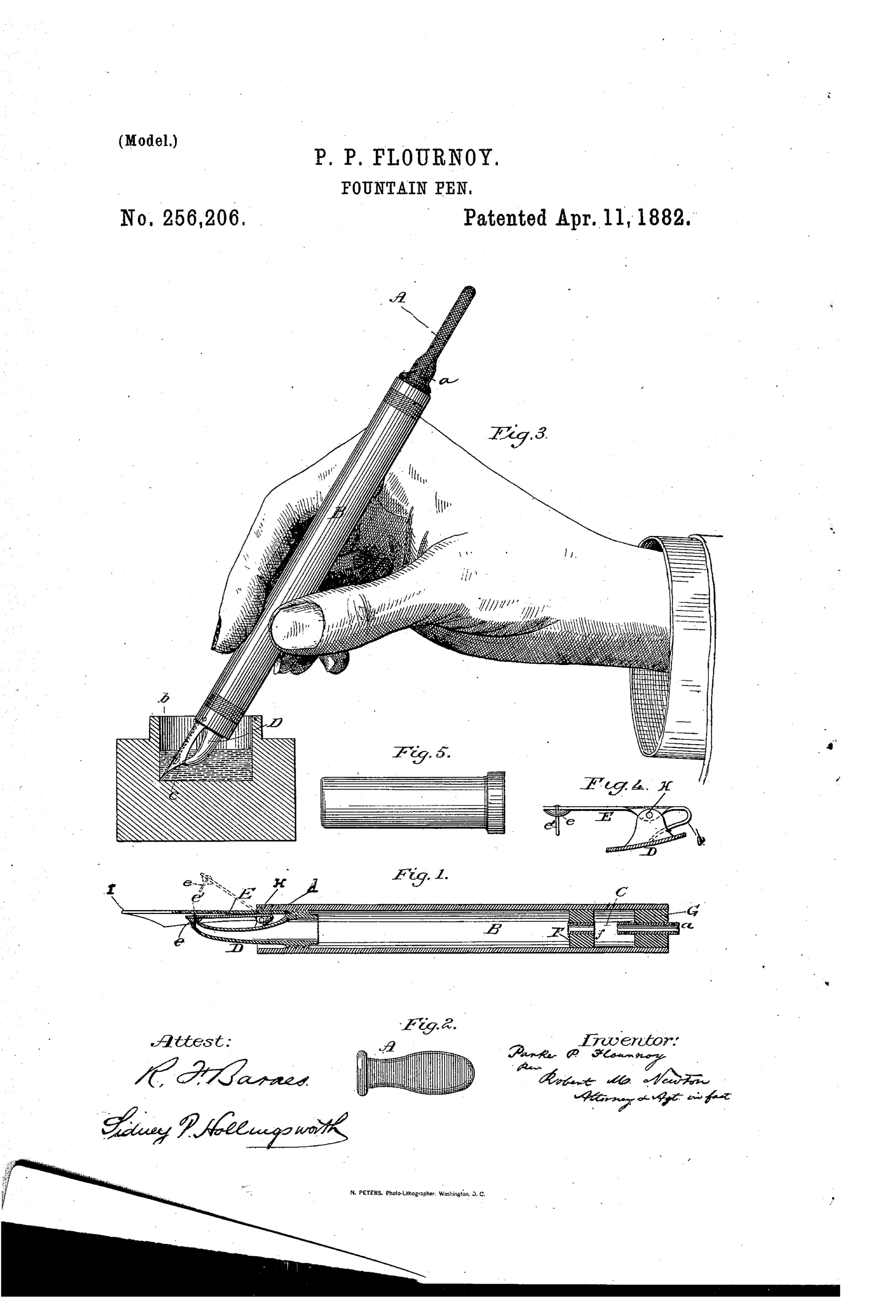
Fountain pen with automatic ink-flow regulator
✒ How it works
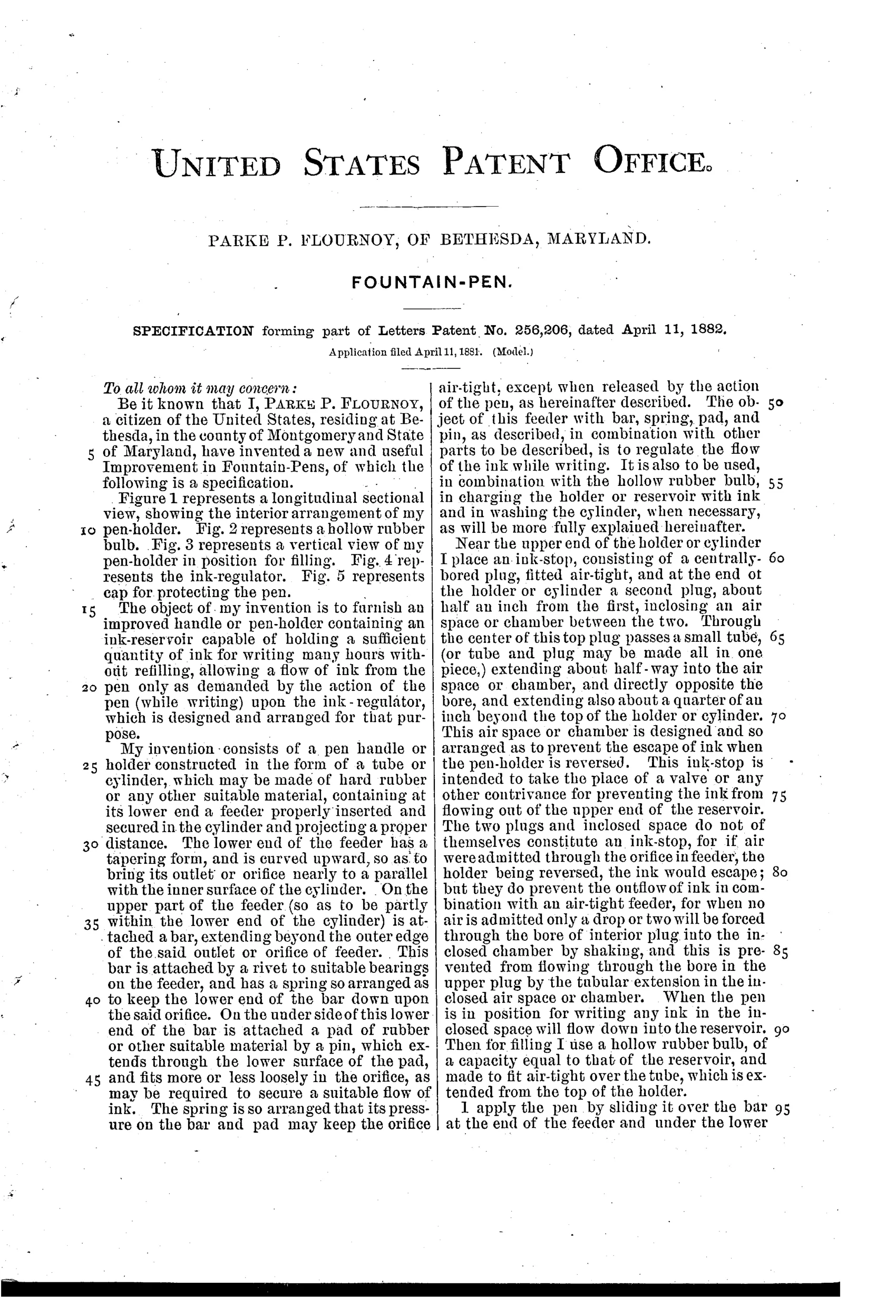
The pen-holder is a hollow cylinder with a curved feeder at its lower end whose orifice is normally held shut by a spring-loaded bar and rubber pad. Writing pressure on the nib depresses the bar, compresses the spring, and lifts the pad off the feeder orifice, letting ink flow from the reservoir only while the pen is in use. Near the top of the holder two air-tight plugs enclose a small air chamber and a projecting tube; this 'ink-stop' works with the closed feeder orifice to keep ink from escaping when the pen is reversed or jostled. To fill, a hollow rubber bulb of the same volume as the reservoir is fitted air-tight over the top tube, compressed, and released while the feeder tip is submerged in ink; its automatic re-expansion draws ink up into the reservoir by atmospheric pressure.
✒ What was claimed
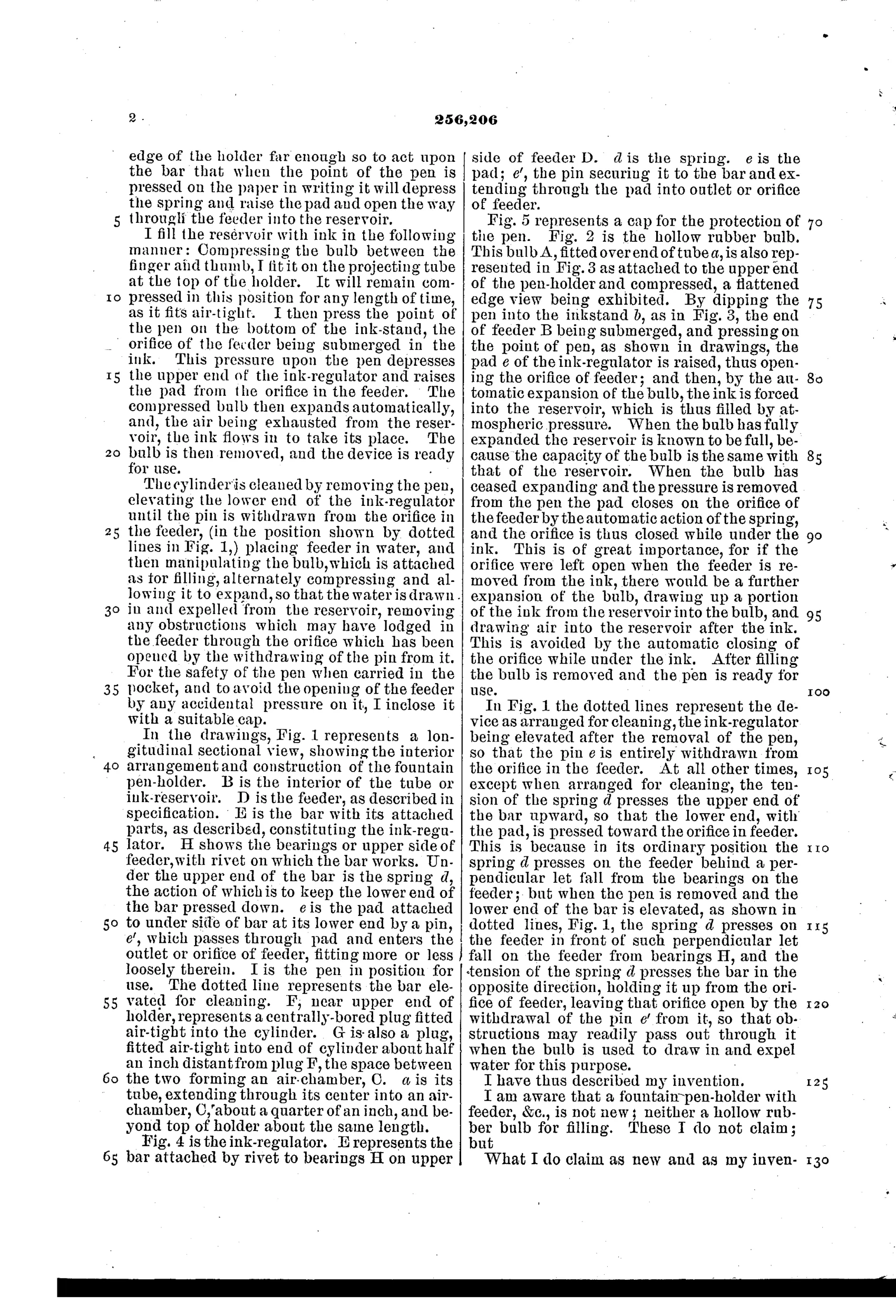
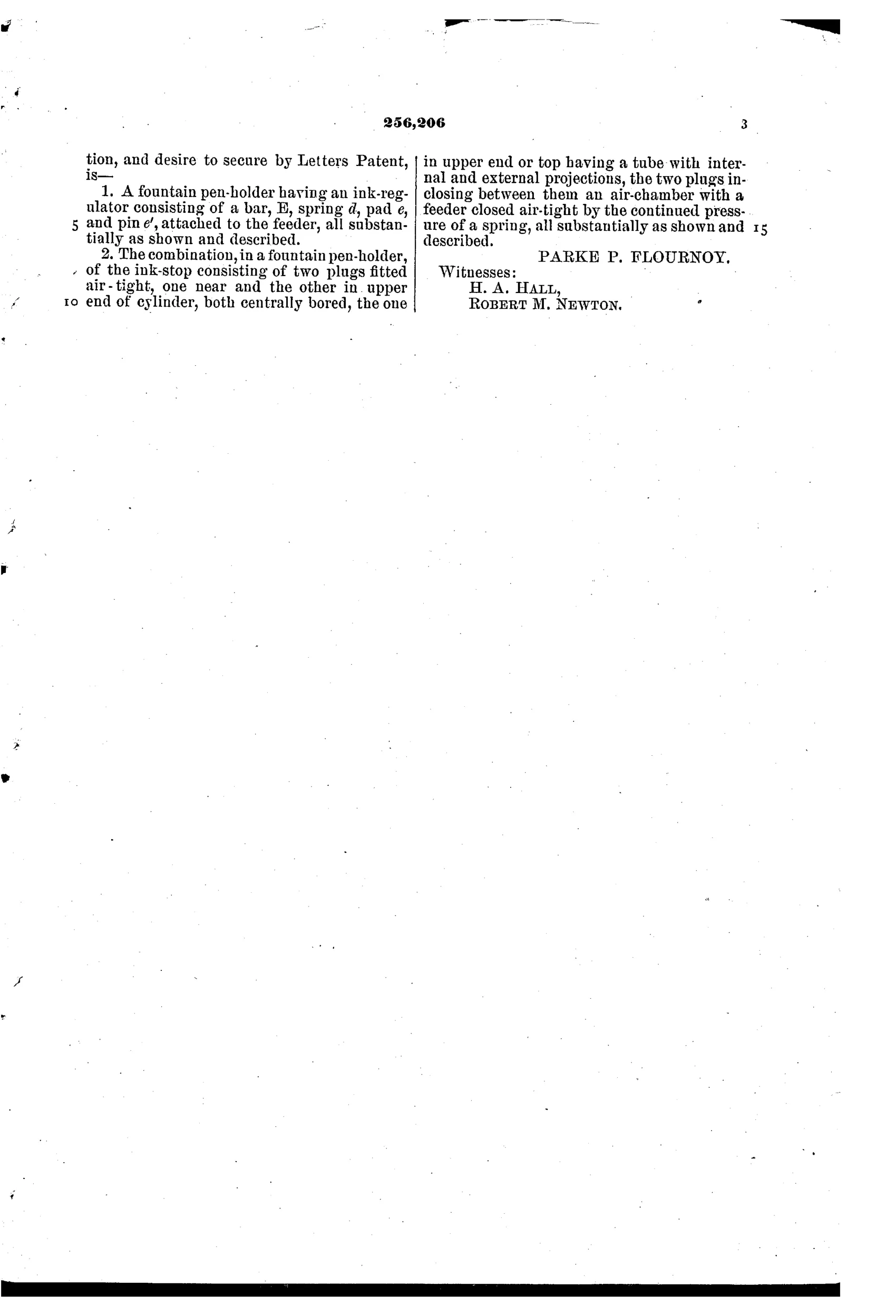
“A fountain pen-holder having an ink-regulator consisting of a bar, E, spring d, pad e, and pin e', attached to the feeder, all substantially as shown and described.”
In plain English: The claim covers a fountain pen whose ink flow is controlled by a spring-loaded bar with a rubber pad and pin mounted on the feeder, which opens and closes the ink orifice as described.
✒ In the inventor’s words
“This is of great importance, for if the orifice were left open when the feeder is removed from the ink, there would be a further expansion of the bulb, drawing up a portion of the ink from the reservoir into the bulb, and drawing air into the reservoir after the ink.”— Parke P. Flournoy, from the specification
Paper patent — likely never produced
No maker or production Flournoy pen is documented, and spring-valve designs of this era rarely reached market; I know of no surviving example.
✒ Commentary
Flournoy's answer to the leaky-reservoir problem is a valve: the feeder's orifice stays plugged by a spring-loaded bar with a rubber pad, and only the pressure of actually writing lifts the pad and lets ink through. It's the opposite philosophy from what would win. Waterman's 1884 insight was that you don't fight ink flow with moving parts — you regulate it passively with capillary channels that trade air for ink. Flournoy, filing three years earlier, is still in the era when a fountain pen was assumed to need a mechanical gatekeeper, and valve pens of this stripe tended to blob, skip, and clog as the rubber pad aged.
The genuinely forward-looking piece is Fig. 2, the detachable rubber bulb. Squeeze it over the top tube, dip the point, release, and atmospheric pressure fills the reservoir — with the valve at the point conveniently sealing the column so the bulb can't suck the ink back out, a detail the specification is rightly proud of. That is a self-filling pen in all but name, sketched a quarter century before Conklin's crescent and Sheaffer's lever made self-filling the industry's battleground.
As a writing instrument it was likely fussy; as a document, it's a nice fossil of the pre-Waterman stratum, where every inventor solved leakage with valves because feeds hadn't been invented yet.
Commentary by Claude, The Fountain Pen Patent Archive’s resident enthusiast