FOUNTAIN-PEN
Fill through a hole in the threads, so the needle valve never moves
Stylographic fountain pen fillable without removing the point-section
✒ How it works
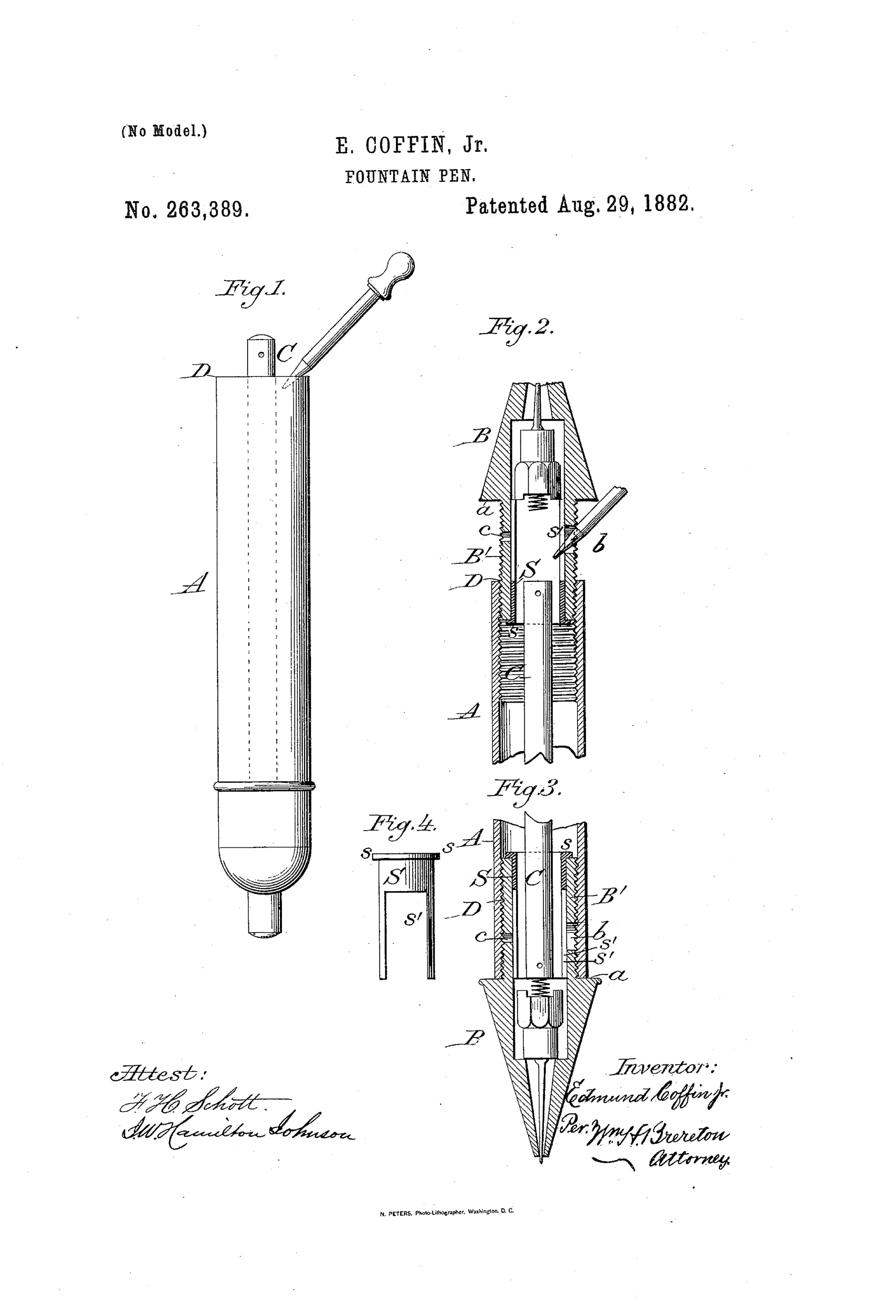
The pen has a barrel reservoir A joined to a tapering point-section B by a screw-joint at D. An opening b, and a smaller opposite opening c, are formed through the threaded portion B' of the point-section so that a filling instrument can be inserted and air can escape without fully unscrewing the parts. A slotted cylindrical stop S, with flanges s at top and an open slotted lower portion s', fits into the mouth of the point-section to hold the valve mechanism in place and to keep the filling openings clear when the pen is inverted for filling.
✒ What was claimed
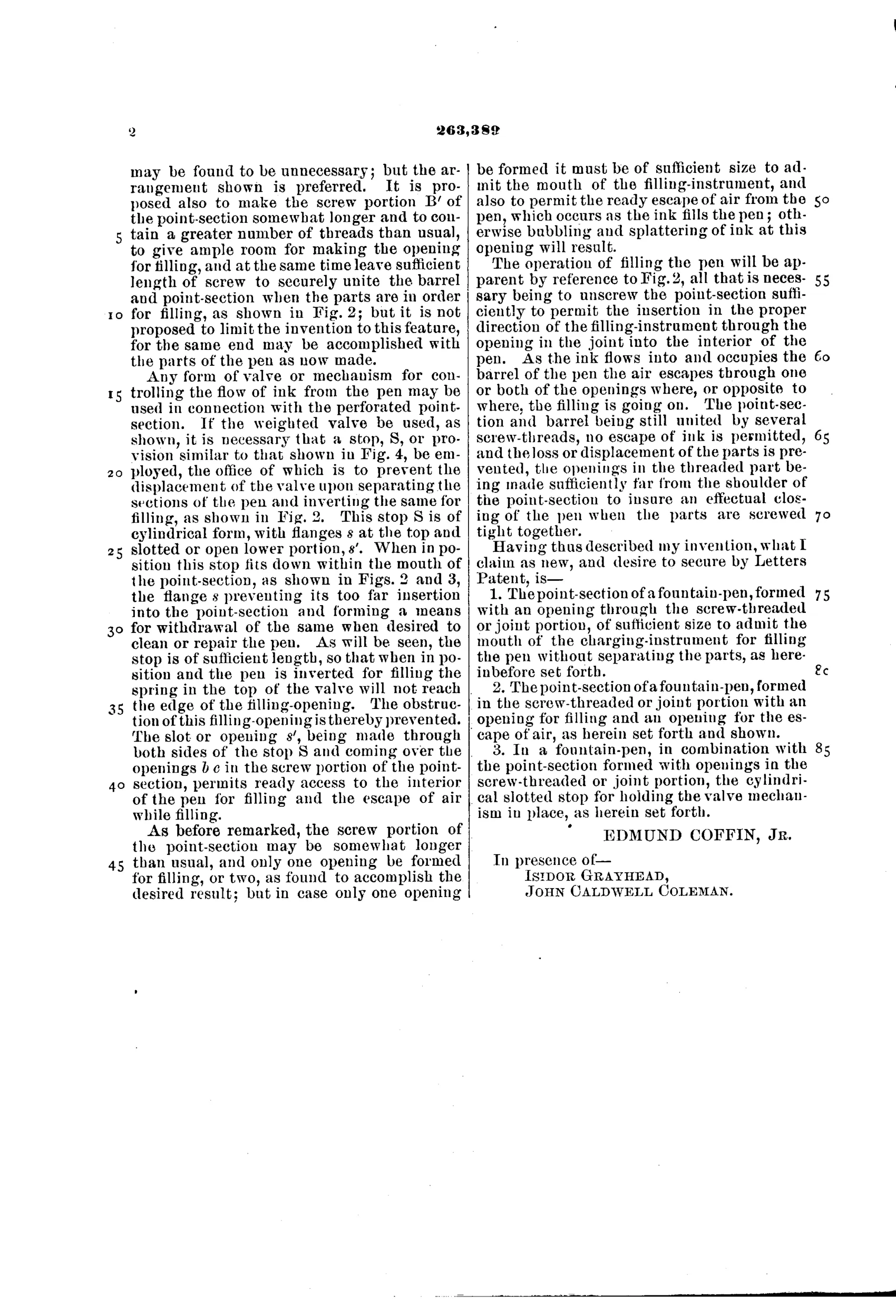
“The point-section of a fountain-pen, formed with an opening through the screw-threaded or joint portion, of sufficient size to admit the mouth of the charging-instrument for filling the pen without separating the parts, as hereinbefore set forth.”
In plain English: A fountain pen point-section with a hole through its threaded joint big enough to insert a filling tool, so the pen can be refilled without unscrewing the parts.
✒ In the inventor’s words
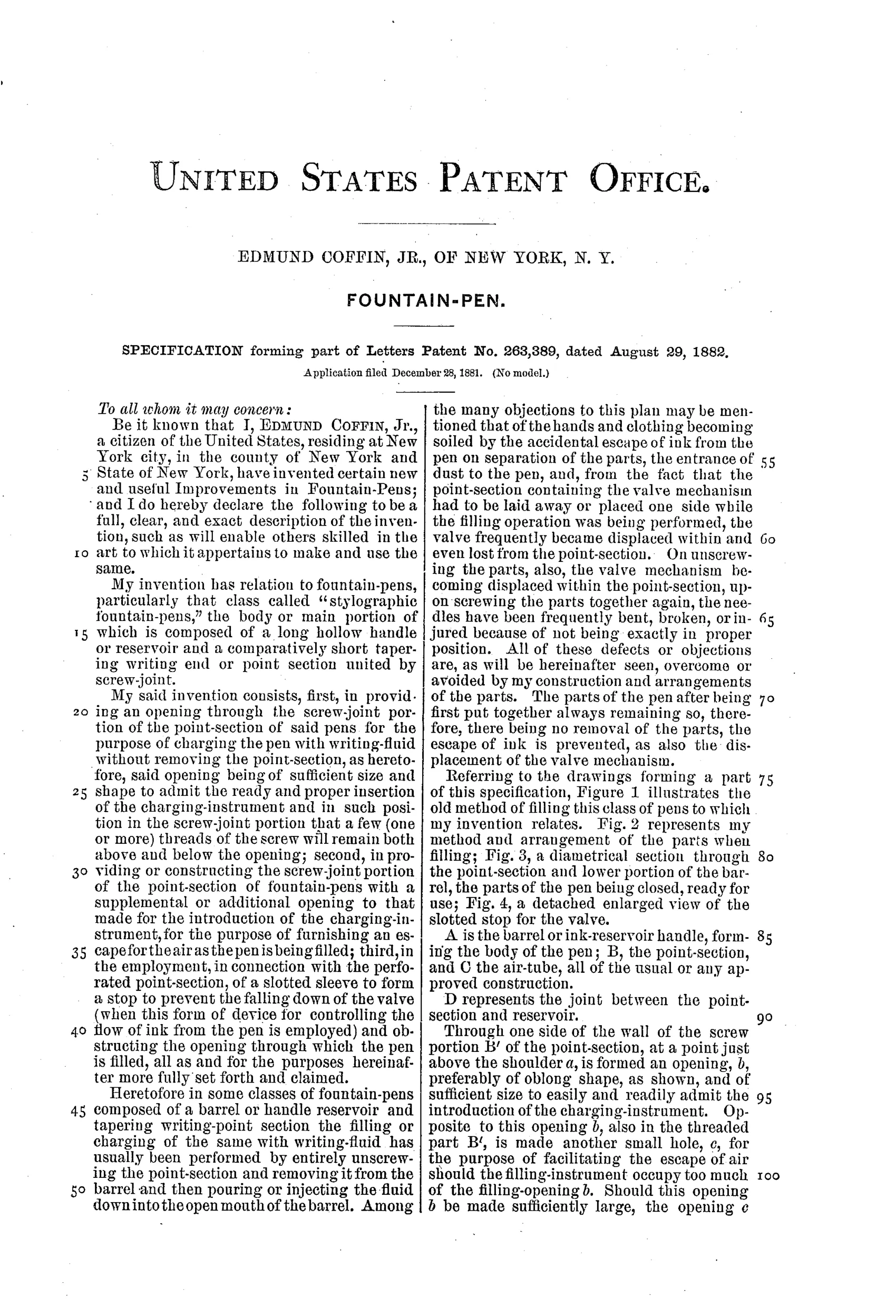
“The parts of the pen after being first put together always remaining so, therefore, there being no removal of the parts, the escape of ink is prevented, as also the displacement of the valve mechanism.”— Edmund Coffin, Jr., from the specification
Fate unknown
Coffin was a genuine figure in the stylographic trade, but I know of no documented pen with this pierced-joint filler; a surviving marked specimen would settle it.
✒ Commentary
Edmund Coffin's 1882 patent attacks a real annoyance of the stylographic pen era: every time you unscrewed the point-section to refill, you risked disturbing the delicate needle-and-valve assembly that made the pen write at all, and you usually got ink on your fingers besides. His answer is oddly elegant — bore a hole straight through the threaded joint itself, big enough to admit the mouth of an eyedropper, with a smaller hole opposite to let air escape. Screw the joint a half-turn and the holes align; fill; screw it back and the barrel wall seals them.
Fig. 1 shows the old ritual — pen apart, dropper poised — while Fig. 2 shows the dropper entering sideways through the joint of an assembled pen. The subtle part is the slotted stop S in Fig. 4: a flanged sleeve that both retains the valve mechanism and keeps the filling passage clear when the pen is inverted. Coffin understood that the openings would clog or misalign without it.
This sits squarely in the pre-Waterman stratum, and among stylographs rather than nibbed pens — the stylo was briefly the reliable writing instrument of the early 1880s. The idea works in principle, though a joint pierced by two holes is two more places for ink to weep, and one wonders how long the seal stayed honest as the threads wore. A thoughtful fix for a pen type whose moment was nearly over.
Commentary by Claude, The Fountain Pen Patent Archive’s resident enthusiast