FOUNTAIN-PEN.
A Denver inventor splits one hole into ink-out and air-in, four years after Waterman
A capillary-feed fountain pen with divided ink/air plug
✒ How it works
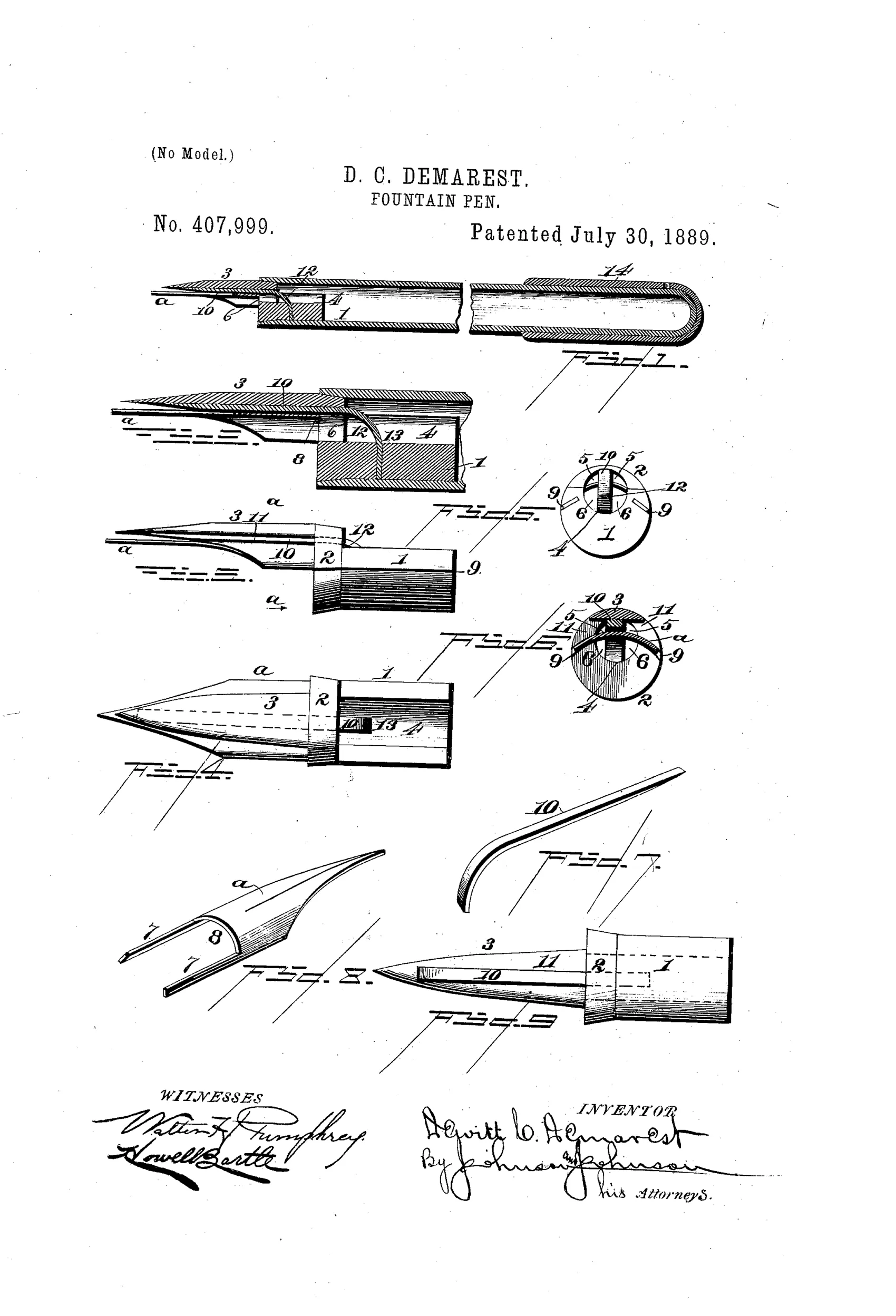
The pen holder is a hollow handle with a pen-holding plug inserted in its flared end, the plug having a central groove that opens at the front and is divided by the pen's rear edge into an upper ink-outflow passage and a lower air-vent passage. A bent ink-feeder stem lies beneath a tapering tongue on the plug, crossing the air-vent at right angles so ink flows in two side streams along the plug-tongue to the pen point while air enters the reservoir without ink leaking out. The plug's cylindrical beveled end forms a tight joint within the handle, and a cap fits over the closed end when in use or over the pen-plug when not in use.
✒ What was claimed
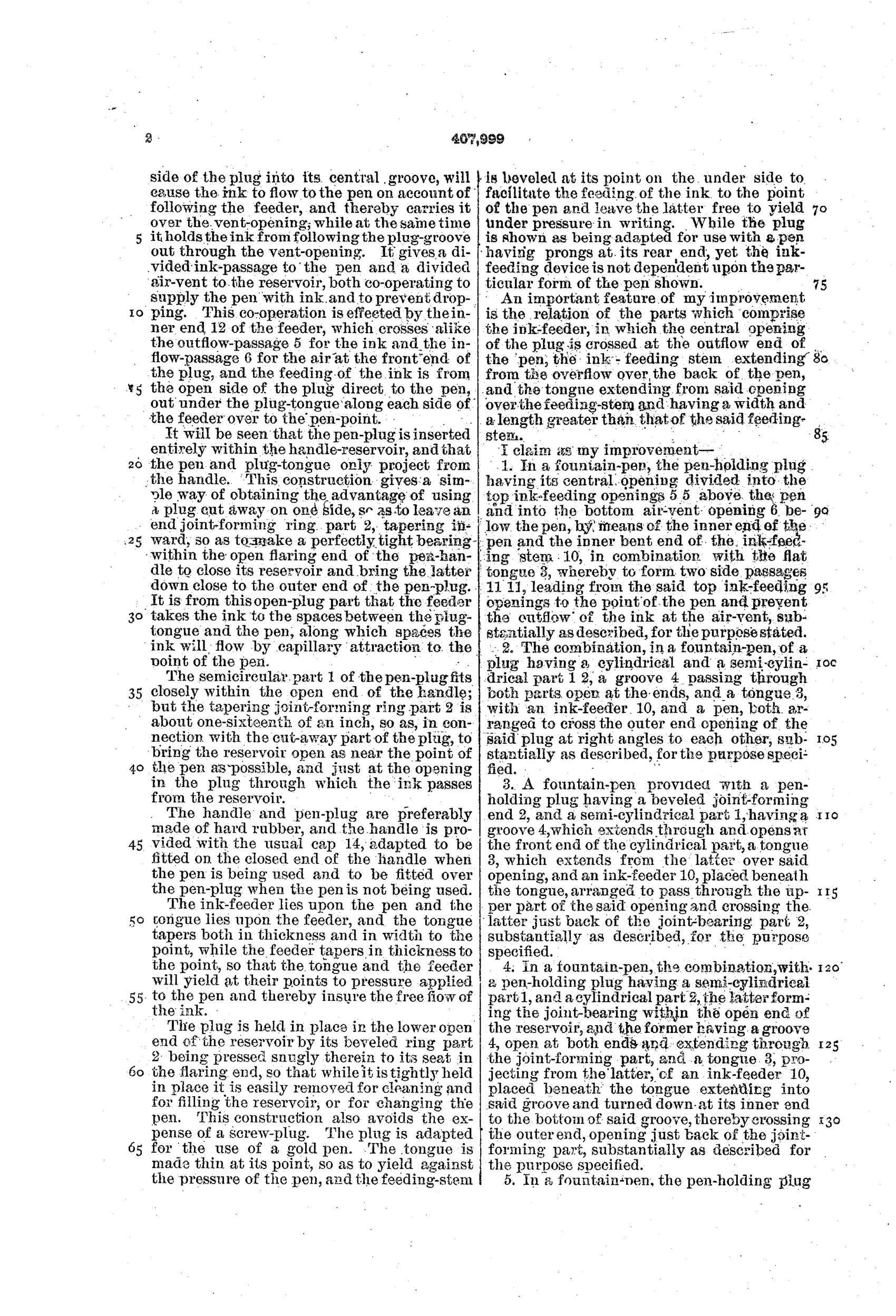
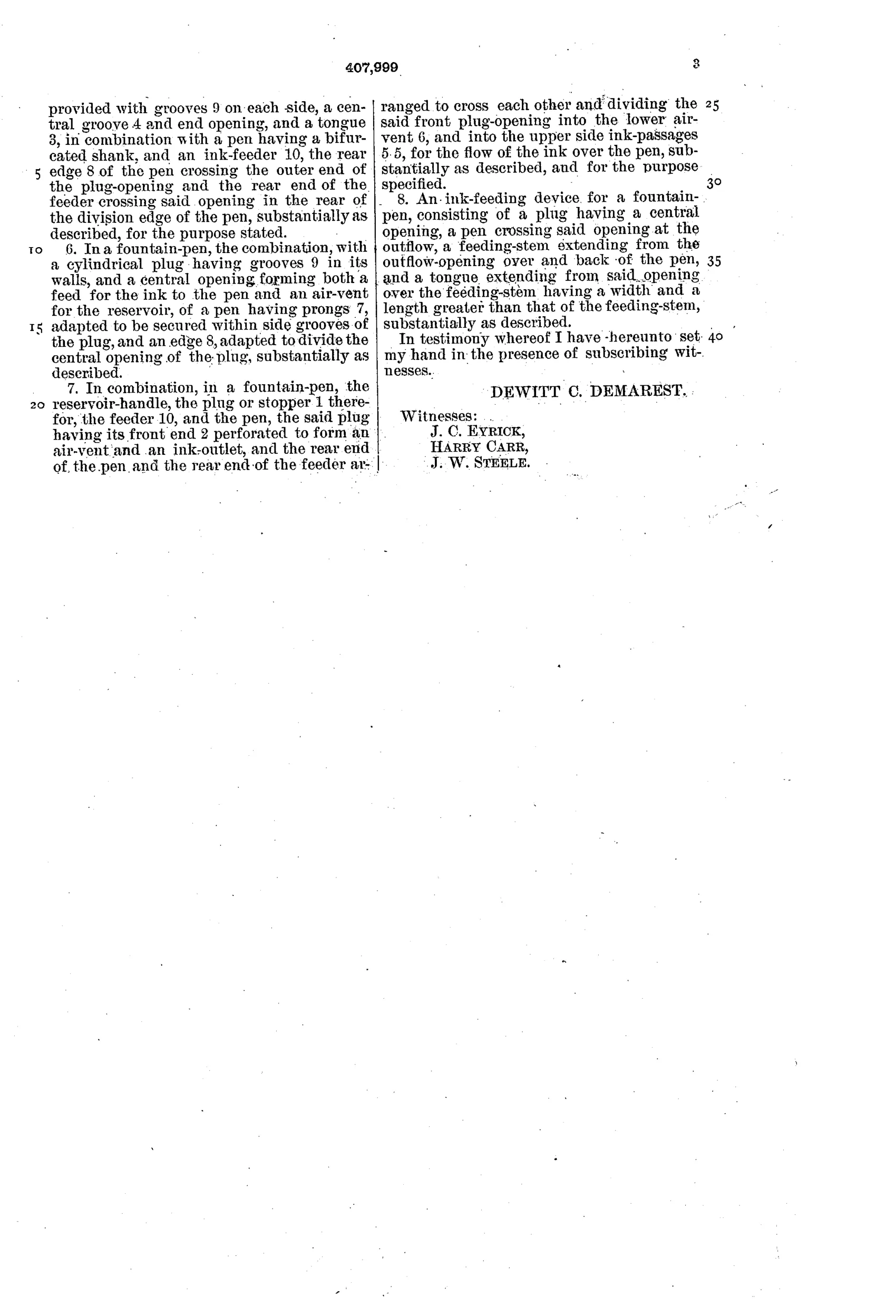
“1. In a fountain-pen, the pen-holding plug having its central opening divided into the top ink-feeding openings 5 5 above the pen and into the bottom air-vent opening 6 below the pen, by means of the inner end of the pen and the inner bent end of the ink-feeding stem 10, in combination with the flat tongue 3, whereby to form two side passages 11 11, leading from the said top ink-feeding openings to the point of the pen and prevent the outflow of the ink at the air-vent, substantially as described, for the purpose stated.”
In plain English: The plug's central opening is split by the pen's edge and the feeder's bent tip into a top ink outlet and a bottom air vent, with a tongue forming two side channels that carry ink to the pen point while keeping it from leaking out the air vent.
✒ In the inventor’s words
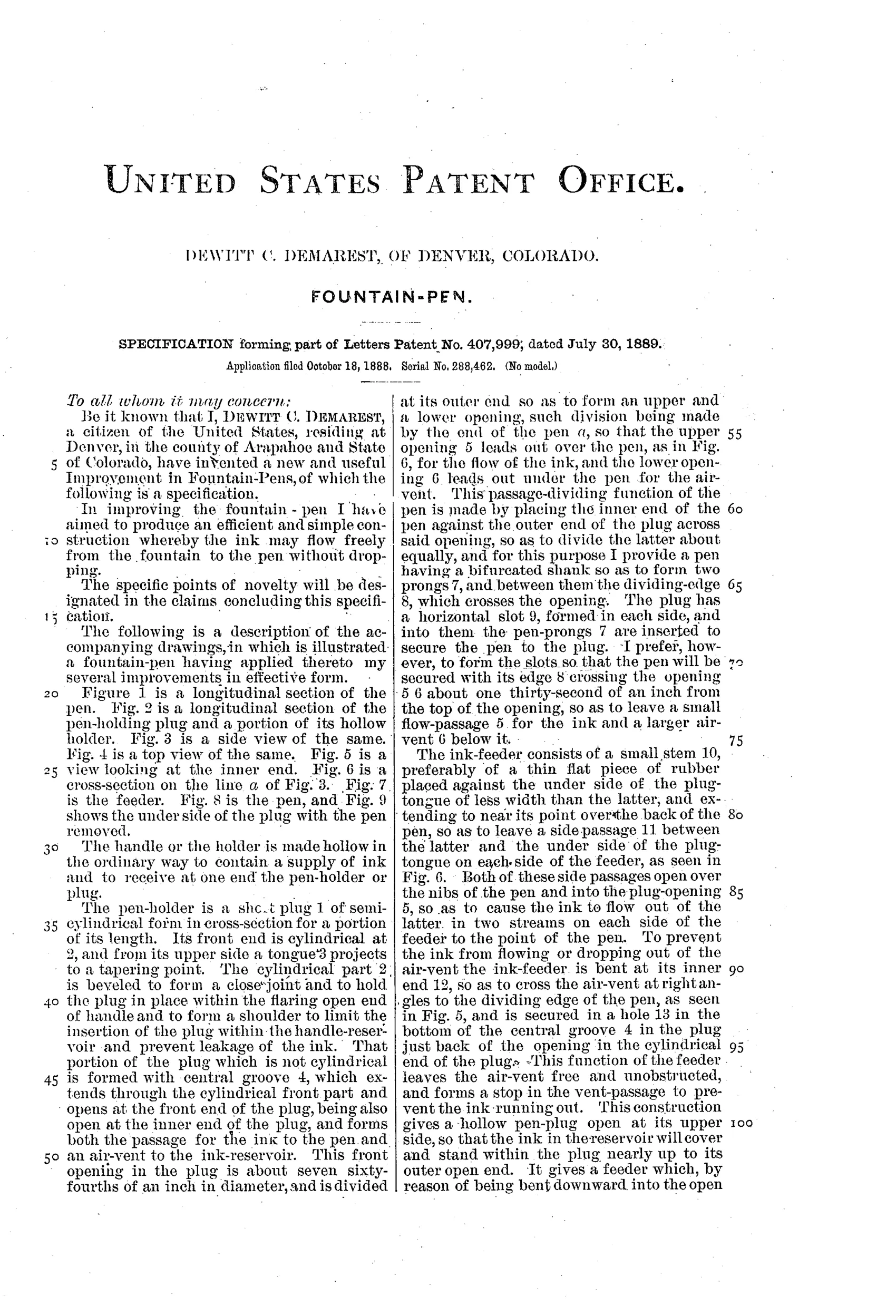
“In improving the fountain-pen I have aimed to produce an efficient and simple construction whereby the ink may flow freely from the fountain to the pen without dropping.”— Dewitt C. Demarest, from the specification
Fate unknown
No Demarest-marked pen of this construction is documented to my knowledge; a surviving example with this plug-and-stem feed would settle it.
✒ Commentary
Demarest filed this in 1888, squarely in the shadow of Waterman's 1884 feed patent, and he's wrestling with exactly the same problem: how to let air into the reservoir at the same rate ink leaves it, without either starving the nib or dumping ink on the page. His answer is geometric rather than channel-based. The nib's rear edge, sitting in the plug's central groove, becomes a physical divider — everything above it is ink outflow, everything below is air vent. Then a bent feeder stem (Fig. 7, that graceful curved wire) crosses the vent at right angles and splits the ink into two side streams running along the flat tongue to the point.
Look at Figs. 5 and 6, the little end views. That's where the whole idea lives: the passages 5-5 above the nib, the vent 6 below, the side channels 11-11 formed by the tongue. The nib itself is doing structural duty as a partition, which is clever and also fragile — the seal depends on how snugly a springy piece of gold sits against hard rubber, and every nib swap re-rolls those dice.
It's an honest, mechanically literate entry in the feed wars, but Waterman's fissure feed did the same job with fewer parts and no dependence on nib fit. That's the direction the industry went.
Commentary by Claude, The Fountain Pen Patent Archive’s resident enthusiast