FOUNTAIN-PEN.
A sliding valve on the feed-bar — Moore's shutoff before his famous safety pen
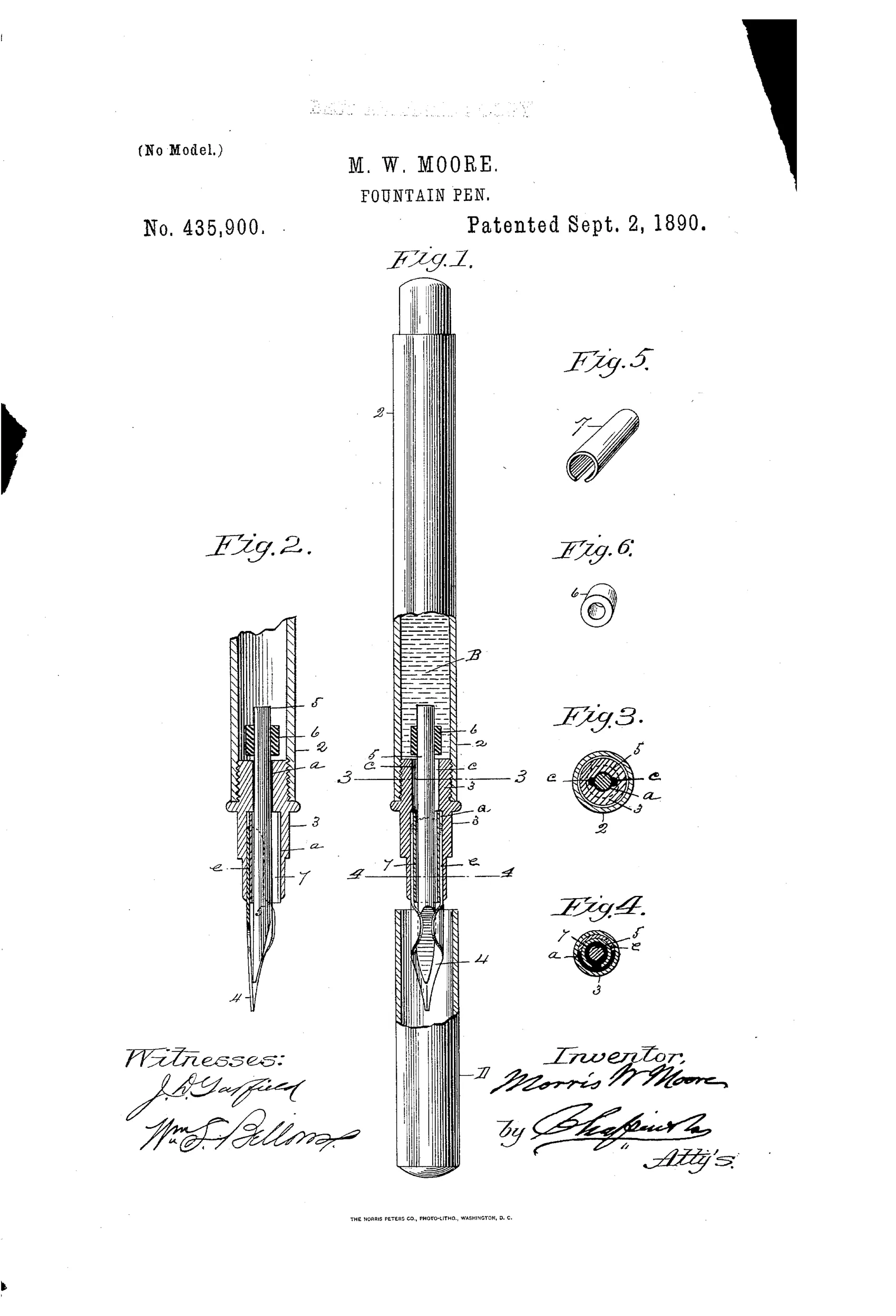
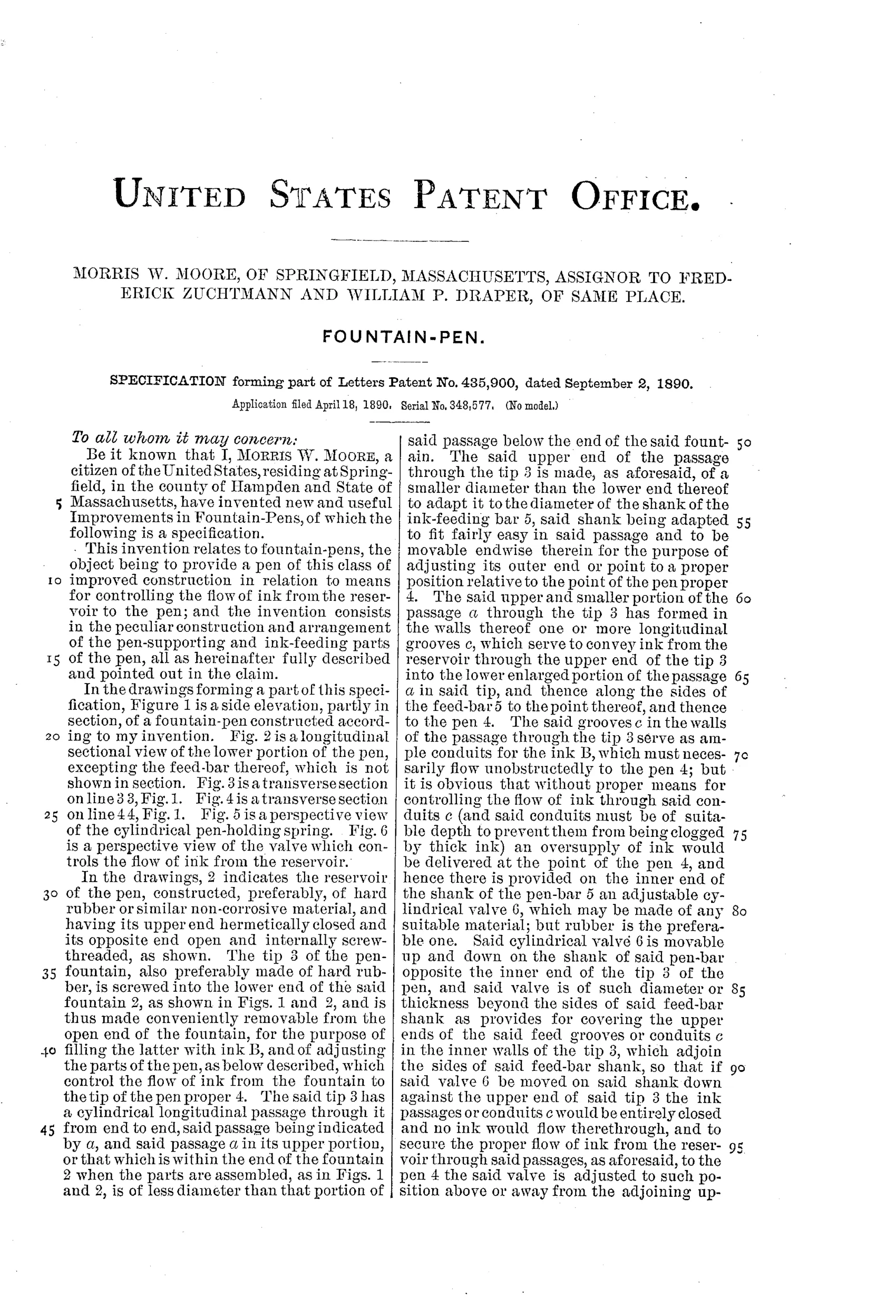
Adjustable ink-flow control mechanism for fountain pens
✒ How it works
The pen's tip has a longitudinal passage with grooves cut into its inner walls, which act as conduits carrying ink from the hard rubber reservoir down to the pen point. A feed-bar extends through this passage, and a movable cylindrical valve is fitted onto the shank of the feed-bar so it can slide up or down to cover or uncover the grooves. Sliding the valve toward the tip closes off the ink-conducting grooves entirely, while moving it away allows ink to flow through the conduits and along the feed-bar to the nib. A separate cylindrical spring inside the tip's enlarged passage frictionally grips the shank of the pen point to hold it firmly in place.
✒ What was claimed
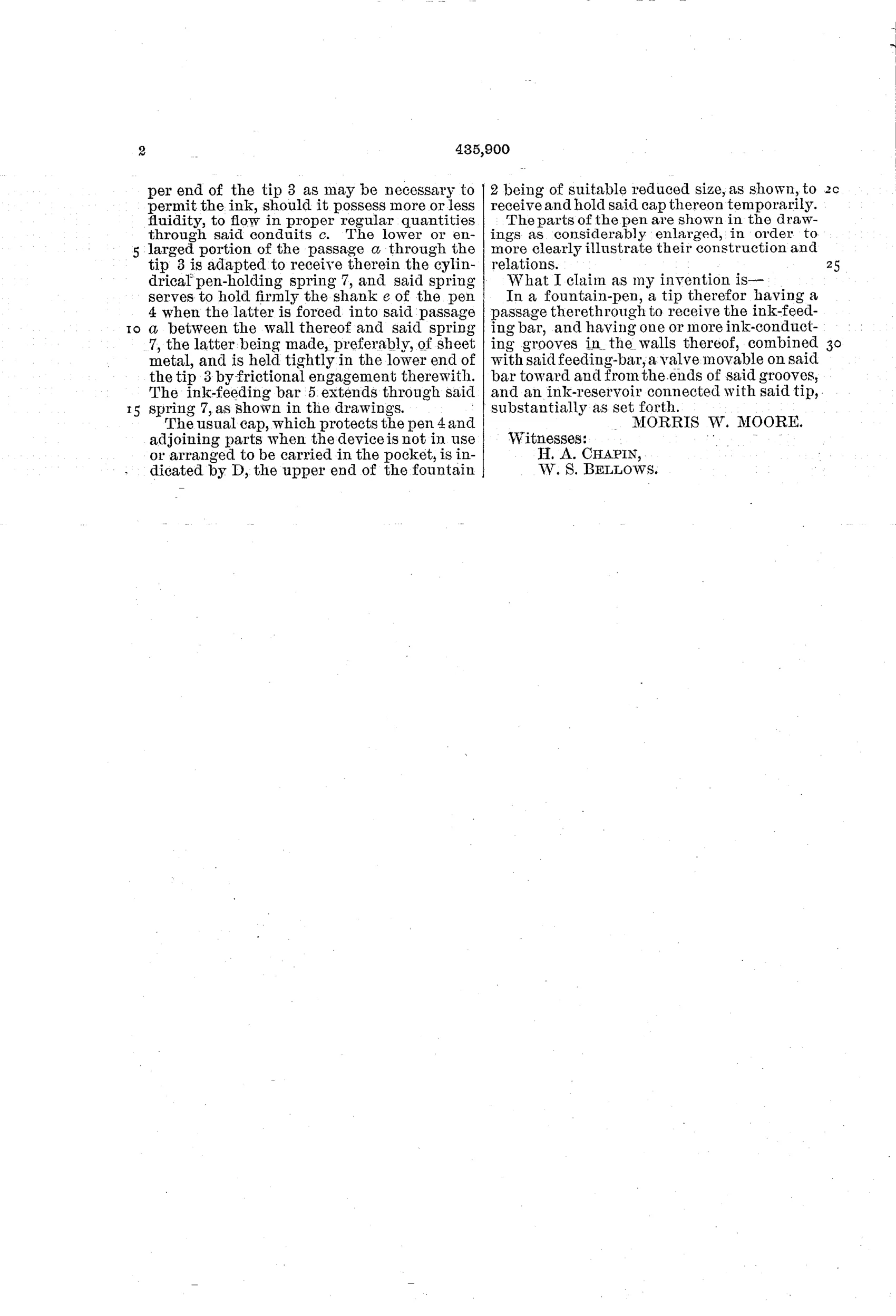
“In a fountain-pen, a tip therefor having a passage therethrough to receive the ink-feeding bar, and having one or more ink-conducting grooves in the walls thereof, combined with said feeding-bar, a valve movable on said bar toward and from the ends of said grooves, and an ink-reservoir connected with said tip, substantially as set forth.”
In plain English: The pen's tip contains a passage with ink-conducting grooves, paired with a feed-bar and a valve that slides along the bar to open or close those grooves, all connected to an ink reservoir.
✒ In the inventor’s words
“The parts of the pen are shown in the drawings as considerably enlarged, in order to more clearly illustrate their construction and relations.”— Morris W. Moore, from the specification
Fate unknown
Moore and assignee Zuchtmann later launched the celebrated Moore Non-Leakable safety pen, but that used his 1896 retracting-nib design; no production pen with this 1890 valve mechanism is documented, and a marked specimen would settle it.
✒ Commentary
Six years before Morris W. Moore patented the retracting-nib safety pen that carried his name into the twentieth century, here he is in Springfield working the same obsession from a different angle: how do you stop a fountain pen from leaking? His answer in 1890 is a tiny cylindrical valve (Fig. 6) riding on the shank of the feed-bar. Slide it toward the tip and it blankets the ink-conducting grooves cut into the passage walls; slide it back and ink flows again. It's a faucet inside the section.
The cross-sections in Figs. 3 and 4 are where the design earns its keep — you can see the grooves are in the tip's walls rather than in the feed itself, which is a genuine departure from the Waterman orthodoxy of fissures cut into the feed-bar. The other quiet detail is the split cylindrical spring of Fig. 5, a friction sleeve that grips the nib's shank. That's a maker thinking about assembly and nib replacement, not just theory.
As flow control, the idea is plausible but fussy: any valve sitting in the ink path is a valve that gums with dried ink, and it doesn't address evaporation or pocket-carry leakage the way Moore's later retractable design would. Read this as a first draft of a lifelong problem — the dead end that taught him where the real leak was.
Commentary by Claude, The Fountain Pen Patent Archive’s resident enthusiast