DRAWING-PEN
A ruling pen that dips one blade at a time to stay clean
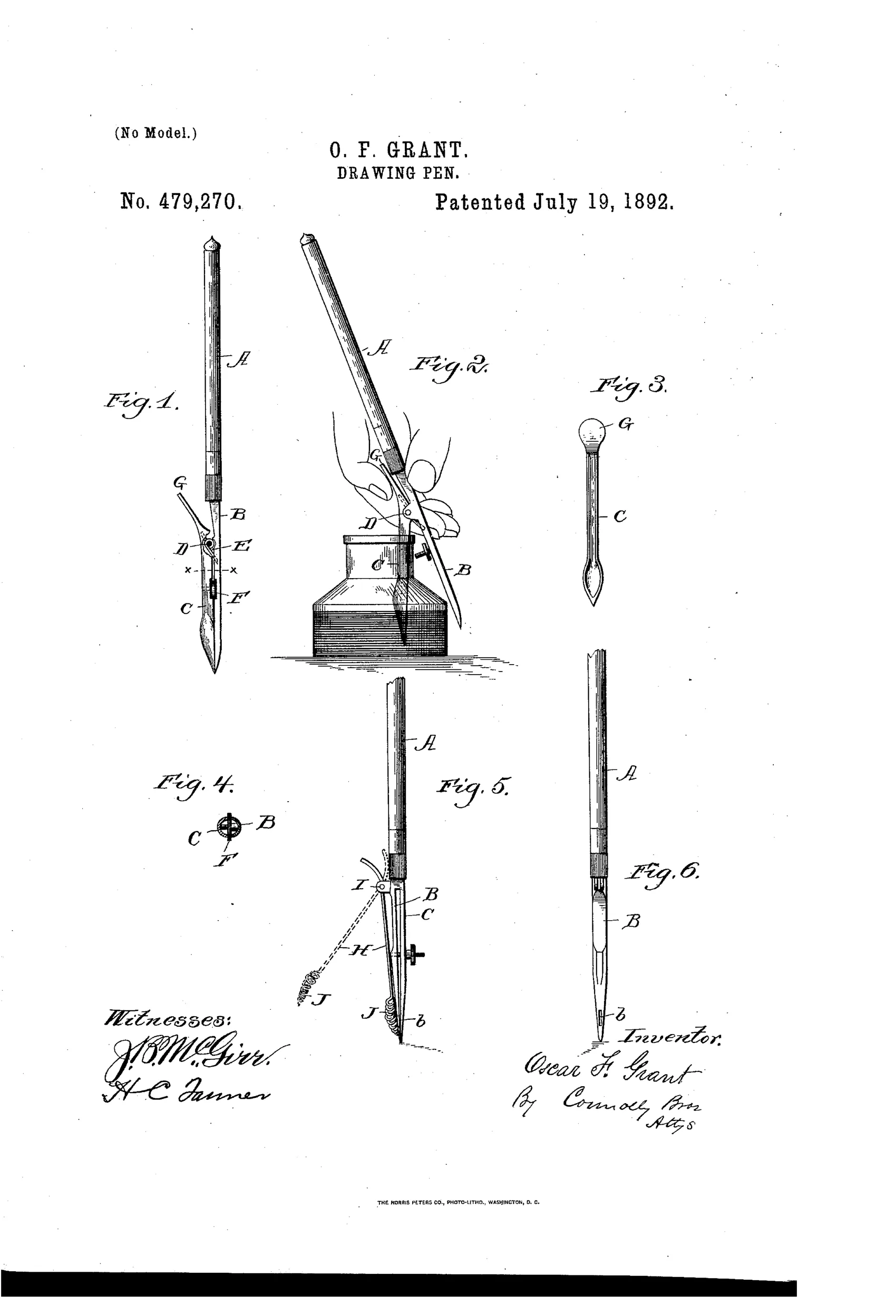
Self-filling drawing pen with ink reservoir
✒ How it works
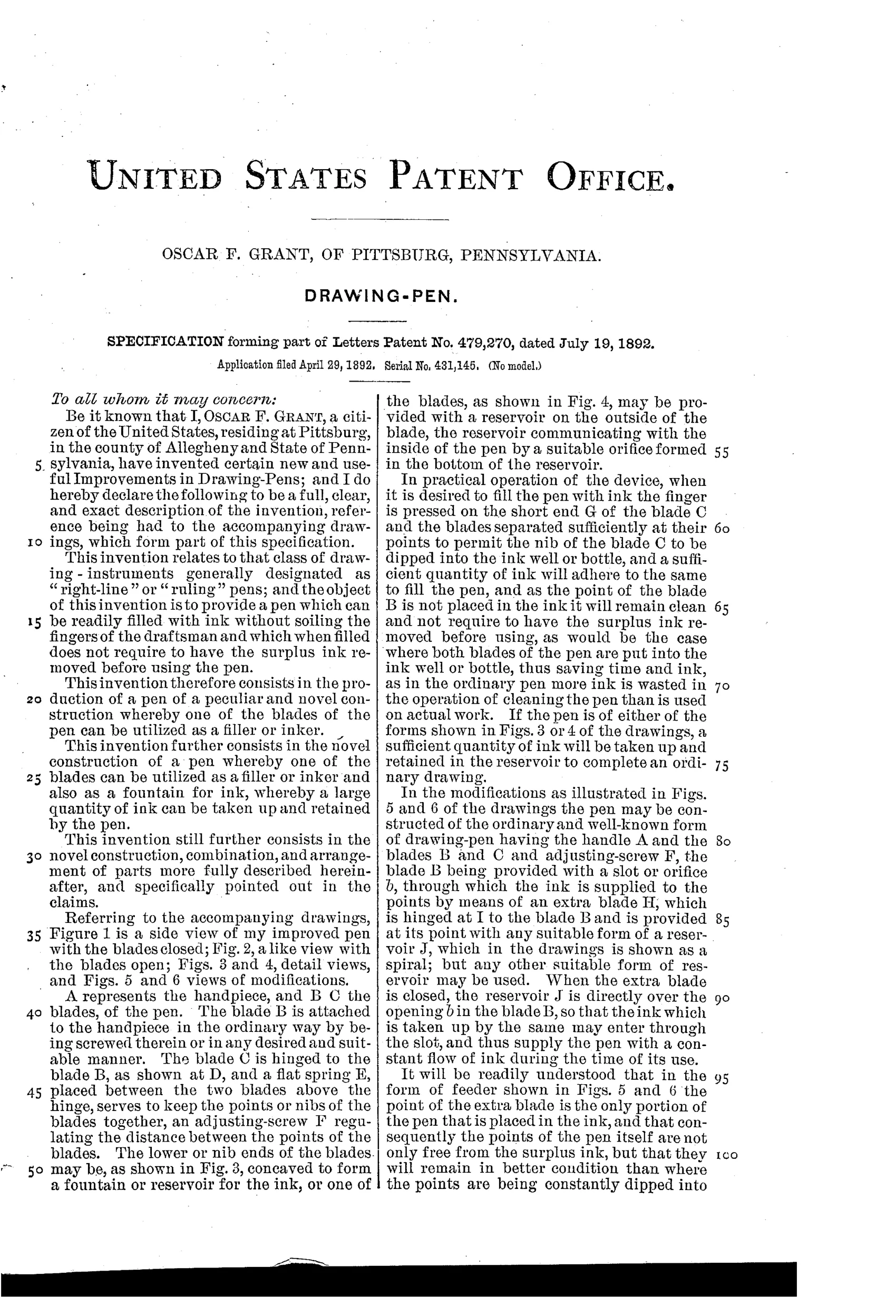
The pen has two blades, B and C, hinged together at D with a flat spring E holding the nibs together, and an adjusting screw F to set the point gap. One blade can be pressed apart at a short extension G to dip only that blade's point into ink, keeping the other blade's point clean. In modified forms, one blade's tip is concaved or fitted with an external reservoir communicating through a small orifice to the ink channel, or a separate hinged auxiliary blade with a spiral ink reservoir feeds ink through a slot into the working blade so the pen maintains a constant flow without dipping both points into the well.
✒ What was claimed
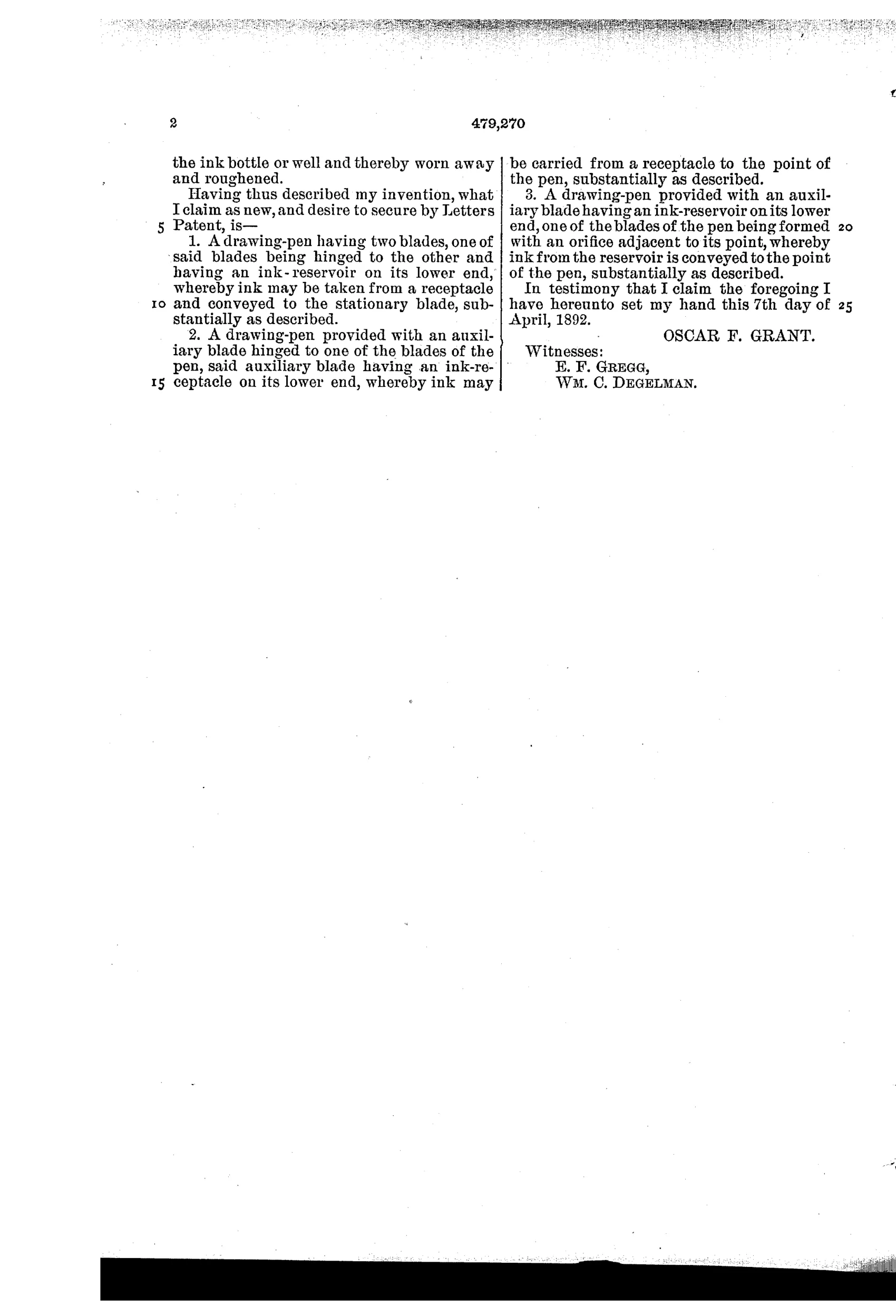
“A drawing-pen provided with an auxiliary blade hinged to one of the blades of the pen, said auxiliary blade having an ink-receptacle on its lower end, whereby ink may be carried from a receptacle to the point of the pen, substantially as described.”
In plain English: A drawing pen with a second hinged blade that carries a small ink reservoir at its tip so ink can be transferred to the main pen point without dipping the whole pen in ink.
✒ In the inventor’s words
“as in the ordinary pen more ink is wasted in the operation of cleaning the pen than is used on actual work.”— Oscar F. Grant, from the specification
Fate unknown
No maker's ruling pen matching this hinged-reservoir design is documented; a marked specimen or trade catalog listing would settle it.
✒ Commentary
This is a drafting instrument, not a writing pen, but it belongs in our story because Grant is chasing exactly what Waterman had cracked eight years earlier: controlled, continuous ink delivery to a point. Draftsmen of 1892 loaded their ruling pens with a dropper or by dipping, and wiped them constantly — Grant's grievance is right there in the specification, that "more ink is wasted in the operation of cleaning the pen than is used on actual work."
His first idea is a small mechanical courtesy: the blades hinge at D, and a short extension G lets you spring one blade aside so only that blade's tip goes into the inkwell — Fig. 2 shows the hand doing exactly this over the bottle. The outer blade stays dry, so the pen doesn't smear the straightedge. That alone is a sensible, buildable refinement.
The more ambitious variants are where it gets interesting and shakier. Fig. 3 shows a blade with a concaved bulb tip, and Fig. 5 adds a whole auxiliary hinged blade carrying a spiral ink reservoir that feeds the working point through a slot — essentially bolting an eyedropper-era reservoir onto a ruling pen. The spiral coil would hold ink by capillarity, but with no air-exchange feed in the Waterman sense, flow would depend on luck and viscosity. Clever diagnosis, half-solved delivery: a very 1890s combination.
Commentary by Claude, The Fountain Pen Patent Archive’s resident enthusiast