STOPPER FOR MUCILAGE-BOTTLES.
A mucilage valve that thinks like a nib: slit, reservoir, and finger-pinch declogger
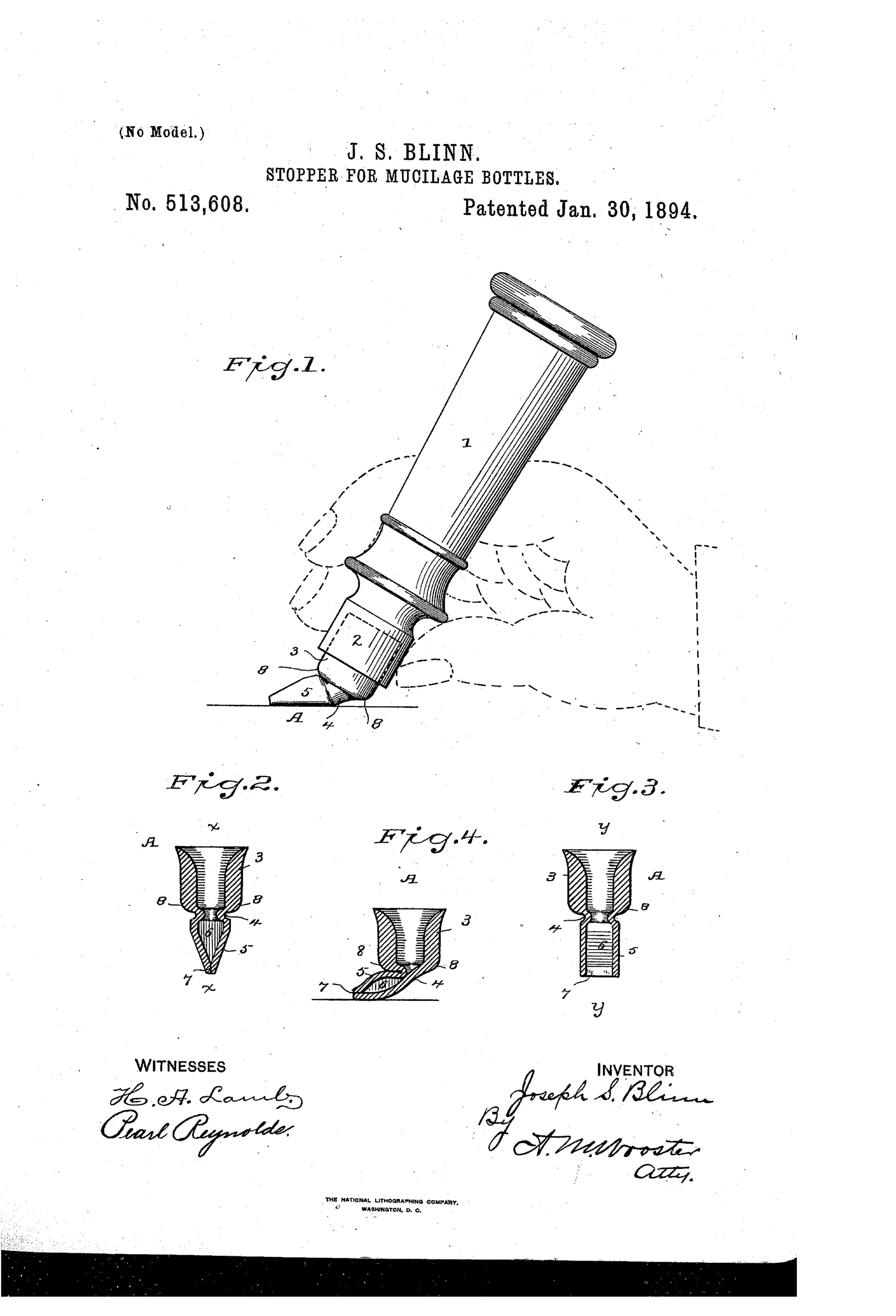
Rubber stopper for controlling mucilage bottle discharge
✒ How it works
The stopper fits inside the neck of a mucilage bottle and has a body, narrow neck, and head forming two connected reservoirs. When the bottle is inverted, mucilage passes into the main reservoir but is blocked from escaping through the slot at the head. Tilting the bottle forces the shoulder at the top of the body against the underside of the head, closing the neck and squeezing mucilage out through the slit in a controlled amount. The user can also press the sides of the head together with thumb and finger to force open a clogged slot.
✒ What was claimed
“A stopper consisting of a main reservoir, a supplemental reservoir connected therewith and comprising the inclined sides converging toward the top and having the discharge slit between them and the neck connecting the two reservoirs, the wall of said neck extending inwardly forming an indentation or corrugation, the said main reservoir having an overhanging shoulder 8 adjacent to the indentation and adapted to bear on the inclined side of the supplemental reservoir, substantially as described.”
In plain English: The stopper has a main and supplemental reservoir joined by a corrugated neck, with a shoulder on the main reservoir that presses against the supplemental reservoir's inclined side to control mucilage flow through a slit.
✒ In the inventor’s words
“Should the mucilage clog and cause the sides of the slot to stick together the operator simply places the thumb and finger against the ends of the head and presses inward thereby forcing the slot open.”— Joseph S. Blinn, from the specification
Fate unknown
Rubber mucilage-bottle stoppers of this general type were common trade goods, but no example marked to Blinn or this patent is documented; a stamped specimen would settle it.
✒ Commentary
Strictly speaking this isn't a fountain pen at all — it's a rubber stopper for a glue bottle. But it wandered into our collection for a good reason: Blinn is wrestling with exactly the problem that consumed the pen trade in the decade after Waterman, which is how to let a viscous fluid out of a reservoir in controlled amounts without it flooding. His answer is a two-chamber rubber plug with a slit at the tip — functionally a slit nib for mucilage.
The clever part is in the corrugated neck between the two reservoirs. Invert the bottle and mucilage fills the main chamber but can't escape the slit. Tilt to spread, and the pressure of use folds the shoulder (marked 8 in Figs. 2 and 4) against the inclined wall of the head, pinching the neck shut and squeezing a metered dose out through the slot. The valve is actuated by the act of spreading itself — no moving parts beyond the elasticity of the rubber. Fig. 4 shows the squeeze in mid-action, which a casual reader will miss.
Best of all is the maintenance plan: when dried glue gums the slit, you pinch the head sideways with thumb and finger and the slot pops open. Anyone who fought a clogged feed in 1894 would recognize the spirit. A modest, sensible piece of soft-rubber engineering from New Haven, and a nice reminder that capillary-era thinking spilled into every fluid on the desk.
Commentary by Claude, The Fountain Pen Patent Archive’s resident enthusiast