FOUNTAIN-PEN.
A nib that opens its own ink valve — press harder, get more ink
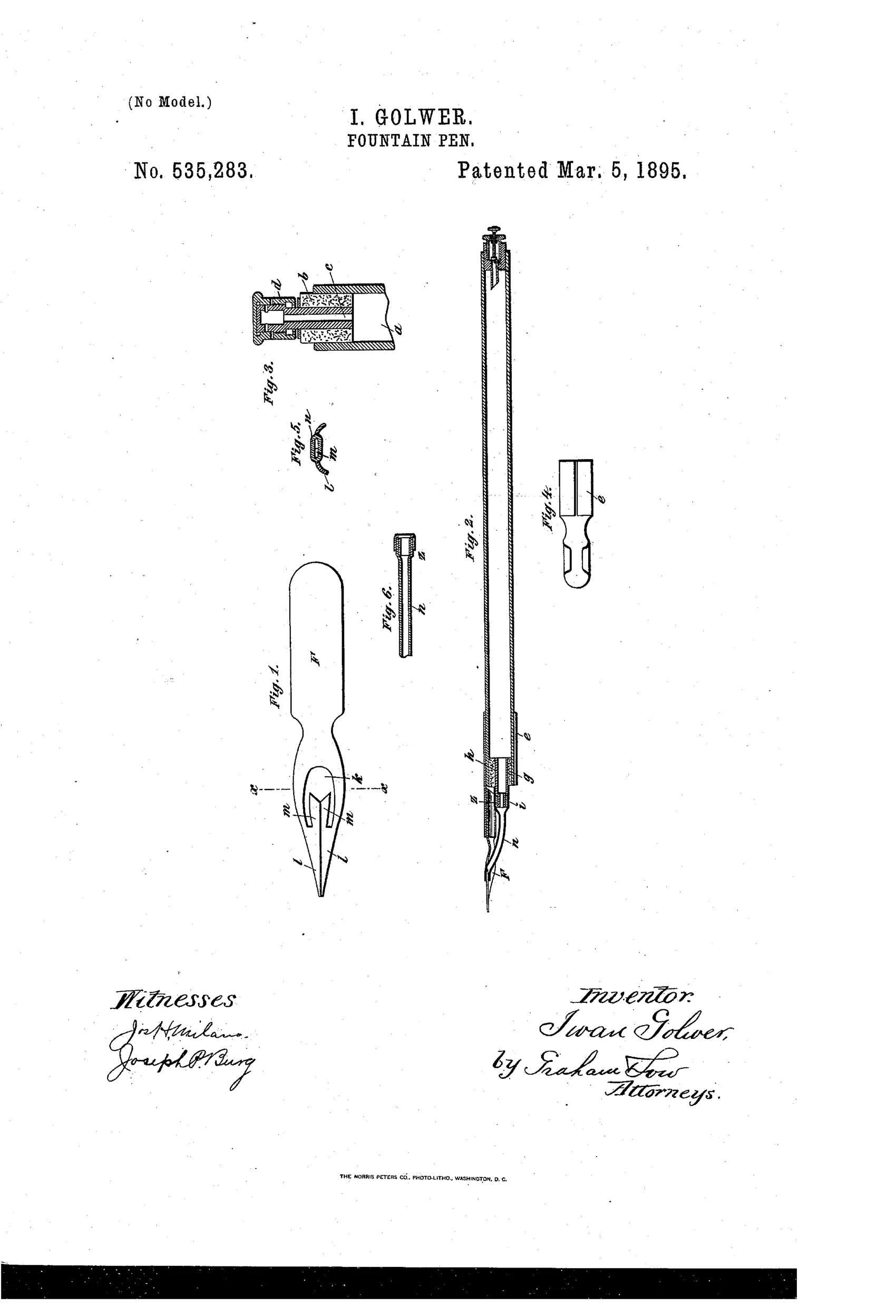
Self-regulating fountain pen with pressure-controlled ink flow
✒ How it works
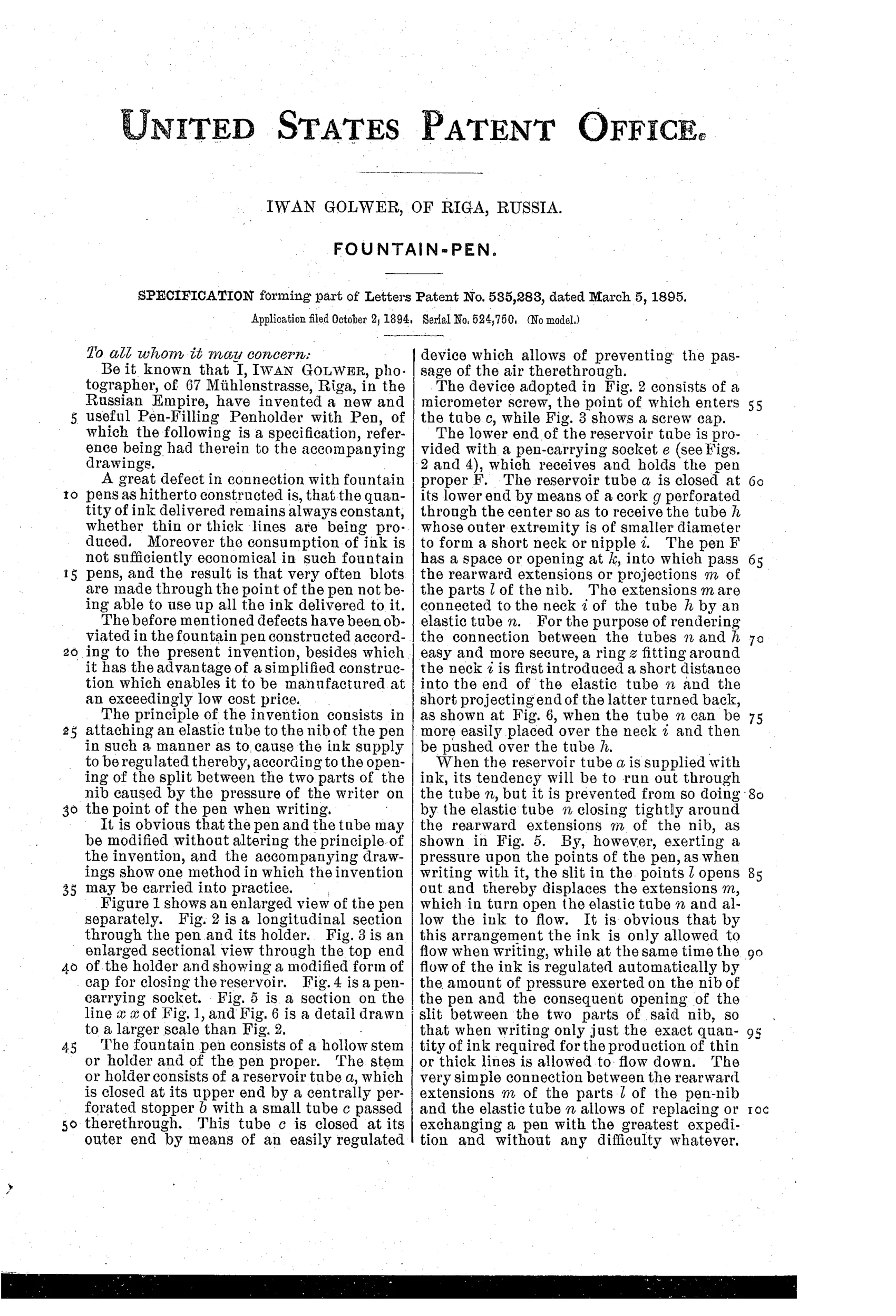
The pen holder consists of a reservoir tube closed at the top by a perforated stopper carrying a small regulated air-inlet tube, and closed at the bottom by a perforated cork through which a smaller tube passes to a nipple. An elastic tube is stretched over this nipple and connects to rearward projections extending from the two halves of the split pen nib, which sit in a pen-carrying socket at the tube's end. When the writer presses on the nib during writing, the slit between the two nib parts opens, displacing the rearward projections outward; this in turn stretches open the elastic tube and allows ink to flow, with the amount of flow automatically proportioned to the pressure applied and hence to the thickness of line being drawn. When pressure is released the elastic tube contracts and closes tightly around the projections, stopping ink flow and preventing blots.
✒ What was claimed
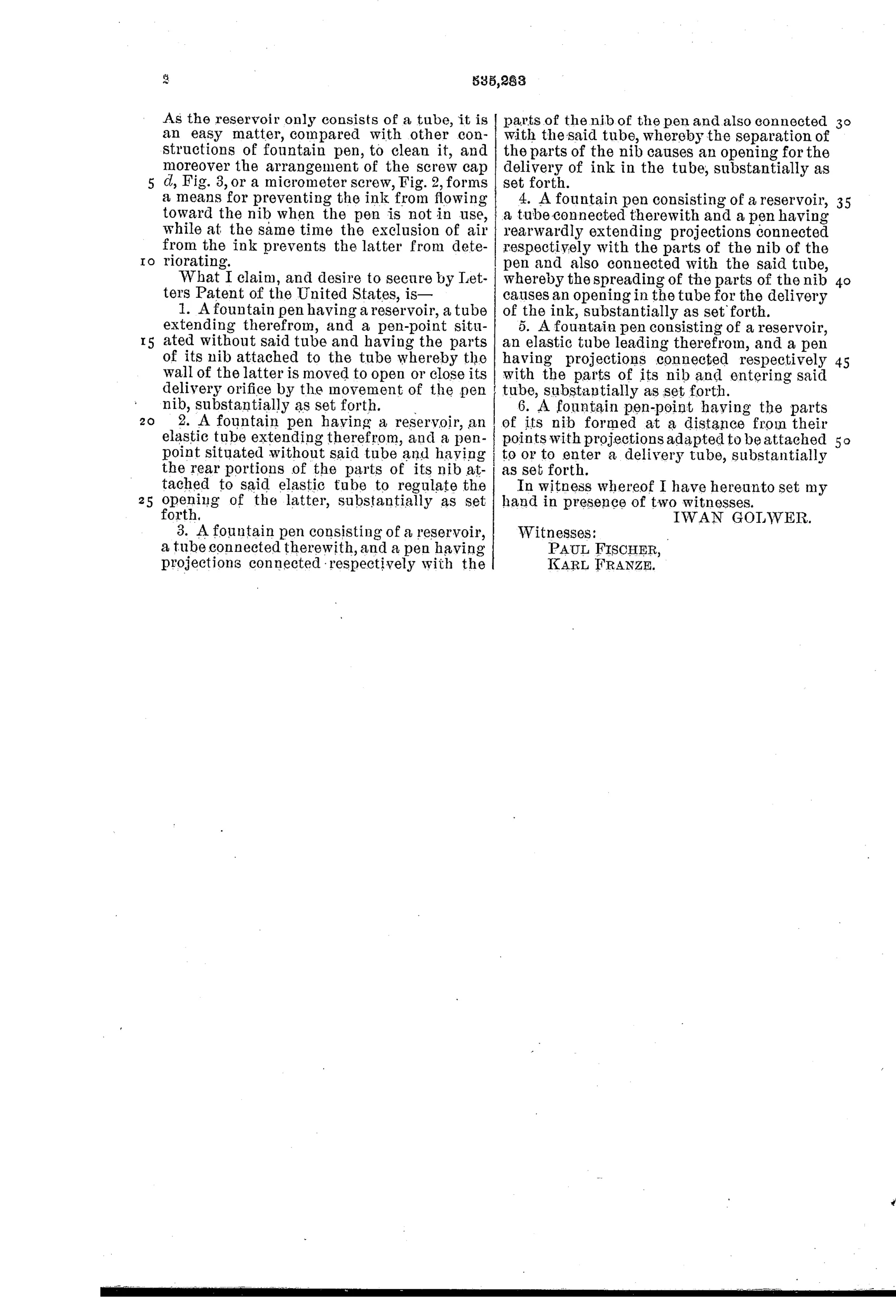
“1. A fountain pen having a reservoir, a tube extending therefrom, and a pen-point situated without said tube and having the parts of its nib attached to the tube whereby the wall of the latter is moved to open or close its delivery orifice by the movement of the pen nib, substantially as set forth.”
In plain English: A fountain pen whose nib parts are attached to a flexible delivery tube so that movement of the nib during writing opens or closes the tube to control ink flow.
✒ In the inventor’s words
“A great defect in connection with fountain pens as hitherto constructed is, that the quantity of ink delivered remains always constant, whether thin or thick lines are being produced.”— Iwan Golwer, from the specification
Paper patent — likely never produced
No maker is known to have produced a valve-nib pen of this type, and the ink-immersed elastic tube makes durable production implausible; a marked specimen would overturn this.
✒ Commentary
Golwer, writing from Riga, puts his finger on a genuine complaint: the feeds of 1894 delivered ink at one rate no matter what your hand was doing. His answer is to make the nib itself the valve. Each half of the split nib carries a projection reaching back into a small elastic rubber tube that connects to the reservoir. At rest the tube clamps shut around those projections and nothing flows. Bear down, the tines spread, the projections pry the rubber tube open, and ink comes through in proportion to your pressure. Flex harder for a broad line, get more ink to fill it. It is a closed-loop feed a century before anyone used that phrase.
Fig. 6 is the part worth studying — the tube-and-projection joint that does all the work. And that joint is also the problem. A rubber sleeve a few millimeters long must seal reliably against ink, flex thousands of times, and survive the ink chemistry of the era, which was murder on soft rubber. When it perishes or takes a set, the pen either starves or floods, and there is no capillary feed underneath to catch it.
Waterman had already shown that a passive channel feed with proper air exchange solved the flow problem more simply. Golwer's valve-nib is the road not taken — clever, honestly motivated, and mechanically doomed by its one perishable part.
Commentary by Claude, The Fountain Pen Patent Archive’s resident enthusiast