IMPROVEMENT IN FOUNTAIN-PEN HOLDERS AND NIBS
An 1848 squeezable rubber ink sac — the self-filler idea, sixty years early
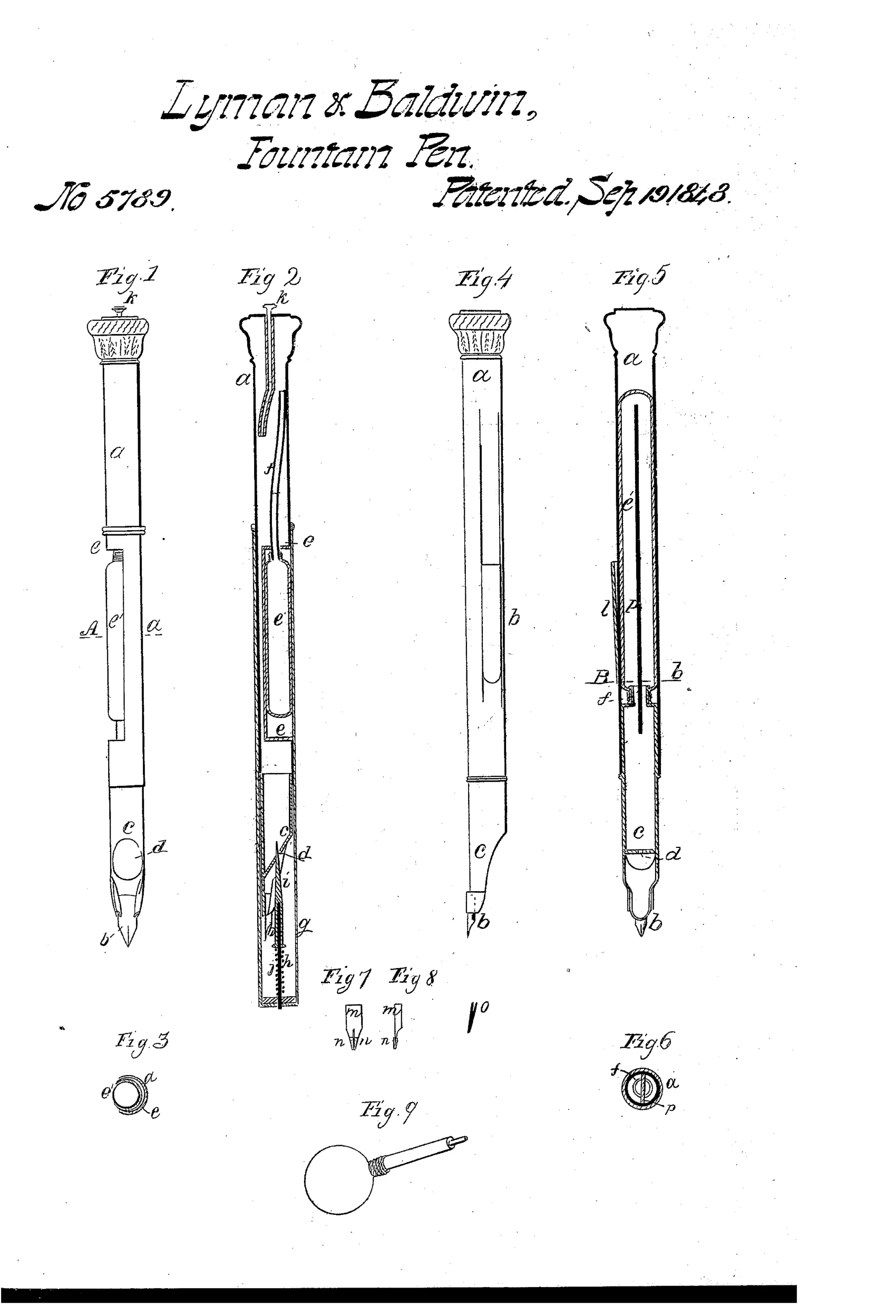
Early fountain pen with elastic ink reservoir and metal-tipped quill nib
✒ How it works
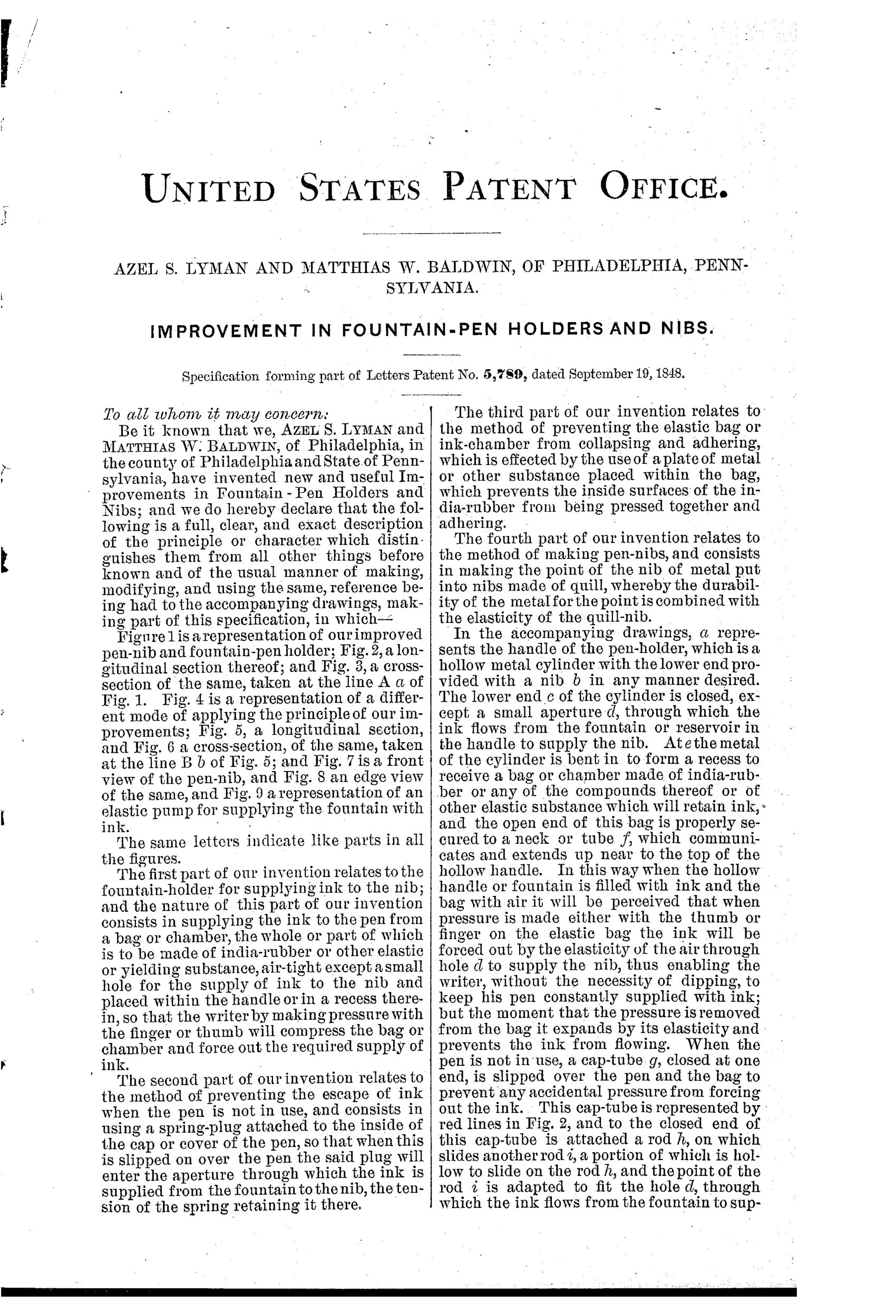
Ink is stored in the hollow metal handle and also in an india-rubber bag or chamber recessed into the handle, connected by a neck tube. Pressing the elastic bag with thumb or finger forces ink through a small aperture to feed the nib, and releasing the pressure lets the bag re-expand and stop the flow, avoiding the need to dip the pen. A spring-loaded plug in the cap enters the ink aperture when the cap is slipped on, sealing it against leakage for pocket carry. The quill nib is reinforced by bending thin sheet metal (gold or silver) over its point and riveting it in place, combining the durability of metal with the elasticity of quill; a metal strip inside the bag prevents its walls from collapsing and sticking together, and an india-rubber bulb pump refills the fountain through a hole closed by a ground-plug when not in use.
✒ What was claimed
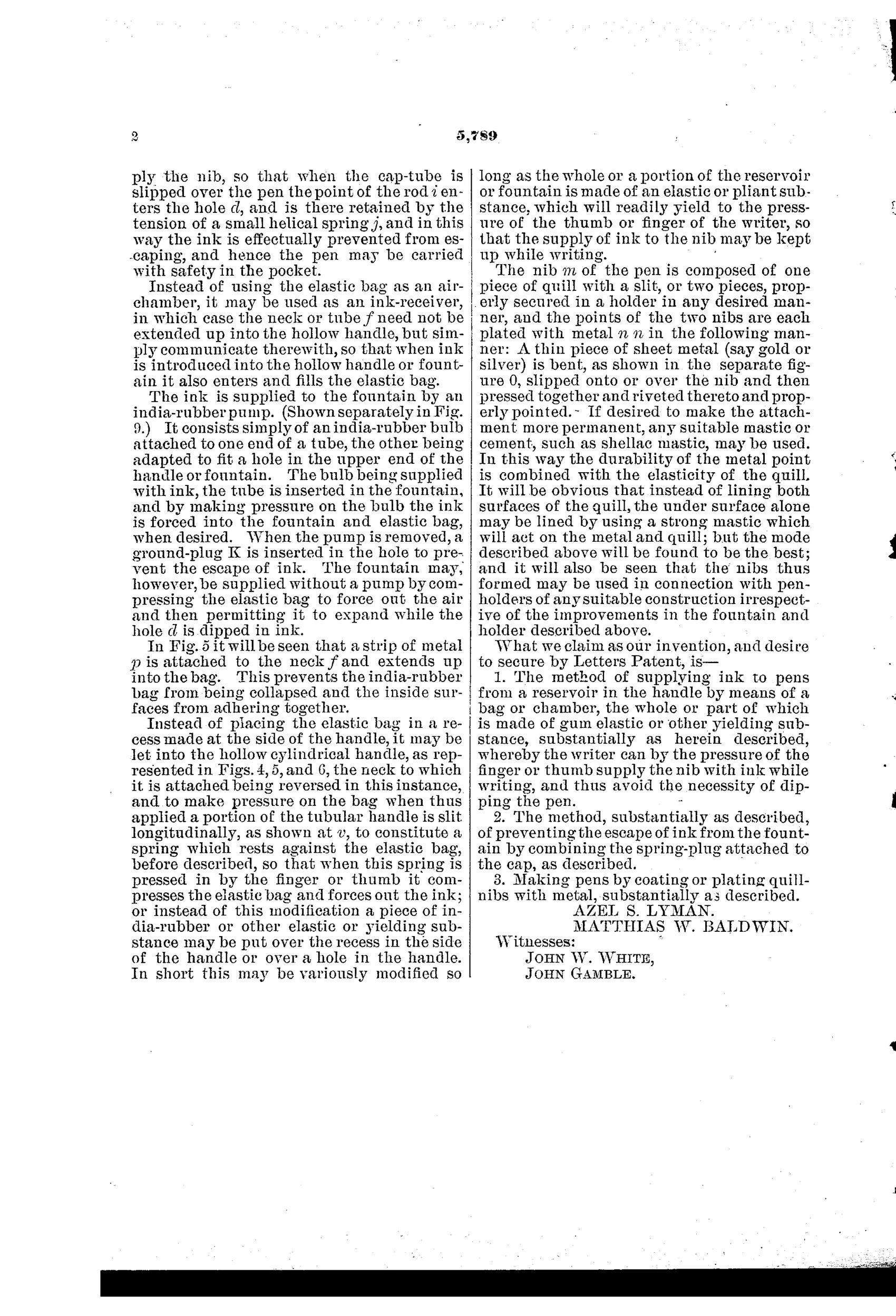
“1. The method of supplying ink to pens from a reservoir in the handle by means of a bag or chamber, the whole or part of which is made of gum elastic or other yielding substance, substantially as herein described, whereby the writer can by the pressure of the finger or thumb supply the nib with ink while writing, and thus avoid the necessity of dipping the pen.”
In plain English: A pen that feeds ink to the nib from a squeezable elastic bag inside the handle, letting the writer supply ink by finger pressure instead of dipping.
✒ In the inventor’s words
“When the pen is not in use, a cap-tube g, closed at one end, is slipped over the pen and the bag to prevent any accidental pressure from forcing out the ink.”— Azel S. Lyman and Matthias W. Baldwin, from the specification
Paper patent — likely never produced
No surviving example is documented, and pre-Waterman reservoir pens of this complexity almost never reached production; a marked specimen would be a major find.
✒ Commentary
Thirty-six years before Waterman made the fountain pen respectable, Lyman and Baldwin of Philadelphia put an india-rubber bag inside the handle and told the writer to squeeze it. Press with the thumb, ink goes to the nib; let go, the bag re-expands and the flow stops. That is on-demand feeding, and it is remarkable how much of the later self-filler era is latent in this one drawing. The metal strip inside the bag to keep its walls from sticking together is exactly the pressure-bar problem Conklin and Sheaffer would still be solving in 1905, and the spring-loaded plug in the cap that seals the ink aperture for pocket carry is a serious, thought-through answer to the leak problem that killed most pre-Waterman pens.
The nib is its own curiosity: a quill point reinforced with thin gold or silver sheet bent over and riveted on, chasing the flex of quill with the durability of metal. Figs. 7 and 8 show it plainly — a transitional artifact from the moment steel and gold nibs were displacing quills. Fig. 9's rubber bulb pump for refilling is an eyedropper before the eyedropper.
The fatal flaw is the one everything of this era shared: no proper feed. Without capillary air exchange, flow depends entirely on the writer's thumb, and metering ink by finger pressure is a recipe for blots. A fascinating dead end that guessed right about the sac and wrong about everything downstream of it.
Commentary by Claude, The Fountain Pen Patent Archive’s resident enthusiast