FOUNTAIN-PEN.
A Swedish glass-bodied pen that regulates ink with a thumb-adjustable air valve, not a feed
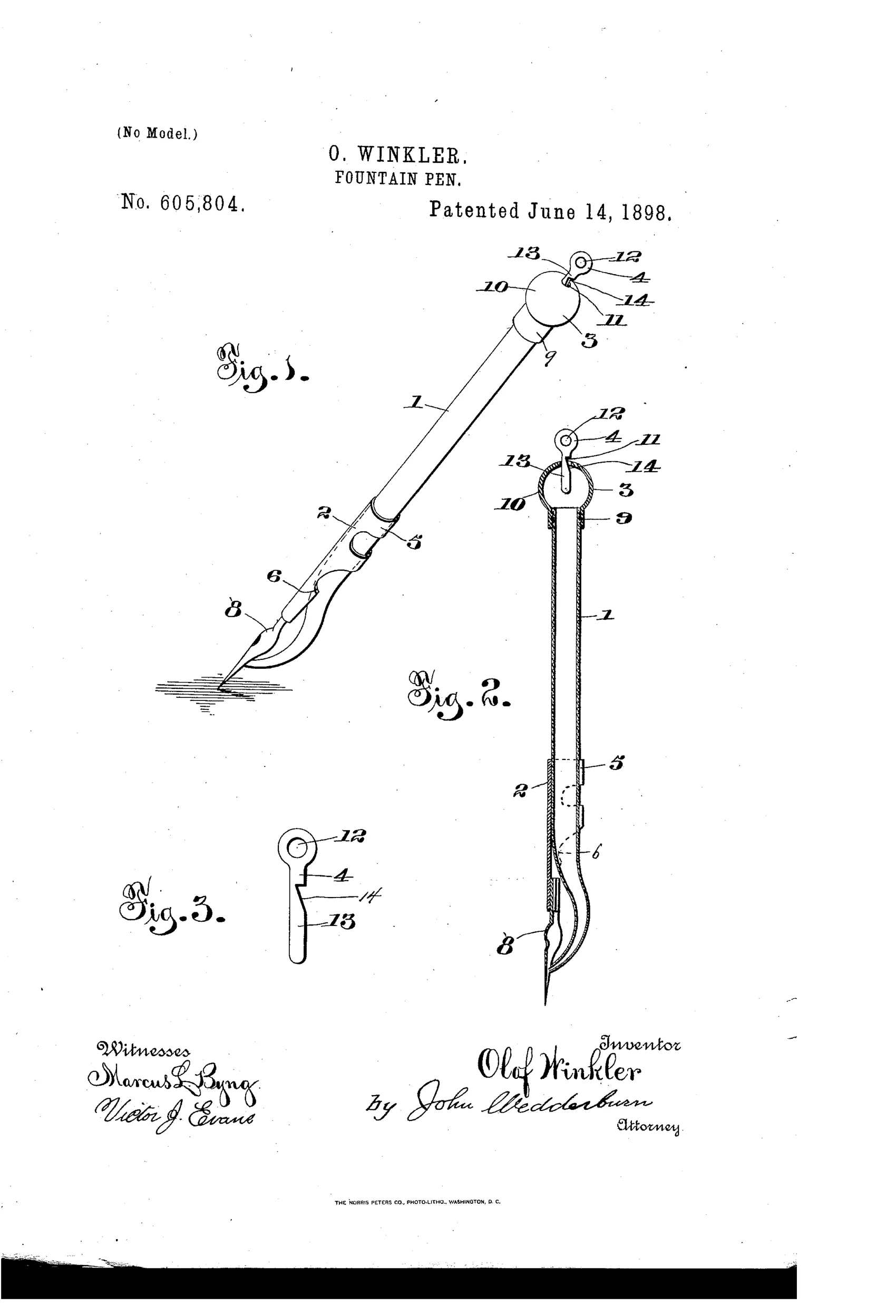
Glass reservoir fountain pen with adjustable air valve
✒ How it works
A hollow glass body holds ink and discharges it from a curved, reduced lower end that flows laterally into the pen nib held by a metal clamp. A flexible rubber bulb-cap seals the upper end and, when compressed and released, draws ink into the body through the lower discharge end. An adjustable plug-valve with an inclined recess passes through an aperture in the bulb-cap; sliding this plug in or out varies or completely shuts off the air inlet to the bulb, thereby controlling and regulating the flow of ink onto the pen. The metal pen-clamp uses spring clamping-arms to grip the cylindrical glass body without the ink ever touching the metal, preventing corrosion or discoloration.
✒ What was claimed
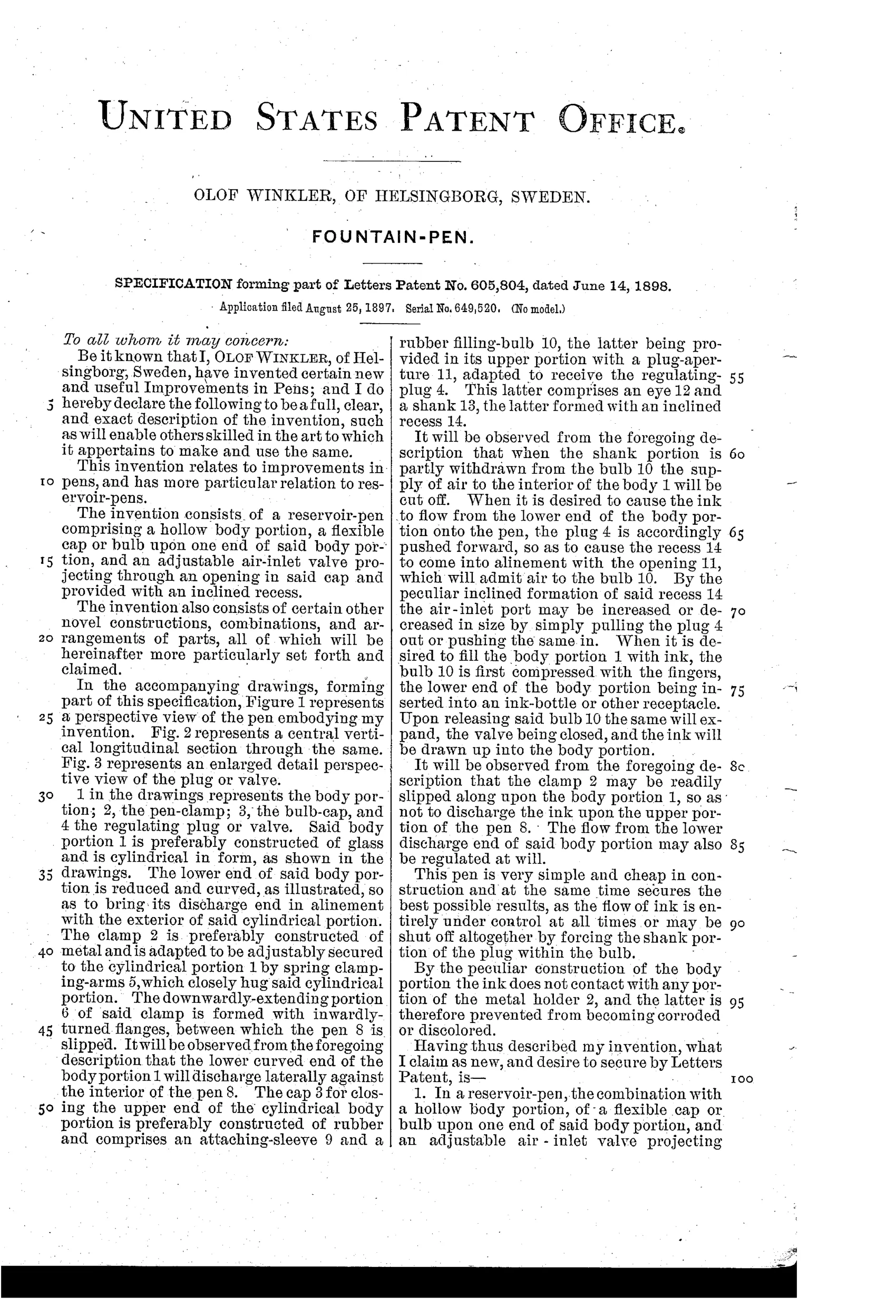
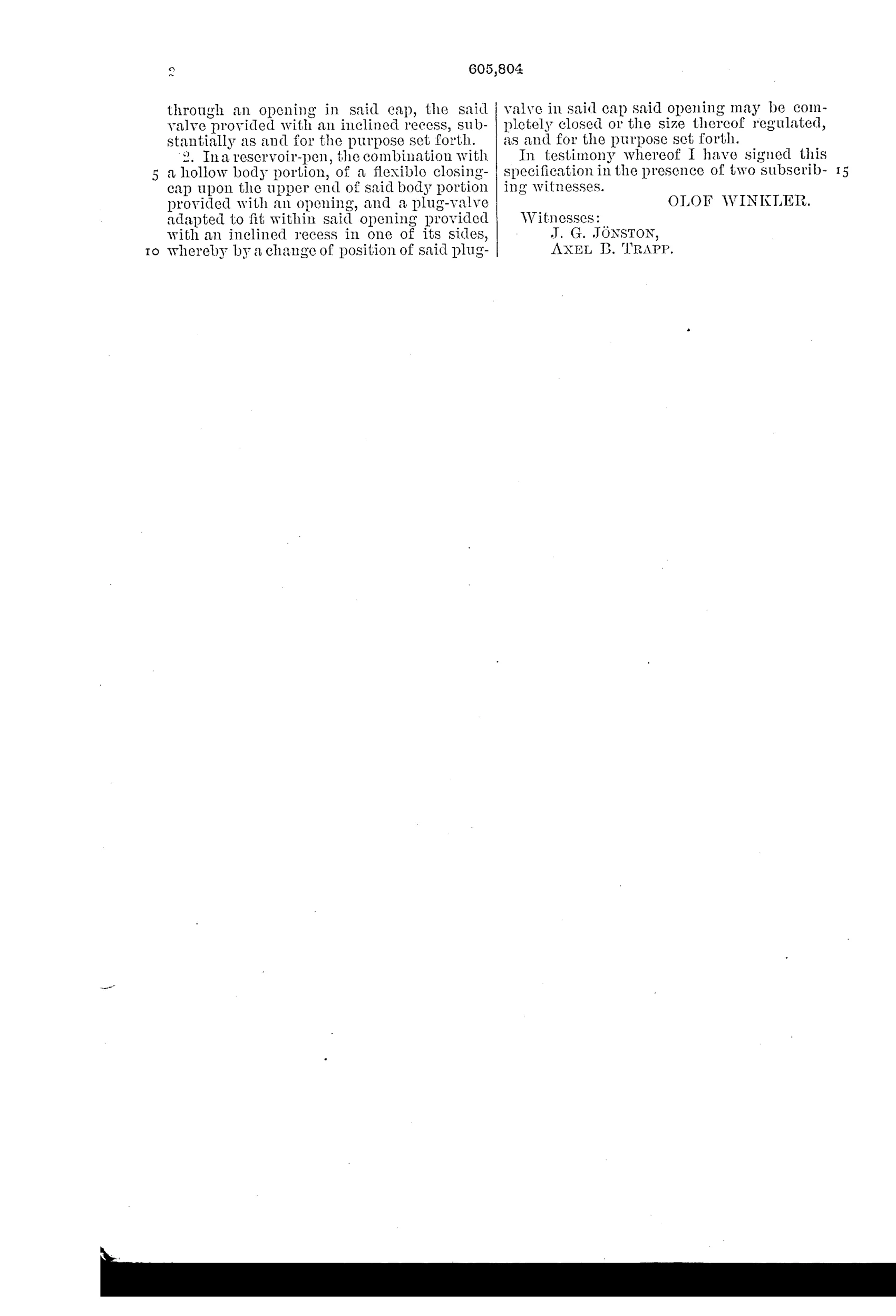
“In a reservoir-pen, the combination with a hollow body portion, of a flexible cap or bulb upon one end of said body portion, and an adjustable air-inlet valve projecting through an opening in said cap, the said valve provided with an inclined recess, substantially as and for the purpose set forth.”
In plain English: The pen combines a hollow ink body, a flexible bulb cap on one end, and an adjustable air-inlet valve with a slanted recess passing through the cap to regulate air and ink flow.
✒ In the inventor’s words
“By the peculiar construction of the body portion the ink does not contact with any portion of the metal holder 2, and the latter is therefore prevented from becoming corroded or discolored.”— Olof Winkler, from the specification
Paper patent — likely never produced
No maker or surviving example is known, and a hand-regulated glass-barreled pen runs against everything the market was buying by 1898; a marked specimen would be a real surprise.
✒ Commentary
By 1898 the settled answer to fountain-pen flow was Waterman's capillary feed: fine channels that trade air for ink automatically, no user attention required. Olof Winkler of Helsingborg proposes the opposite philosophy. His pen has essentially no feed at all — a glass reservoir tapers to a curved discharge tip that drops ink laterally onto the nib, and the writer regulates flow by hand, sliding a tiny plug valve (Fig. 3) through the rubber bulb-cap at the top. The plug's inclined recess acts as a variable air inlet: push it in and the pen is sealed; ease it out and air bleeds in, letting ink descend. It is a manually throttled eyedropper, a decade after the industry decided throttling should be automatic.
The drawing rewards a close look at Fig. 2. The metal holder never touches ink — the glass body carries ink all the way to the nib, gripped only externally by spring clamping-arms. That is a genuinely thoughtful detail in an era of corroding fittings and iron-gall ink, and glass is inert where hard rubber stains. The bulb doubles as a filler: squeeze, dip, release.
But the whole scheme asks the user to be the feed. Air pressure, temperature, and ink level all shift the balance, so the correct valve setting changes as you write. Add a glass barrel's fragility in a coat pocket, and this reads as an elegant refusal of the lesson Waterman had already taught.
Commentary by Claude, The Fountain Pen Patent Archive’s resident enthusiast