DETACHABLE FOUNTAIN OR RESERVOIR FOR PENS.
A clip-on ink reserve that doubles as an adjustable nib stiffener
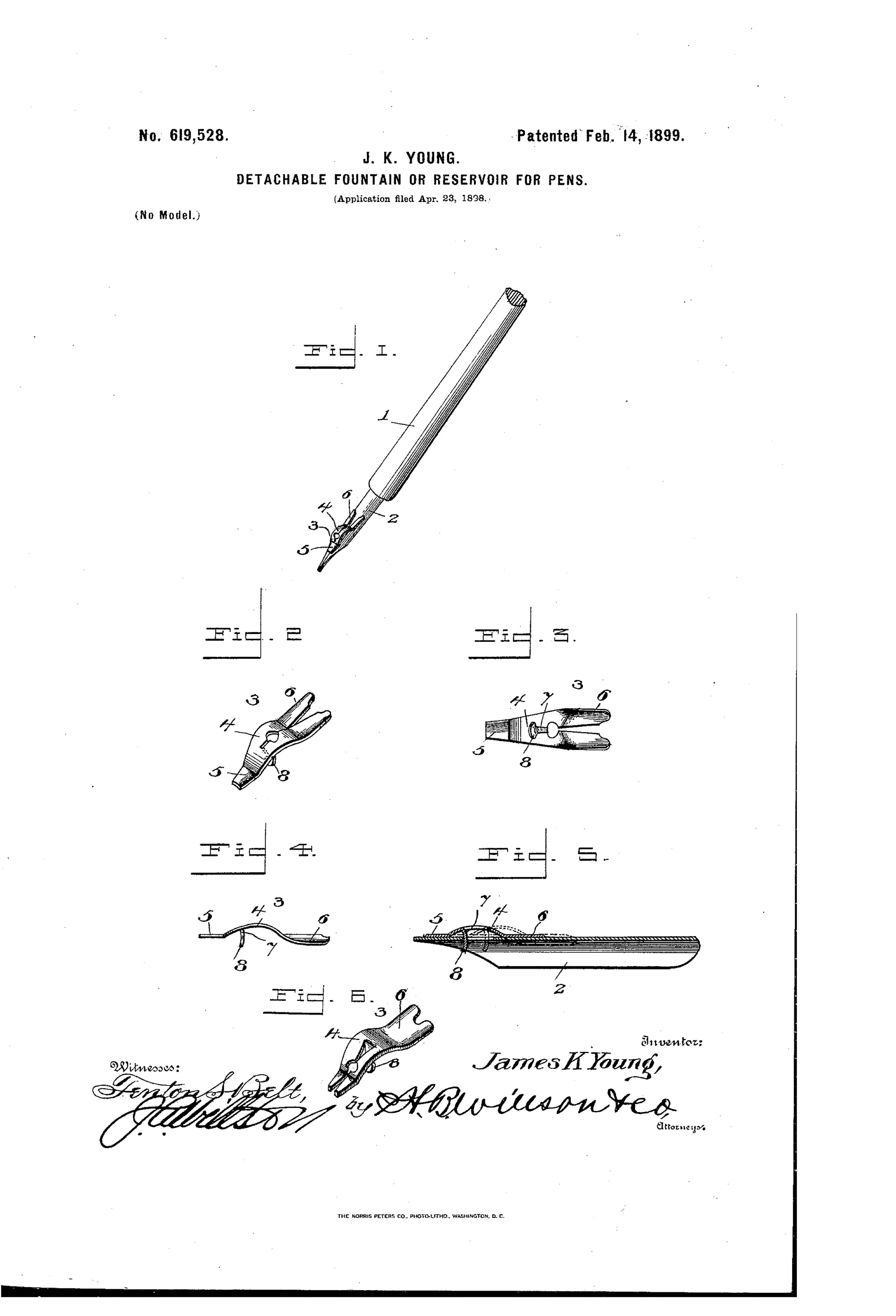
Clip-on ink reservoir attachment for dip pens.
✒ How it works
A single piece of stamped metal or celluloid forms an arched body that clips over the shank of an ordinary pen point, holding a reserve of ink against the nibs by capillary contact. A transversely-curved point (5) engages the nibs while a rearward transversely-curved portion (6) grips the shank, and a T-shaped tongue struck from the arch snaps through the slit or eye of the nibs to lock the fountain in place. Sliding the fountain toward the rear of the pen frees the nibs to spread for heavy strokes, while sliding it toward the point stiffens the nibs for fine lines. A modified form (Fig. 6) forms the T-head by slitting the arch in the opposite direction.
✒ What was claimed
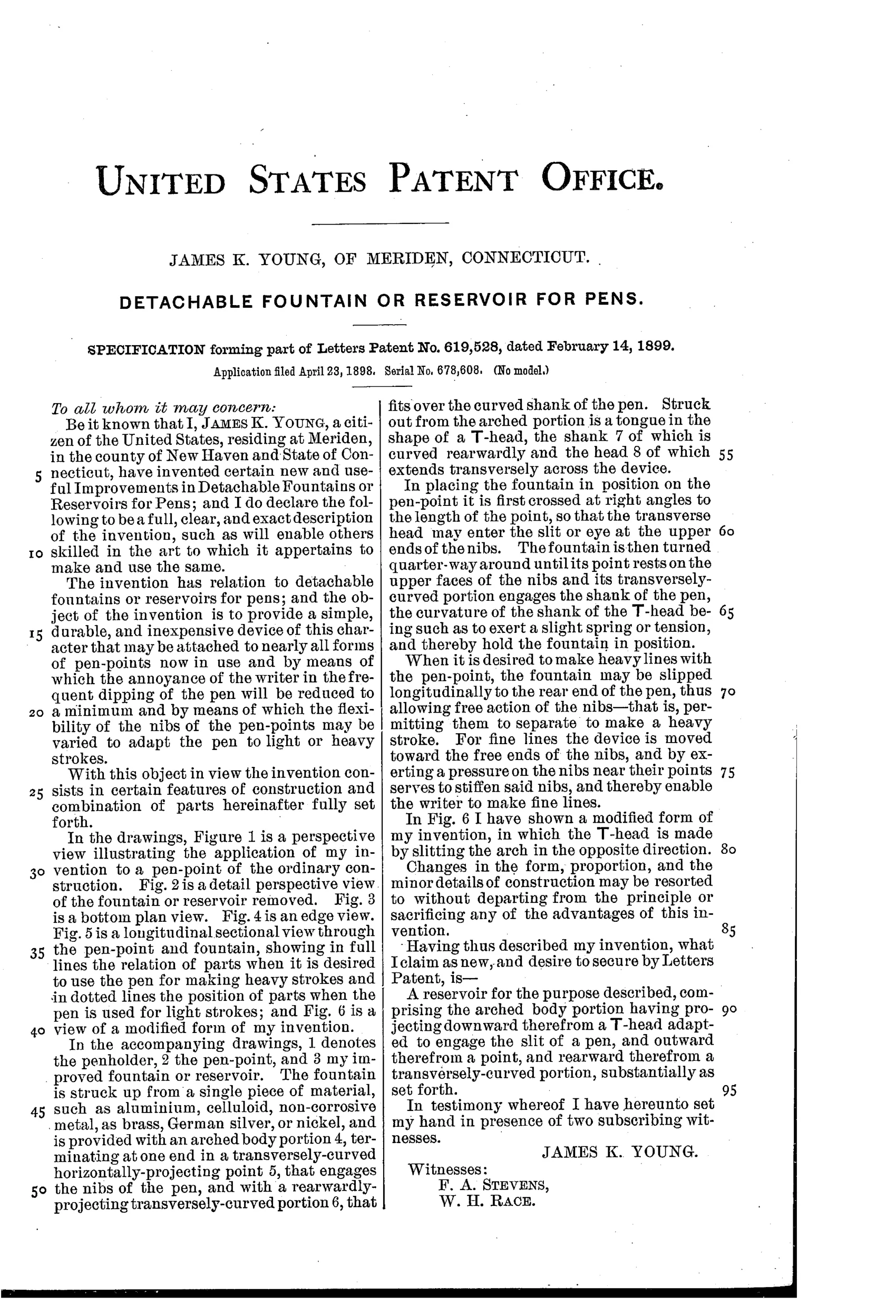
“A reservoir for the purpose described, comprising the arched body portion having projecting downward therefrom a T-head adapted to engage the slit of a pen, and outward therefrom a point, and rearward therefrom a transversely-curved portion, substantially as set forth.”
In plain English: The invention is an arched reservoir with a downward T-shaped tab that locks into a pen's slit, a forward point, and a curved rear portion that clips onto the pen shank.
✒ In the inventor’s words
“For fine lines the device is moved toward the free ends of the nibs, and by exerting a pressure on the nibs near their points serves to stiffen said nibs, and thereby enable the writer to make fine lines.”— James K. Young, from the specification
Fate unknown
Nib-mounted ink retainers were commonly manufactured in this era, but no Young-marked example is documented; a surviving stamped specimen with this T-head would settle it.
✒ Patented the same day
- FOUNTAIN-PEN — Arthur A. Waterman
✒ Commentary
This is not a fountain pen at all — it's a stamped clip that snaps onto an ordinary dip pen nib and holds a bead of ink against it by capillary contact. By 1899 that made it a deliberate sidestep of the whole Waterman revolution: instead of building a reliable feed into a barrel, Young offers the dip-pen crowd a cheap accessory that stretches each dip into a paragraph or two. Ink-retainer clips like this were a real, if minor, product category, sold for pennies to clerks who weren't ready to spend two dollars on a Waterman.
The genuinely clever bit is the T-shaped tongue struck out of the arched body, which passes through the nib's slit and twists to lock — a one-piece fastener with no solder, no screws, made in a single stamping operation. Fig. 5's cross-section shows how the arch traps ink in the pocket above the slit, exactly where the nib naturally draws from.
The second claim is the one a casual reader misses: sliding the clip forward presses the tines near the point and stiffens them for fine lines; sliding it back frees them to spread for shaded strokes. So the same piece of metal is both reservoir and adjustable flex control. Whether anyone actually fiddled with it mid-sentence is another matter, but as mechanical economy it's admirable. Historically it's a late entry in a dying accessory market, soon buried by self-fillers.
Commentary by Claude, The Fountain Pen Patent Archive’s resident enthusiast