FOUNTAIN-PEN
The other Waterman: a feed that stays wet by drilling tiny pits in it
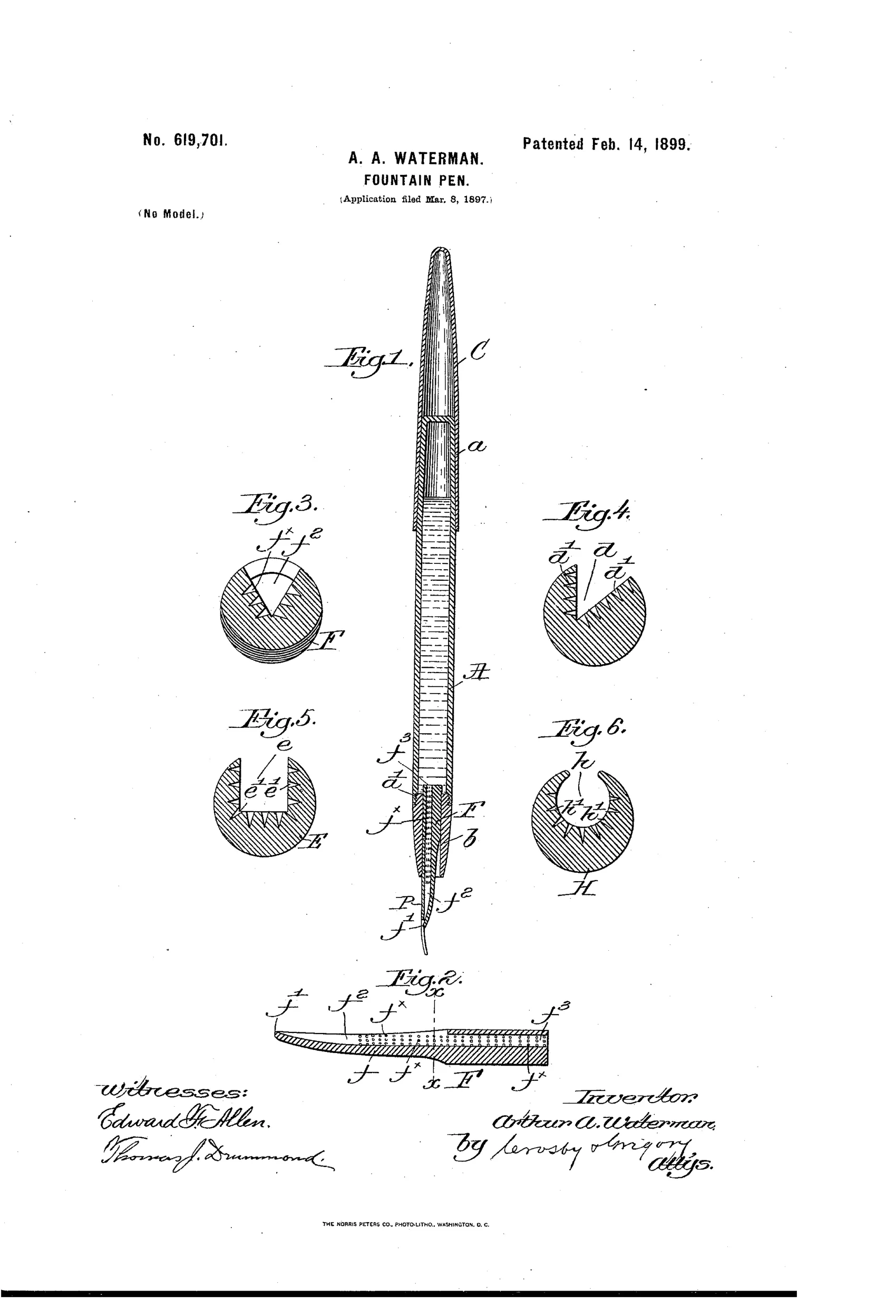
Fountain pen feed with ink-storage pits
✒ How it works
A tubular rubber pen body holds an ink reservoir that feeds a nib through a removable feed-bar seated in a threaded holder. The feed-bar has a longitudinal V-shaped ink duct running from the reservoir to the pen tip, and this duct's surface is studded with minute inversely conical pits or depressions. These pits fill with ink by capillary action and stay moist, keeping the entire duct surface damp so that gravity can quickly and reliably draw ink down to the nib as soon as the pen is tipped for writing. Once flow is established, gravity alone continues feeding ink to the nib while air passes upward through the duct to relieve vacuum in the reservoir.
✒ What was claimed
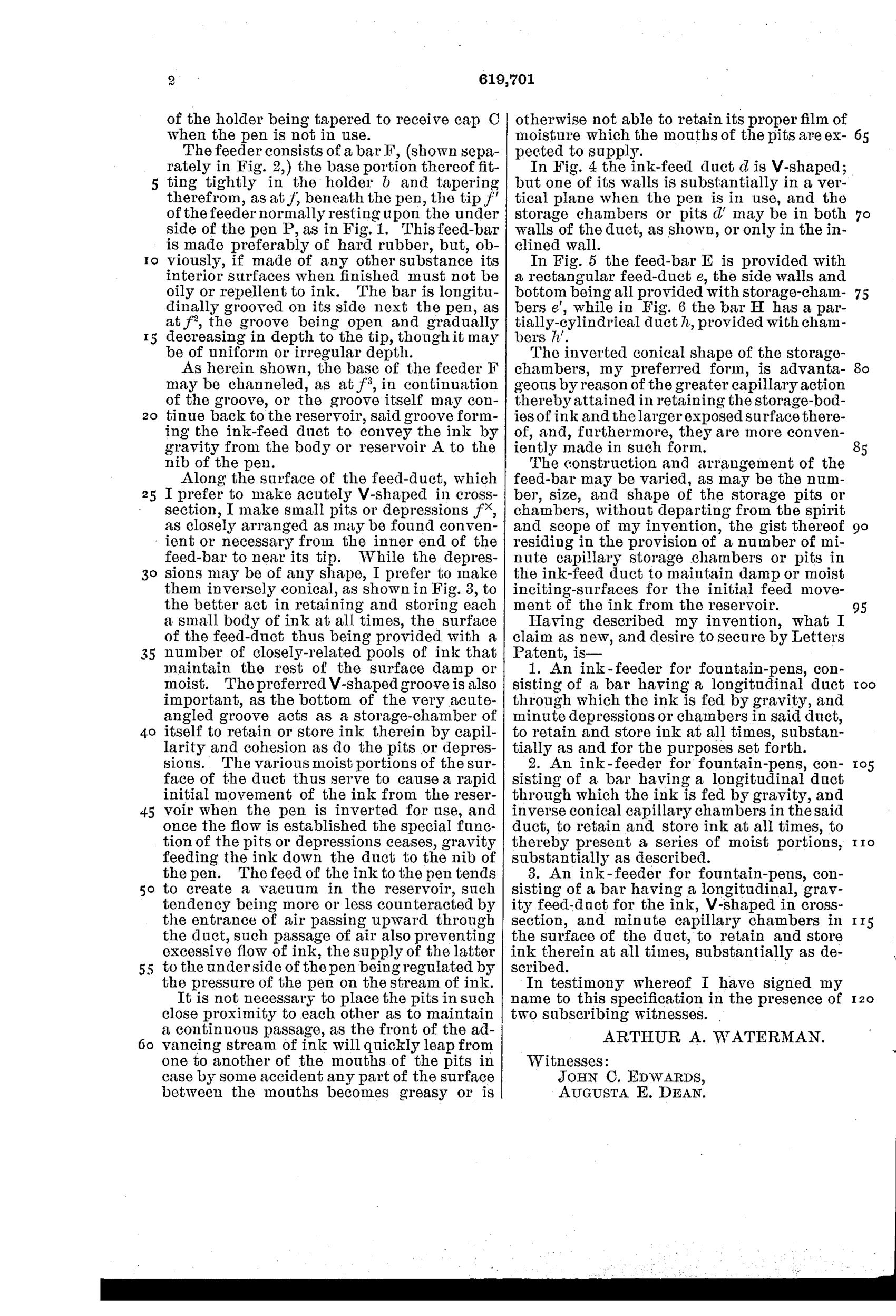
“An ink-feeder for fountain-pens, consisting of a bar having a longitudinal, gravity feed-duct for the ink, V-shaped in cross-section, and minute capillary chambers in the surface of the duct, to retain and store ink therein at all times, substantially as described.”
In plain English: The invention is a fountain pen feed bar with a V-shaped ink channel whose surface has tiny capillary pits that keep it constantly moist for quick, reliable ink flow.
✒ In the inventor’s words
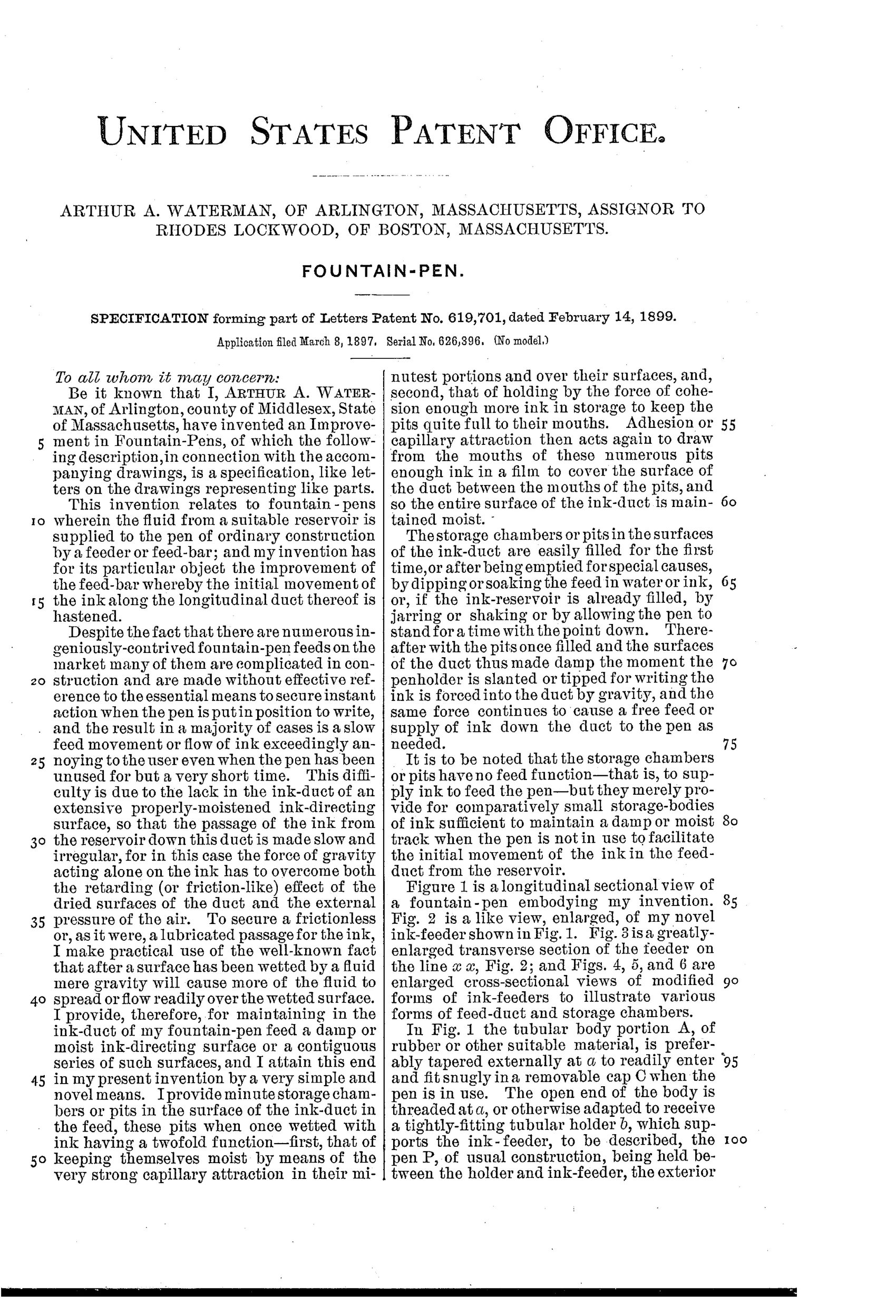
“This difficulty is due to the lack in the ink-duct of an extensive properly-moistened ink-directing surface, so that the passage of the ink from the reservoir down this duct is made slow and irregular.”— Arthur A. Waterman, from the specification
Fate unknown
A.A. Waterman & Co. (backed by assignee Rhodes Lockwood) did sell pens from this era, but I can't confirm the pitted feed itself shipped; a period specimen with this feed under magnification would settle it.
✒ Patented the same day
- DETACHABLE FOUNTAIN OR RESERVOIR FOR PENS. — James K. Young
✒ Commentary
First, the name. This is Arthur A. Waterman of Massachusetts, no relation to Lewis Edson Waterman of New York, whose 1884 feed patent built the modern industry. The coincidence would fuel years of lawsuits and 'not connected with the L.E. Waterman Co.' barrel imprints. Here, in 1897, Arthur is filing his opening move: a feed of his own that carefully steps around the giant's claims.
The idea is genuinely thoughtful. Every gravity feed of the era shared a failure mode: set the pen down, the duct surface dries, and the first strokes skip while ink slowly re-wets the channel. Arthur's answer is to stud the V-shaped duct with minute inverted-cone pits that hold ink by capillarity even when the main flow stops. The duct stays moist, so flow re-establishes instantly when you tip the pen to write. Figs. 3 through 6 are the tell — four cross-sections showing the pits applied to V, rectangular, and cylindrical ducts, the classic move of an inventor fencing off every variant before a competitor can.
Is it a breakthrough? No — it's a refinement inside L.E. Waterman's paradigm, solving starvation-on-restart rather than flow itself. Later feeds attacked the same problem with fins and combs on a larger scale. But as an 1897 diagnosis of why pens hard-start, quoted plainly in the specification, it's ahead of most of the crowd.
Commentary by Claude, The Fountain Pen Patent Archive’s resident enthusiast