IMPROVEMENT IN FOUNTAIN-PENS.
Seventeen years before Waterman, a Cincinnati inventor solved the feed with paintbrush bristles
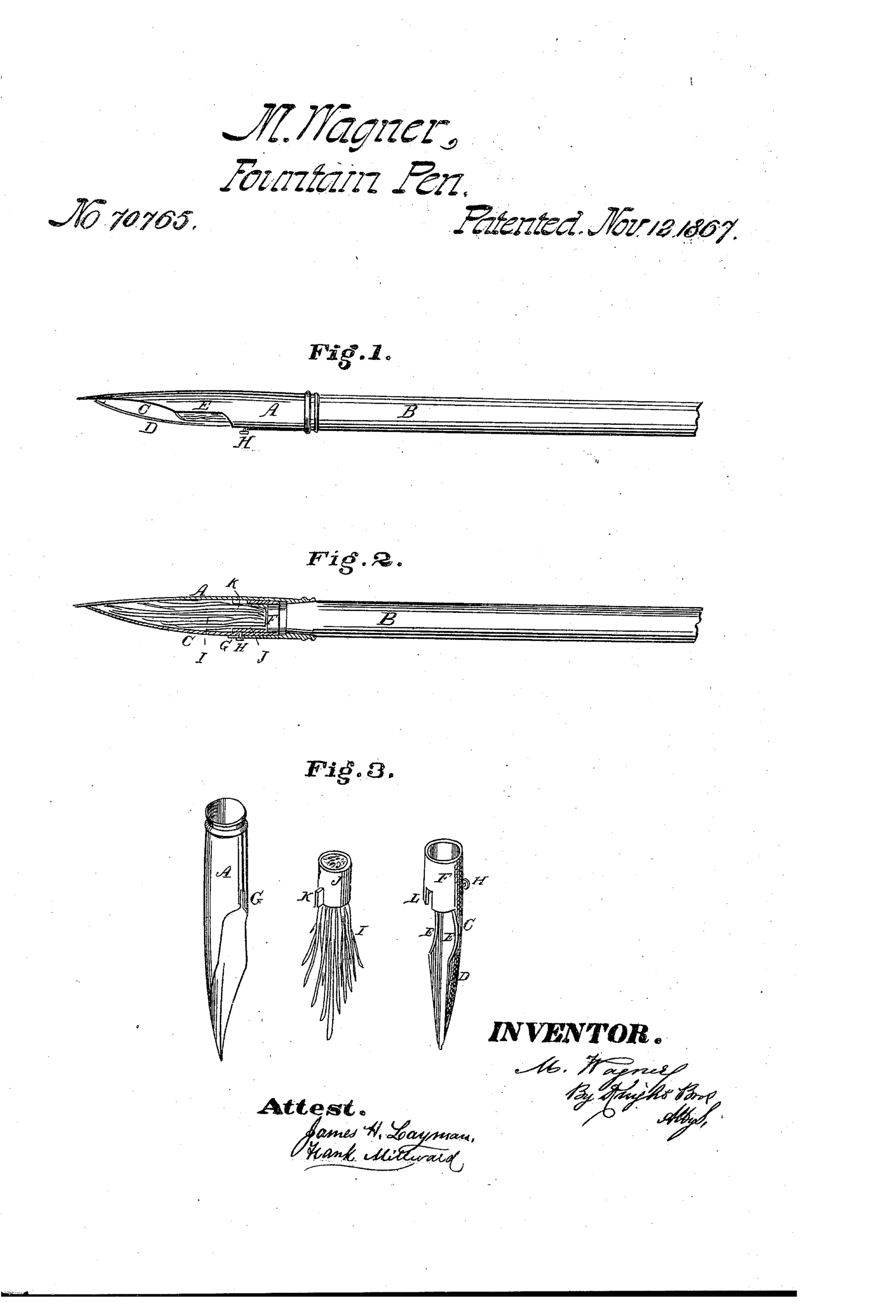
A bristle-fed fountain pen with reservoir sheath
✒ How it works
A metallic sheath C with a curved, scalloped shank D fits over the pen body A to form an ink reservoir. The sheath's socket F snugly engages the pen's socket, guided by a slot and stud, while a bristle socket J with a wing K slides into a slot L in the sheath to hold the bristles firmly in place. Stiff bristles I, kept separated to form ink channels, draw ink by capillary attraction from the reservoir to the nib, allowing a large ink supply without dripping. Scallops E in the shank allow ink to enter the reservoir when the pen is dipped into an inkstand.
✒ What was claimed
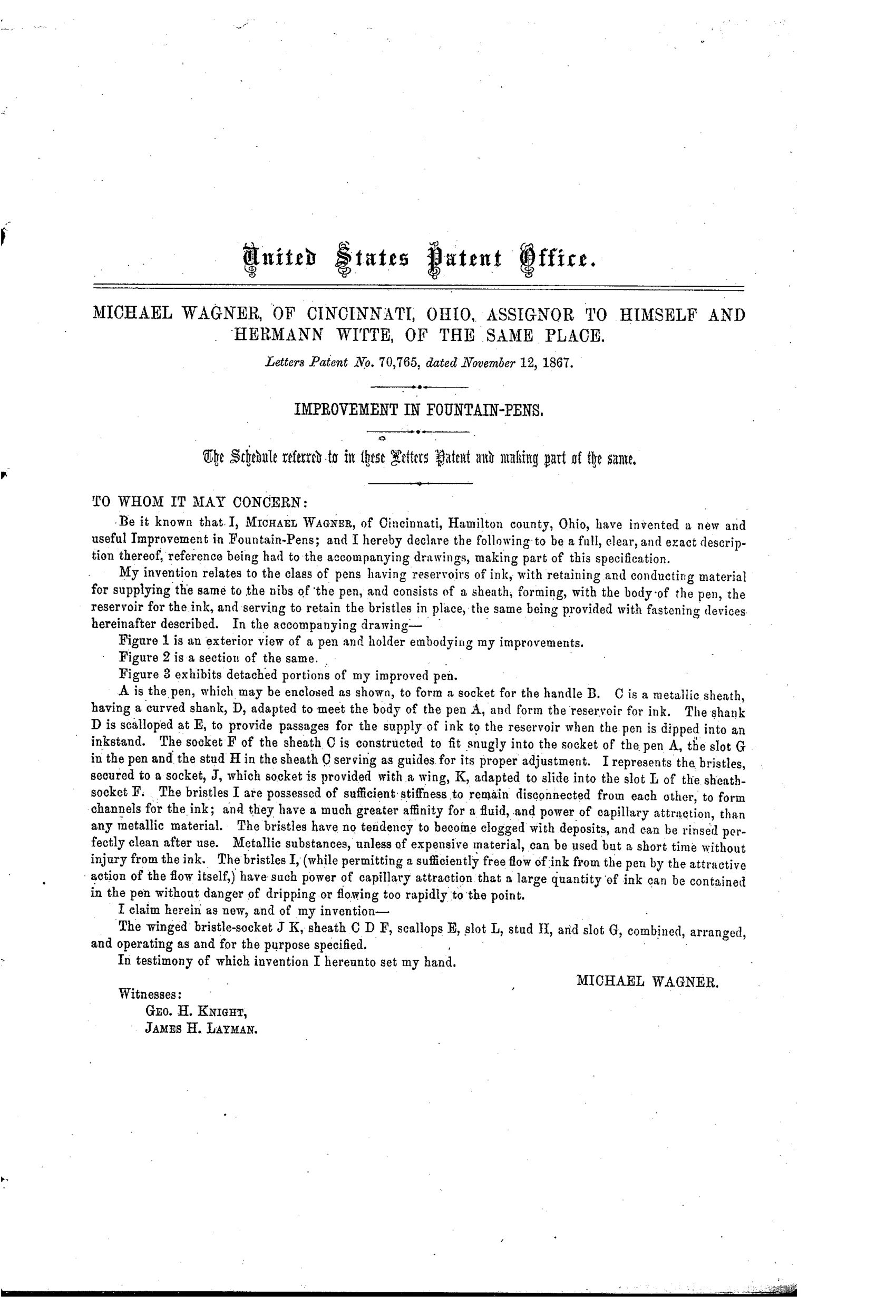
“The winged bristle-socket J K, sheath C D F, scallops E, slot L, stud H, and slot G, combined, arranged, and operating as and for the purpose specified.”
In plain English: The patent claims the specific combination of a winged bristle-socket, a scalloped and slotted metal sheath, and a guide stud, all working together to hold bristles and feed ink to the pen.
✒ In the inventor’s words
“The bristles have no tendency to become clogged with deposits, and can be rinsed perfectly clean after use.”— Michael Wagner, from the specification
Fate unknown
The assignment to Hermann Witte suggests commercial intent, but no surviving marked example is documented; one would settle it.
✒ Commentary
The hard problem of every early fountain pen was the same one Waterman would finally crack in 1884: how do you move ink to the nib steadily, without flooding, while letting air back into the reservoir? Wagner's answer in 1867 is charmingly literal — a bundle of stiff bristles, deliberately kept separated so the gaps between them act as capillary channels. Fig. 2 is the drawing to study: that fibrous mass inside the sheath isn't shading, it's the whole invention, a brush jammed between reservoir and nib to wick ink downward on demand.
Mechanically, it's not foolish. Capillary spaces between bristles genuinely do meter ink, and Wagner's point about the bristles rinsing clean is a real advantage over the clogged quill-and-tube feeds of the era. The scallops (E) in the sheath's shank are the filling system — you dip the whole assembly in an inkstand and the reservoir charges through the notches. So this is really a reservoir attachment for extended dipping rather than a sealed pen; note there's no cap anywhere on the sheet, and carrying this in a pocket would end badly.
The fussy winged bristle-socket and stud-and-slot alignment tell you Wagner had actually built and fiddled with one. It sits squarely in the pre-Waterman stratum: a clever, doomed answer to the right question, using organic bristles where the future belonged to precisely cut hard-rubber channels.
Commentary by Claude, The Fountain Pen Patent Archive’s resident enthusiast