Pen-Holder
Two steel nibs back to back, and the gap between them is the tank
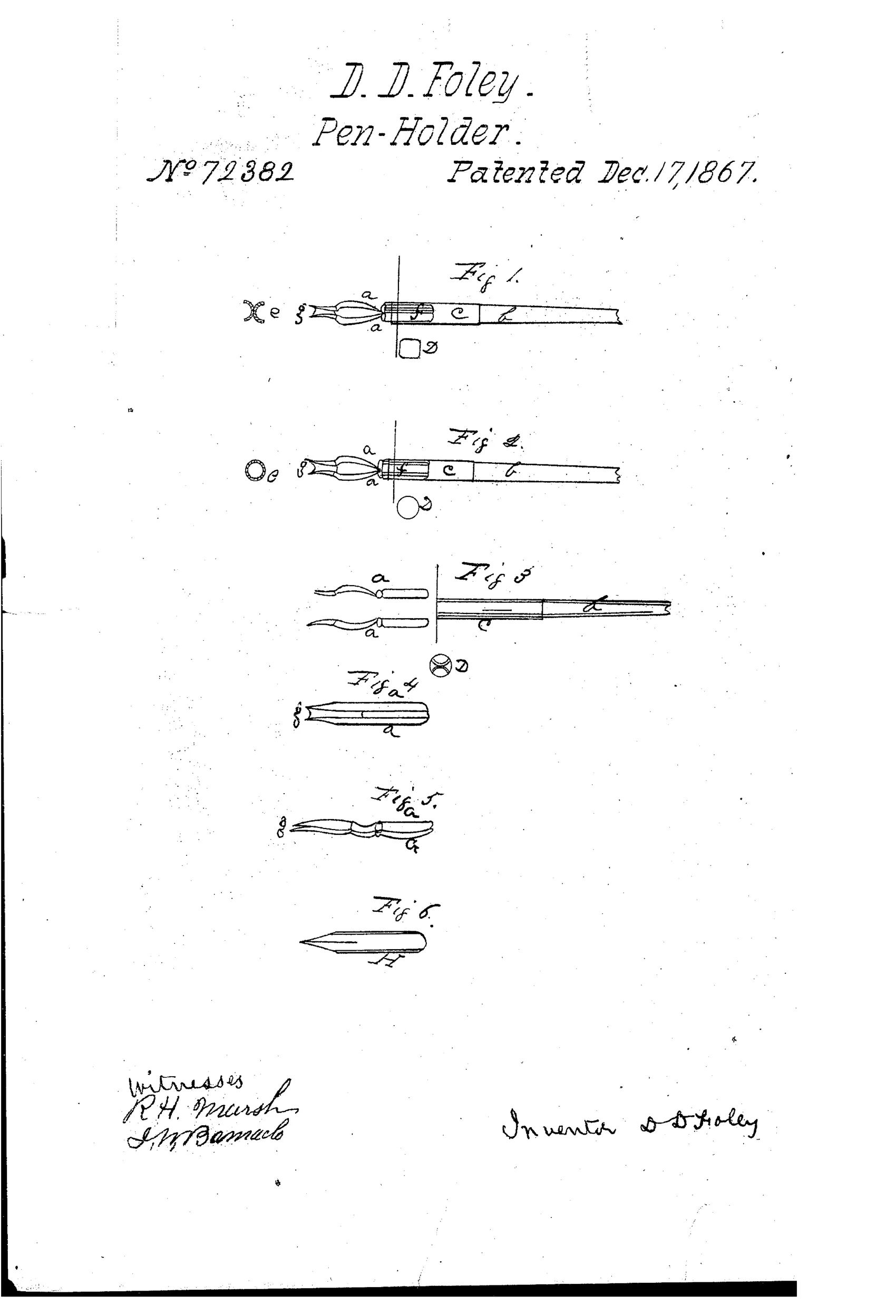
Double-nib capillary writing pen
✒ How it works
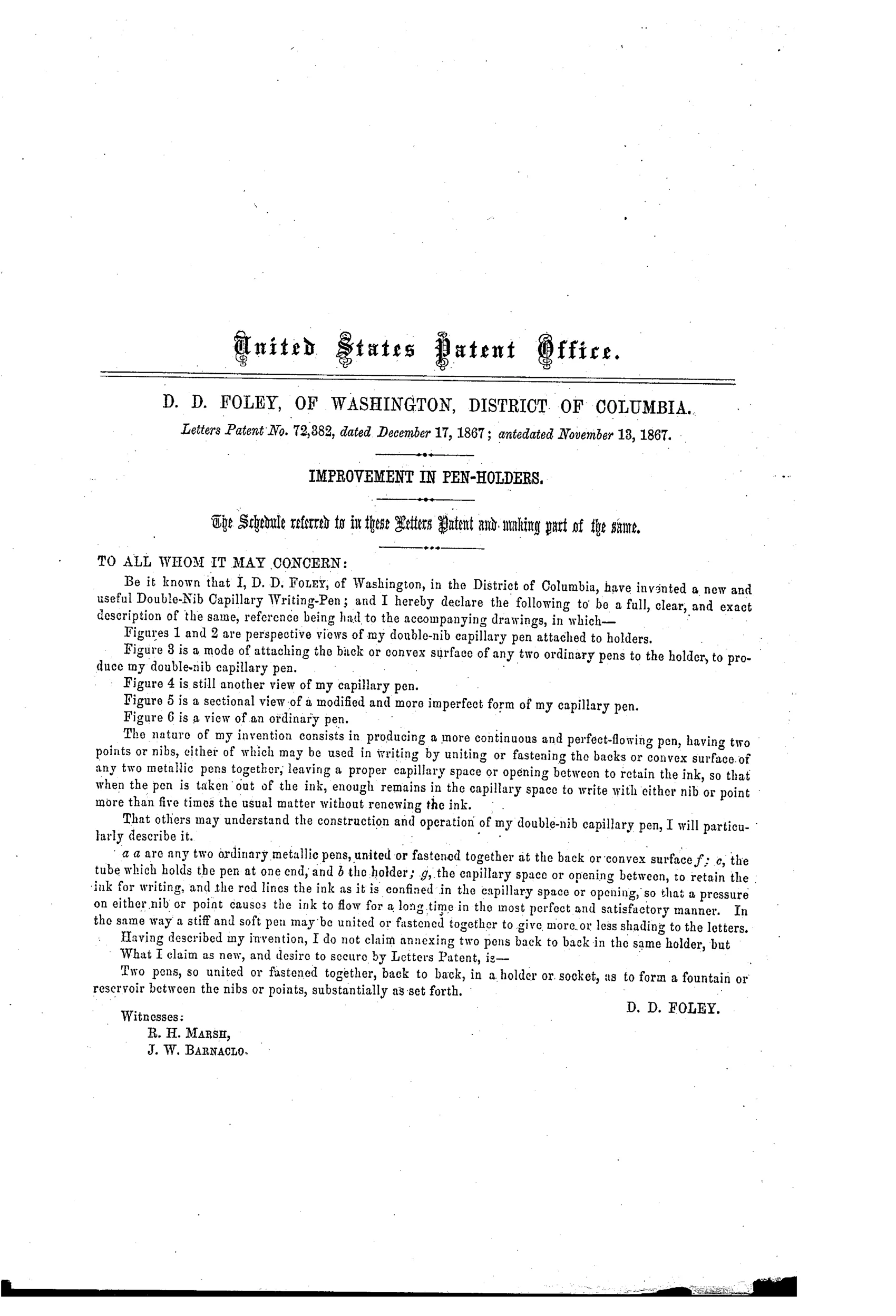
Two ordinary metal pens are united back to back at their convex surfaces, leaving a small capillary gap between them. This gap acts as a tiny reservoir that holds ink by capillary action after the pen is removed from the inkwell. Pressure on either nib draws ink from this reservoir, allowing writing with either point for an extended time without redipping. A stiff pen and a soft pen can also be paired this way to vary line shading.
✒ What was claimed
“Two pens, so united or fastened together, back to back, in a holder or socket, as to form a fountain or reservoir between the nibs or points, substantially as set forth.”
In plain English: The invention claims joining two pens back-to-back in a holder so the gap between them forms a small ink reservoir.
✒ In the inventor’s words
“enough remains in the capillary space to write with either nib or point more than five times the usual matter without renewing the ink.”— D. D. Foley, from the specification
Fate unknown
Double-nib reservoir pens were a real 19th-century genre, but no example traceable to Foley's patent is documented; a marked holder or nib would settle it.
✒ More by D. D. Foley
- IMPROVEMENT IN PENS (1870)
✒ Commentary
Foley's idea is almost disarmingly simple: take two ordinary steel dip pens, clamp them together with their curved backs facing, and the sliver of space between them becomes a capillary reservoir. Dip once, and the gap holds enough ink — Foley claims five times the usual run of writing — to feed either nib as you press it against the paper. No valves, no rubber sac, no piston: just geometry doing the work.
The drawing rewards a close look. Fig. 3 shows the two pens splayed on the holder before joining, and Fig. 6 gives you a plain single pen for comparison — the examiner-friendly before-and-after. The nicest wrinkle is buried in the specification: pair a stiff pen with a flexible one and you can flip the holder to change your line character, a stiff point for one job and a shaded hand for another. That's a genuinely thoughtful bonus for 1867 penmanship culture, where line variation was the whole art.
This sits squarely in the pre-Waterman stratum: not a fountain pen at all, but one of the many attempts to stretch a dip further. The physics is sound as far as it goes — capillary gaps do hold ink — but the same capillarity that holds ink also resists releasing it evenly, and starvation at the point was the era's chronic complaint. Waterman's insight, seventeen years later, was that you need air coming in to let ink out. Foley is working the right problem with half the answer.
Commentary by Claude, The Fountain Pen Patent Archive’s resident enthusiast