IMPROVEMENT IN FOUNTAIN-PENS.
An 1868 pen with an ink window and thumb-button ink dosing, decades early
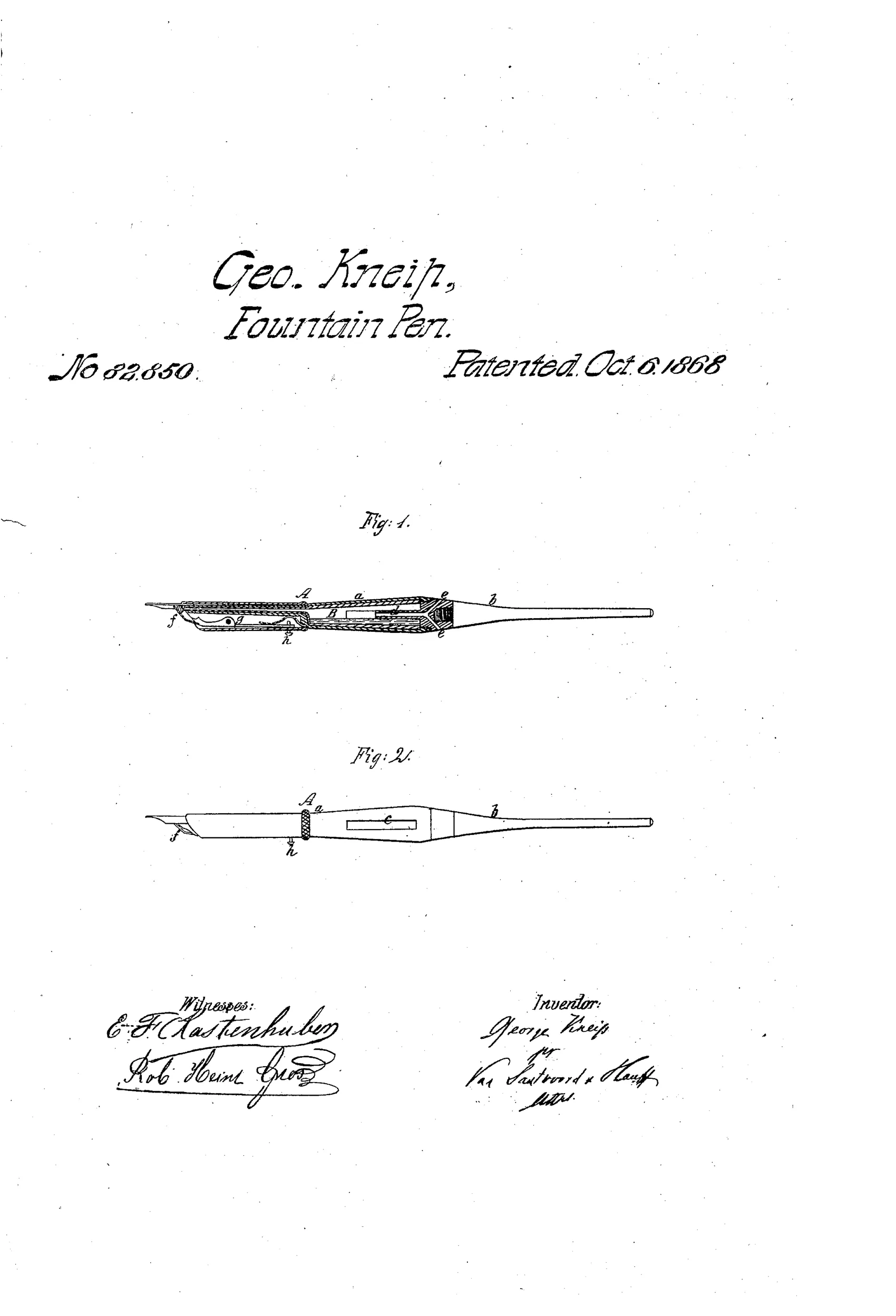
Valve-controlled glass ink-cistern fountain pen
✒ How it works
The pen holder is made in two threaded parts, the lower part receiving a transparent glass ink cistern so the ink level can be observed through side openings. A central vent tube projects into the cistern from the upper part, admitting air to allow ink flow while preventing spills when the pen is laid down, since the enlarged chamber around the tube keeps ink below the tube's level. The discharging end of the cistern is closed by a spring-loaded valve connected to a lever and thumb button; pressing the button lifts the valve and lets ink flow down to the nib. Releasing the button reseats the valve, cutting off ink flow until the writer presses again.
✒ What was claimed
“1. The ink-cistern B, provided with a central tube, d, in its receiving-end, and with a valve, f, at its discharging-end, in combination with the pen-holder A, constructed and operating substantially as and for the purpose set forth. 2. Also, the openings c in the sides of the pen-holder, in combination with the transparent ink-cistern B, substantially as and for the purpose described.”
In plain English: The pen combines a glass ink reservoir fitted with a central air tube at one end and a spring valve at the other, held within a pen-holder that has side openings for viewing the ink level.
✒ In the inventor’s words
“When the pen is held in position for writing, a small pressure of the thumb on the button h is sufficient to supply the pen with ink, and as this ink is used up, the pressure has to be repeated from time to time.”— George Kneip, from the specification
Paper patent — likely never produced
Valve-dosed pens of this era left no known commercial trace, and the glass-cistern-plus-valve assembly would have been fragile and costly; no surviving example is documented.
✒ Commentary
Sixteen years before Waterman's feed, George Kneip was already wrestling with the two problems that would define the whole category: how does ink get to the nib without flooding, and how does the writer know how much is left? His answers are charmingly direct. A glass cistern sits inside the holder, visible through side openings — an ink window in 1868, an idea the industry wouldn't standardize until visulated sections and celluloid demonstrators in the twentieth century. And instead of trusting capillarity, he simply doesn't: a spring-loaded valve seals the cistern's outlet, and the writer presses a thumb button to release a dose of ink whenever the nib runs dry.
Look at Fig. 1 and you can see the whole apparatus — the lever running along the section, the valve seat at the cistern's mouth, and the central vent tube projecting into the reservoir. That tube is the subtle part: with the pen laid down, ink pools in the enlarged chamber around the tube rather than dribbling out the air path. Kneip understood that uncontrolled air exchange was the enemy; he just solved it with a mechanical gate rather than a regulating feed.
The trouble is the writing experience. Pressing a button 'from time to time' means judging your own ink flow mid-sentence, and a spring valve in a wet, corrosive environment is asking for trouble. It's a dead end, but an honest and thoughtful one — pre-Waterman reservoir work at its most instructive.
Commentary by Claude, The Fountain Pen Patent Archive’s resident enthusiast