IMPROVEMENT IN PENS
A snap-on spoon reservoir whose tip wedges into the nib slit under flourish pressure
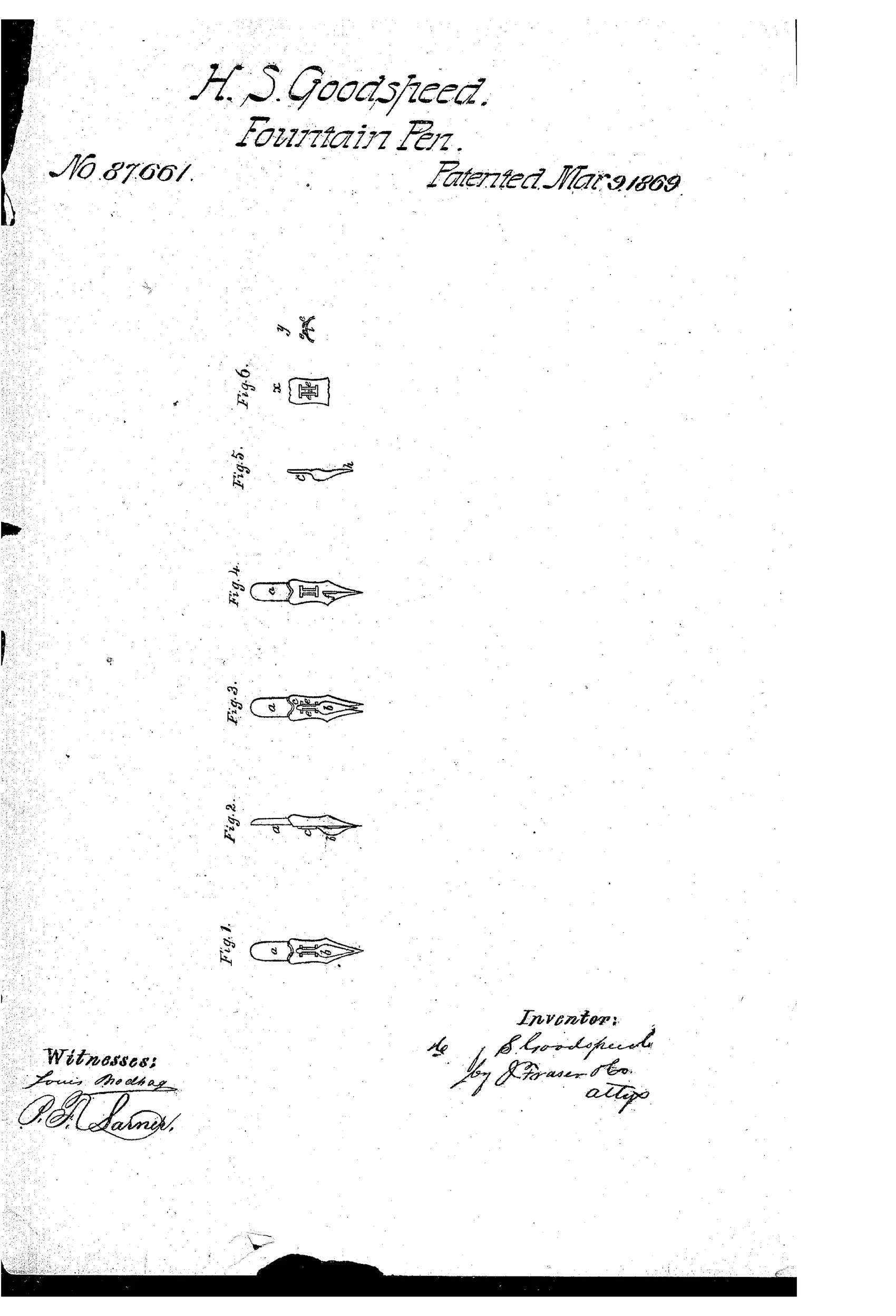
Fountain pen with spoon-shaped ink reservoir attachment
✒ How it works
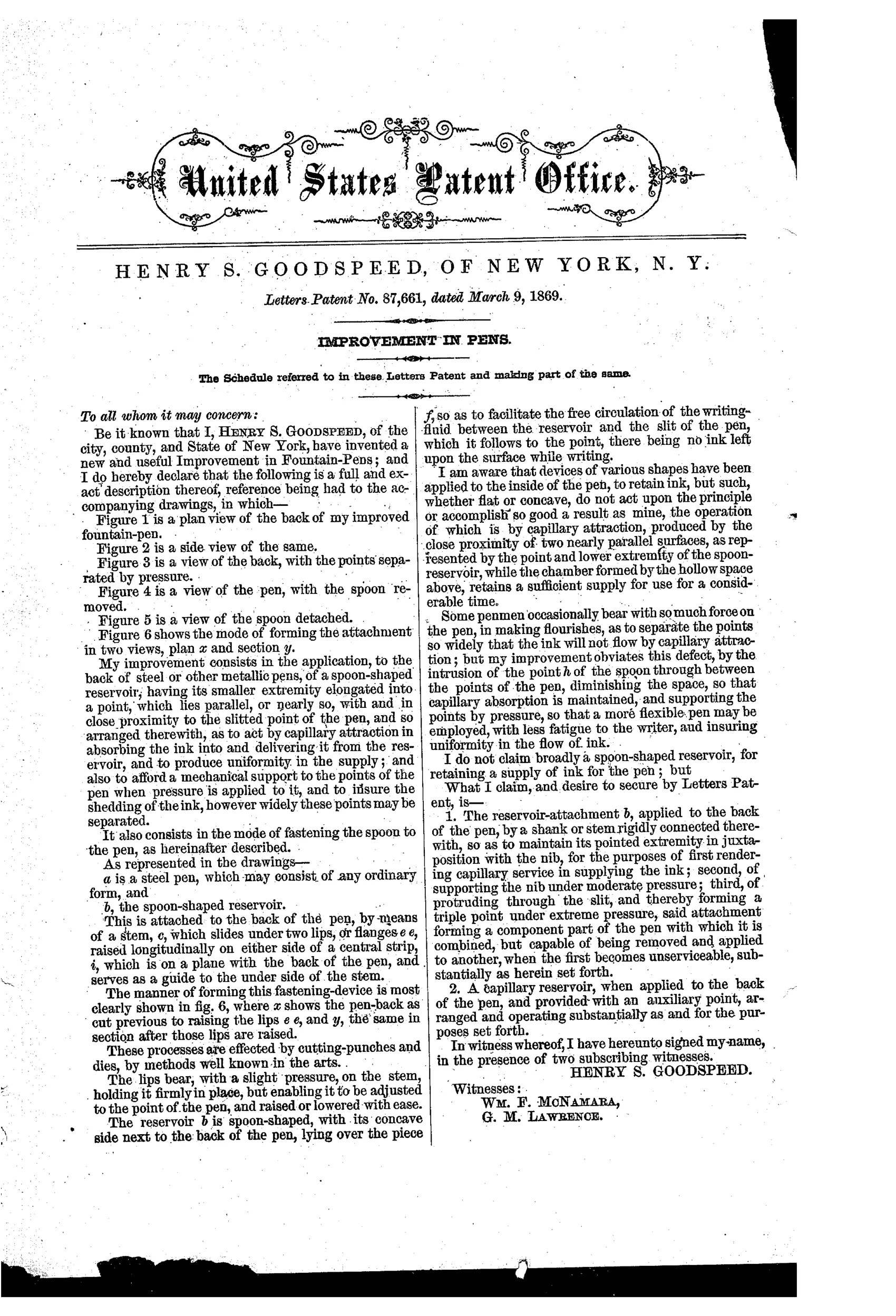
A spoon-shaped metallic reservoir (b) is attached to the back of a steel pen (a) via a shank or stem (c) that slides beneath raised lips or flanges (e,e) on a central guide strip. The reservoir's smaller extremity is elongated into a point (h) that lies parallel to and in close proximity with the slitted point of the pen, delivering ink by capillary attraction. This auxiliary point can intrude between the pen's nib points when they separate under writing pressure, maintaining capillary flow and mechanically supporting the nib. The attachment is removable and can be replaced when worn, while the concave side of the reservoir faces the pen's back to allow free circulation of ink.
✒ What was claimed
“1. The reservoir-attachment b, applied to the back of the pen, by a shank or stem rigidly connected therewith, so as to maintain its pointed extremity in juxtaposition with the nib, for the purposes of first rendering capillary service in supplying the ink; second, of supporting the nib under moderate pressure; third, of protruding through the slit, and thereby forming a triple point under extreme pressure, said attachment forming a component part of the pen with which it is combined, but capable of being removed and applied to another, when the first becomes unserviceable, substantially as herein set forth.”
In plain English: A removable spoon-shaped ink reservoir with an extended point is attached to the back of the pen so its tip stays right next to the nib, feeding ink by capillary action, supporting the nib under pressure, and even poking through the nib's slit to form a triple point when writing pressure spreads the nib open wide.
✒ In the inventor’s words
“Some penmen occasionally bear with so much force on the pen, in making flourishes, as to separate the points so widely that the ink will not flow by capillary attraction; but my improvement obviates this defect, by the intrusion of the point h of the spoon through between the points of the pen, diminishing the space, so that capillary absorption is maintained, and supporting the points by pressure, so that a more flexible pen may be employed, with less fatigue to the writer, and insuring uniformity in the flow of ink.”— Henry S. Goodspeed, from the specification
Fate unknown
Clip-on ink retainers for steel pens were a real commercial genre, but no Goodspeed-marked example is documented; a surviving specimen would settle it.
✒ Commentary
Fifteen years before Waterman, Goodspeed is already thinking hard about the one problem that would eventually define the whole category: how do you keep capillary action alive when the writer's hand is working against it? His answer isn't a fountain pen in our sense — it's a spoon-shaped metal reservoir that slides onto the back of an ordinary steel dip pen, held by a shank tucked under two raised flanges stamped into a guide strip. Fig. 5 shows the spoon detached; Fig. 4 shows the bare pen with its little dovetail track waiting.
The genuinely clever part is in Fig. 3. Ornamental penmanship of the era demanded heavy shading strokes, and pressing hard spreads the tines so wide the ink film between them breaks. Goodspeed elongates the spoon into a point that rides just behind the slit, so when the tines gape open, that third point intrudes between them — narrowing the gap enough to keep capillary flow going, and bracing the tines mechanically. He calls it a triple point, and it means a writer could use a softer, more flexible pen without the flow failing at exactly the moment of maximum drama.
This is a dip-pen accessory, not a reservoir pen, and it sits in the crowded pre-Waterman era of ink-retainer add-ons. But the insight — that the feed must actively serve the nib under stress — is the right one, arrived at early.
Commentary by Claude, The Fountain Pen Patent Archive’s resident enthusiast