IMPROVEMENT IN PENS
A built-in overload stop to keep dip-pen tines from snapping, 1869.
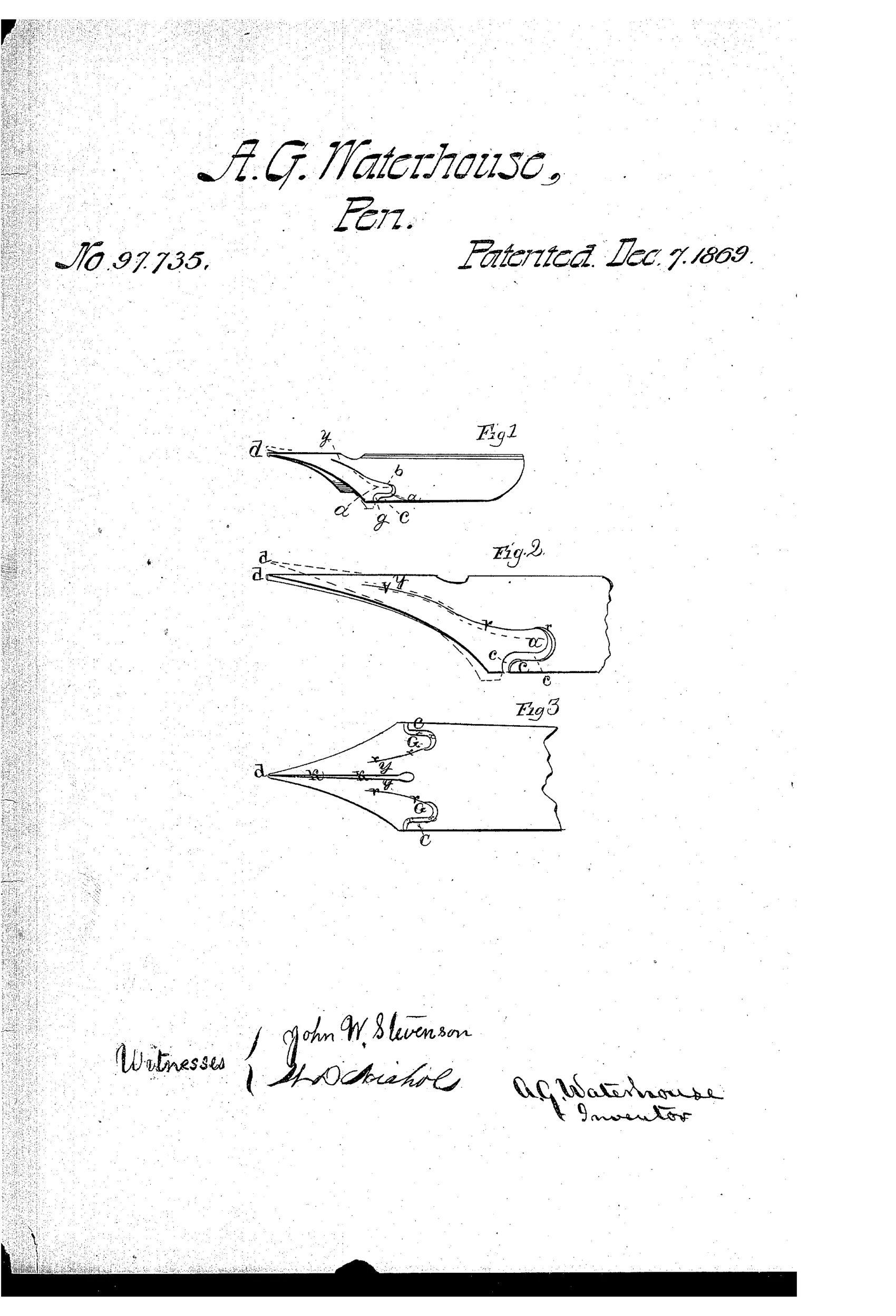
Metallic writing pen with spring-protecting shoulder
✒ How it works
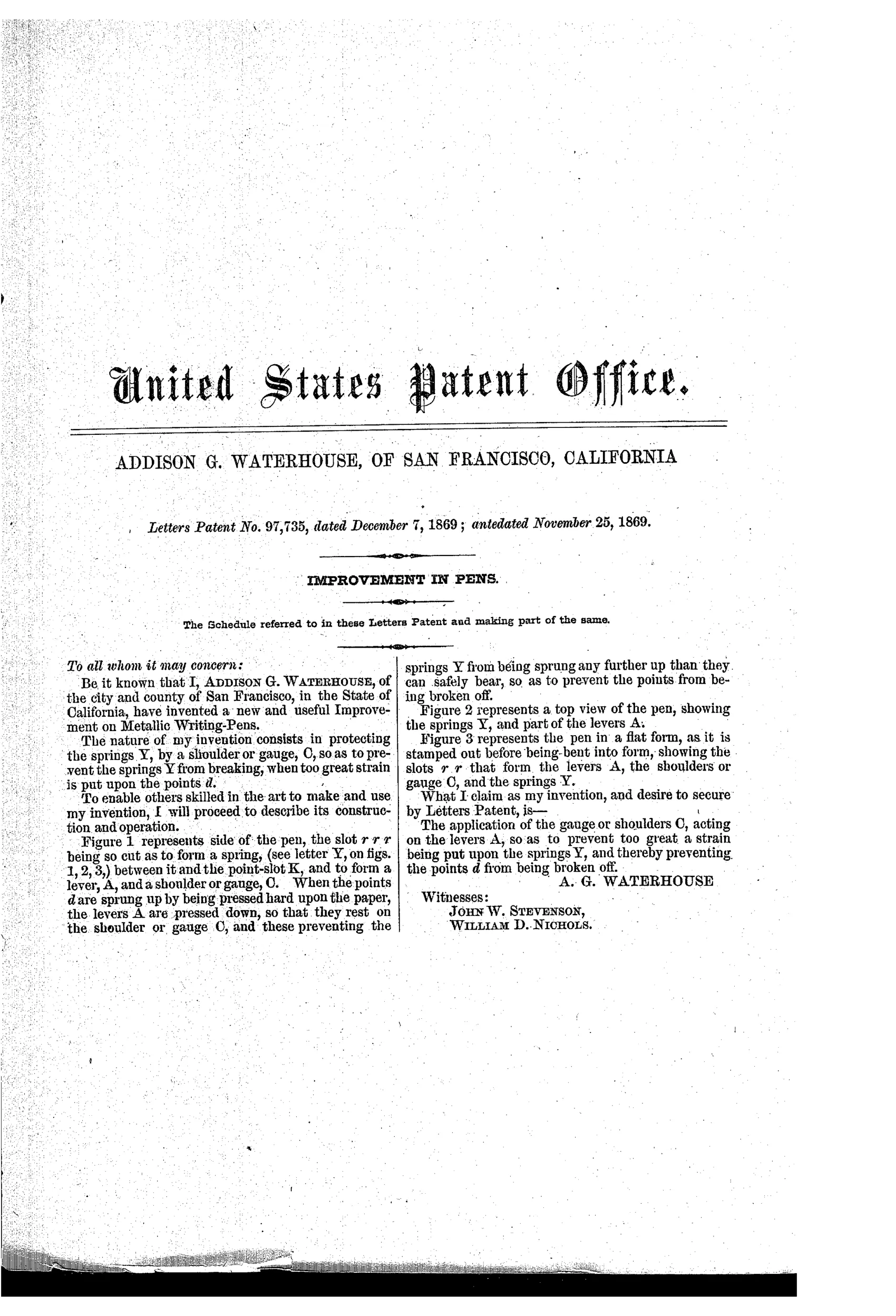
A slot is cut into the pen body to form a spring (Y) between it and the point-slot, creating a lever (A) and a shoulder or gauge (C). When the points (d) are pressed hard against the paper and sprung upward, the levers (A) press down to rest on the shoulder or gauge (C). This shoulder limits how far the springs (Y) can flex, preventing them from being sprung beyond their safe limit. The design thereby guards the pen points from breaking off under excessive writing pressure.
✒ What was claimed
“The application of the gauge or shoulders C, acting on the levers A, so as to prevent too great a strain being put upon the springs Y, and thereby preventing the points d from being broken off.”
In plain English: The invention claims a gauge or shoulder that limits how far the pen's spring levers can flex, protecting the pen points from snapping off.
✒ In the inventor’s words
“The nature of my invention consists in protecting the springs Y, by a shoulder or gauge, C, so as to prevent the springs Y from breaking, when too great strain is put upon the points d.”— Addison G. Waterhouse, from the specification
Fate unknown
Stamped steel pens were made by the million and rarely marked with patent data; a pen imprinted with this date or Waterhouse's name would settle it, and none is documented.
✒ Patented the same day
- IMPROVEMENT IN PENS — William A. Morse
✒ Commentary
Fifteen years before L.E. Waterman solved the feed problem, this Waterhouse — Addison G., of San Francisco, no relation established to the New York pen man — was worrying about a humbler failure: heavy-handed writers snapping the points off their steel pens. His answer is purely mechanical and rather elegant. An extra slot cut alongside the point-slit turns part of the pen body into a leaf spring with a lever arm. Press the points hard and the lever swings down until it lands on a shoulder stamped into the metal, and there it stops. The spring simply cannot flex past its safe limit, no matter how much force the writer applies.
The drawing worth lingering on is Fig. 3, the flat blank before bending. It shows that all of this — spring, lever, gauge shoulder — comes out of the die in one stamping operation, with no added parts. That is the mark of someone thinking about manufacture, not just mechanism. Overload stops of exactly this kind show up everywhere in later spring engineering; here it is applied to a pen point in 1869.
This is a dip-pen patent, strictly speaking, and sits outside the reservoir story. But flexible points and how far they can safely spread would haunt fountain pen makers for the next half century, and this is one of the earliest patents to treat tine strain as a designable limit rather than a user's problem.
Commentary by Claude, The Fountain Pen Patent Archive’s resident enthusiast