IMPROVEMENT IN PENS
Riveting the reservoir to the nib itself, fifteen years before Waterman
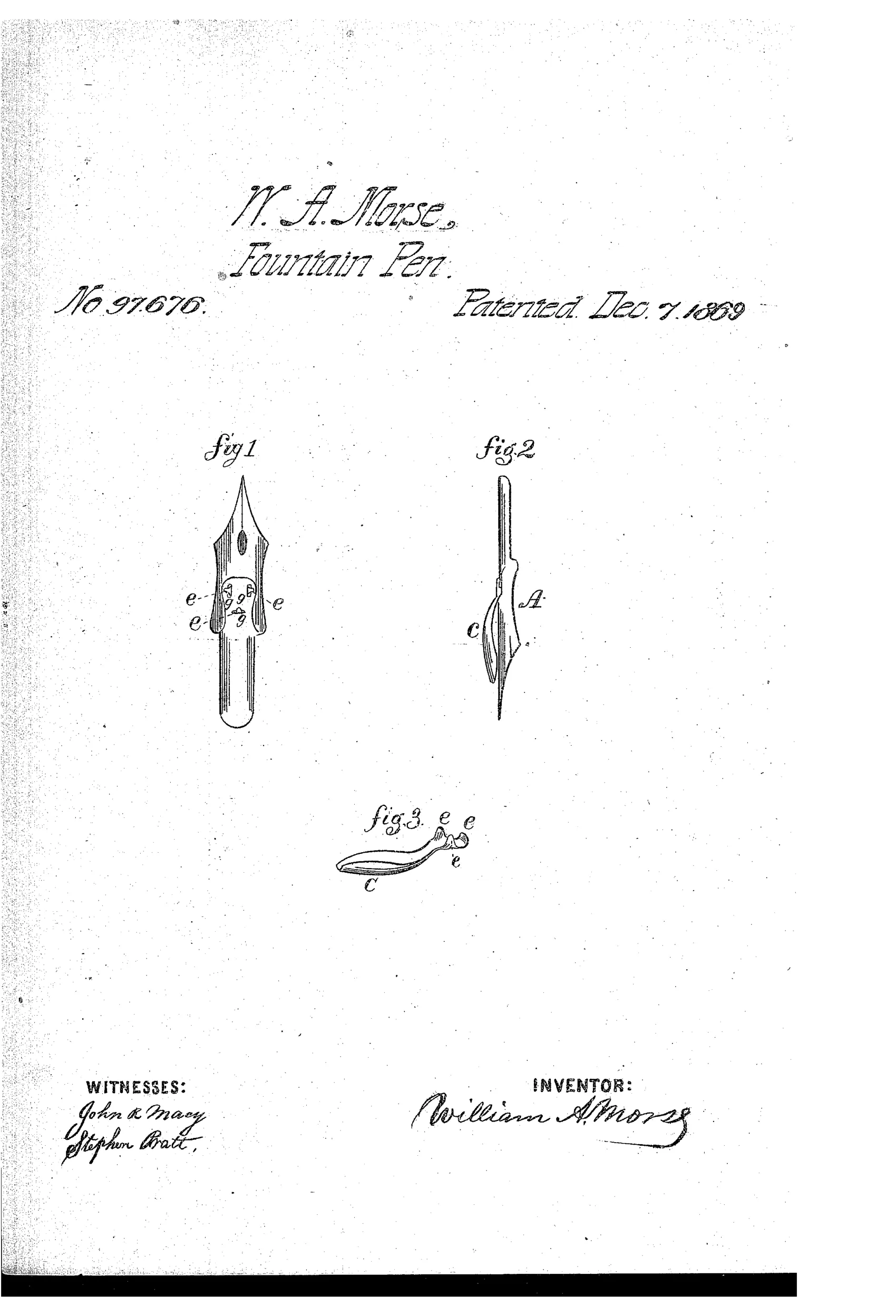
Fountain pen with ink-retaining spring attachment
✒ How it works
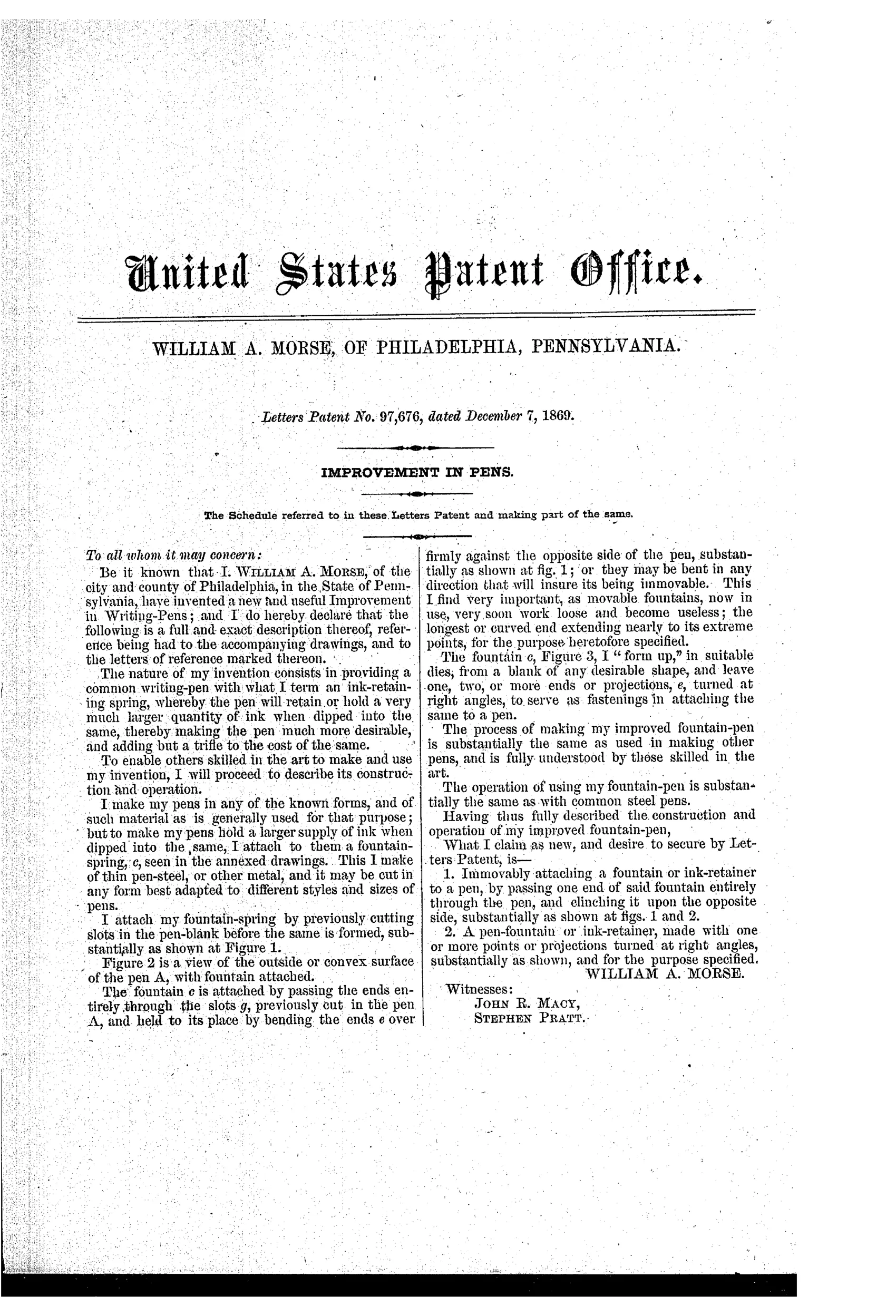
A common writing-pen nib has slots cut into the pen-blank before it is formed into shape. A thin metal fountain-spring, formed with one or more right-angle projections at its ends, is passed through these slots so its ends extend entirely through the pen. The projecting ends are then bent or clinched flat against the opposite (convex) side of the pen, immovably fastening the spring in place. This fountain spring allows the pen to retain and hold a much larger quantity of ink when dipped, without the fountain working loose as movable fountains tend to do.
✒ What was claimed
“1. Immovably attaching a fountain or ink-retainer to a pen, by passing one end of said fountain entirely through the pen, and clinching it upon the opposite side, substantially as shown at figs. 1 and 2.”
In plain English: A fountain (ink-reservoir spring) is permanently fixed to the pen by pushing one end all the way through the pen body and bending it flat against the other side.
✒ In the inventor’s words
“This I find very important, as movable fountains, now in use, very soon work loose and become useless.”— William A. Morse, from the specification
Fate unknown
Reservoir-spring dip pens were widely made in this era, but no marked Morse example is documented; a surviving nib with clinched tabs would settle it.
✒ Patented the same day
- IMPROVEMENT IN PENS — Addison G. Waterhouse
✒ Commentary
Call this a "fountain pen" loosely. What Morse actually patented is a dip-pen nib with a permanently attached ink-retainer — a curved spring that sits under the nib and holds a larger charge of ink between dips. Reservoir attachments like this were common accessories in 1869; the trouble, as Morse says plainly, is that clip-on versions "very soon work loose and become useless." His answer is pure sheet-metal pragmatism: cut slots in the pen blank before it's formed, pass the spring's tabs entirely through, and clinch them flat on the convex side. It's a rivet, essentially, made from the spring's own ends.
The drawing rewards a close look. Fig. 1 shows the slots g and the clinched ends e right at the nib's shoulder; fig. 3 shows the little spring piece by itself, with its right-angle projections — the whole invention is that bent tab. The claim covers nothing but the fastening method, which is honest and narrow.
Historically this sits in the pre-Waterman stratum, but on the humbler branch: not a barrel-reservoir pen at all, just a better-behaved dipping aid. It would work — clinched fastenings are how steel pens were assembled to holders anyway — but it solves a small problem while the real one, controlled feed from a true reservoir, waited another fifteen years.
Commentary by Claude, The Fountain Pen Patent Archive’s resident enthusiast