FOUNTAIN-PEN
A Londoner's answer to Sheaffer: the lever pivots on a split ring, not a pin
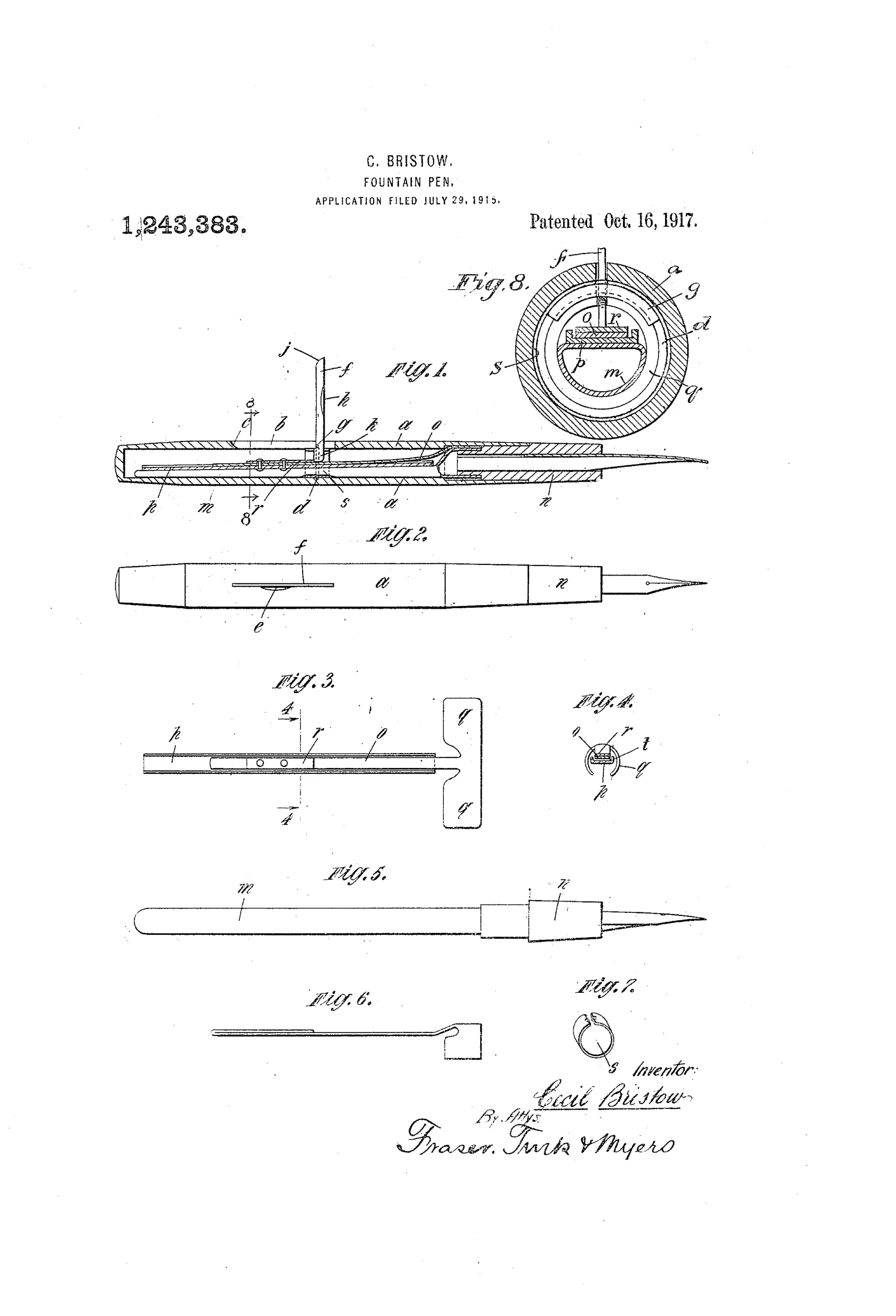
Lever-and-plate filling mechanism for a fountain pen
✒ How it works
A lever pivots on a bearing seated in an annular groove inside the barrel, held in place by a split collar registered with the barrel's longitudinal slot. Raising the lever forces a spring and presser plate against an elastic ink bag inside the barrel, compressing it and expelling air. Lowering the lever releases the plate, letting the bag expand and draw ink in through the nib by suction. The spring's opposite end is bent into wings that grip the barrel's inner surface to hold the assembly firmly in place.
✒ What was claimed
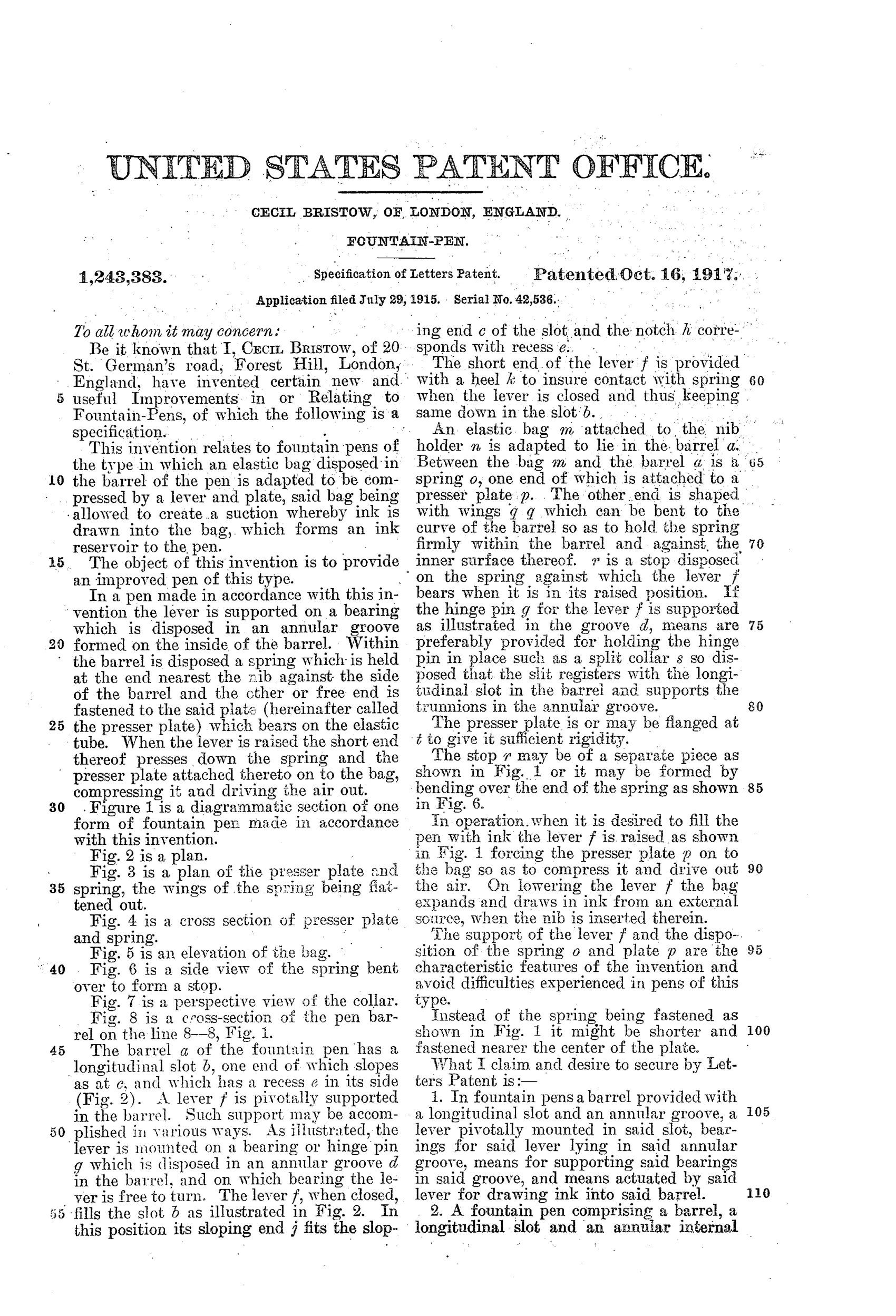
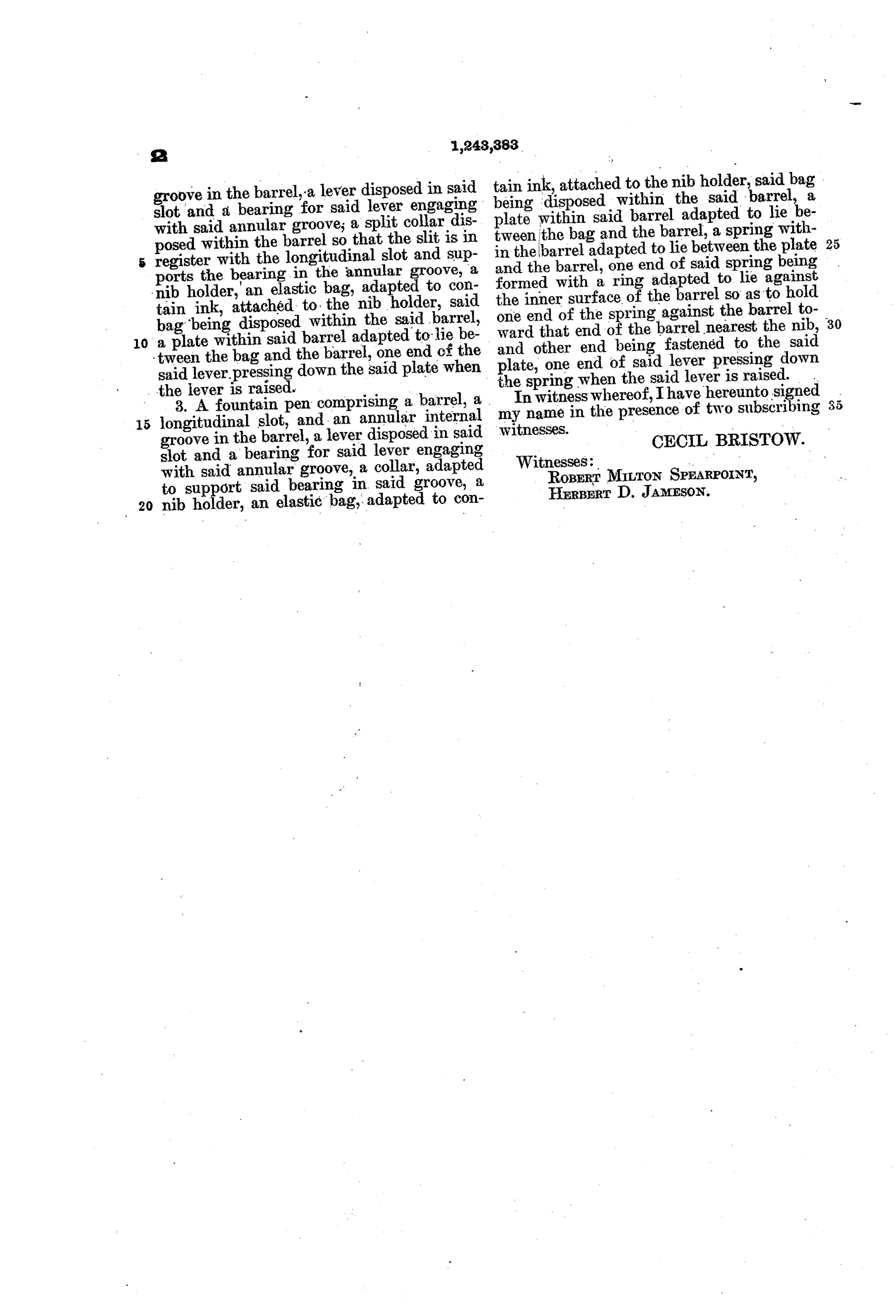
“In fountain pens a barrel provided with a longitudinal slot and an annular groove, a lever pivotally mounted in said slot, bearings for said lever lying in said annular groove, means for supporting said bearings in said groove, and means actuated by said lever for drawing ink into said barrel.”
In plain English: A fountain pen barrel with a slot and internal groove holding a pivoting lever whose bearings sit in the groove, the lever operating a mechanism that draws ink into the barrel.
✒ In the inventor’s words
“On lowering the lever f the bag expands and draws in ink from an external source, when the nib is inserted therein.”— Cecil Bristow, from the specification
Fate unknown
The split-ring lever mounting resembles arrangements later common in production pens, but no pen marked to Bristow or this patent is documented; a stamped specimen would settle it.
✒ Commentary
By 1915, when Cecil Bristow filed this, Sheaffer's lever filler was the design everyone wanted and nobody could copy outright. The lever itself wasn't the hard part — the hard part was mounting it in a thin hard-rubber barrel without drilling pivot holes through the wall (weak, leaky) or paying Sheaffer. Bristow's answer is genuinely tidy: cut an annular groove inside the barrel, seat the lever's bearings in that groove, and hold everything in place with a split collar (Fig. 7) sprung into position and registered against the longitudinal slot. No pins, no holes, no rivets through the wall.
Fig. 8, the cross-section, is where the cleverness lives. You can see the lever bearing sitting in the internal groove with the collar wrapped around it — the barrel wall itself becomes the pivot housing. The pressure bar is equally thrifty: one spring whose far end is bent into wings that grip the barrel bore (Figs. 3 and 4), so the whole filling unit is self-retaining and drops in from the open end.
This kind of internal-ring lever mounting became a standard workaround in the lever-filler era, so Bristow was thinking along the same lines as the trade. Whether he got there first or merely got there independently in wartime London, the mechanics are sound and would work exactly as drawn. A workmanlike, honest entry in the busiest corner of the field.
Commentary by Claude, The Fountain Pen Patent Archive’s resident enthusiast