FOUNTAIN-PEN
In 1855, an ink sac and a finger-operated valve — thirty years before Waterman
A fountain pen with valve-controlled ink flow
✒ How it works
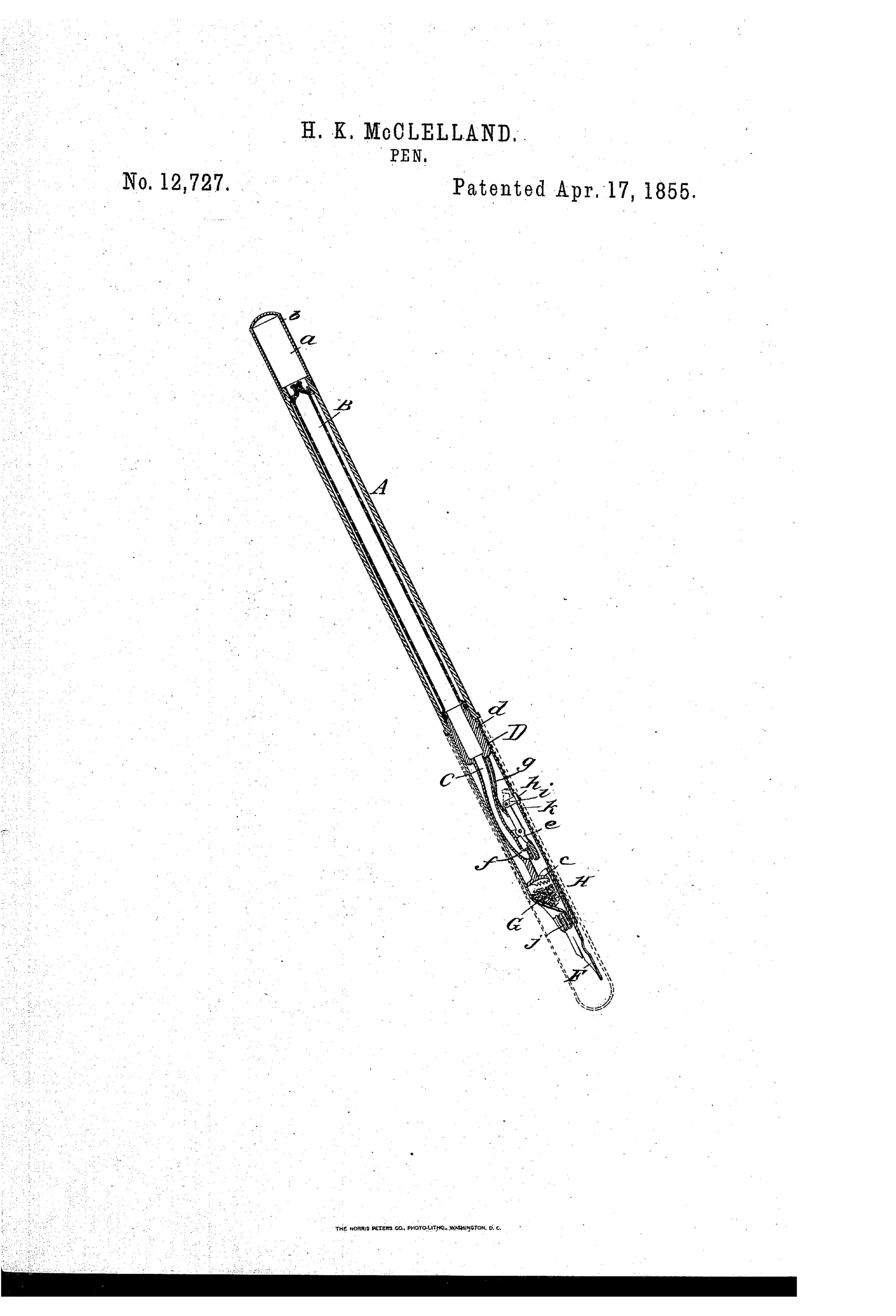
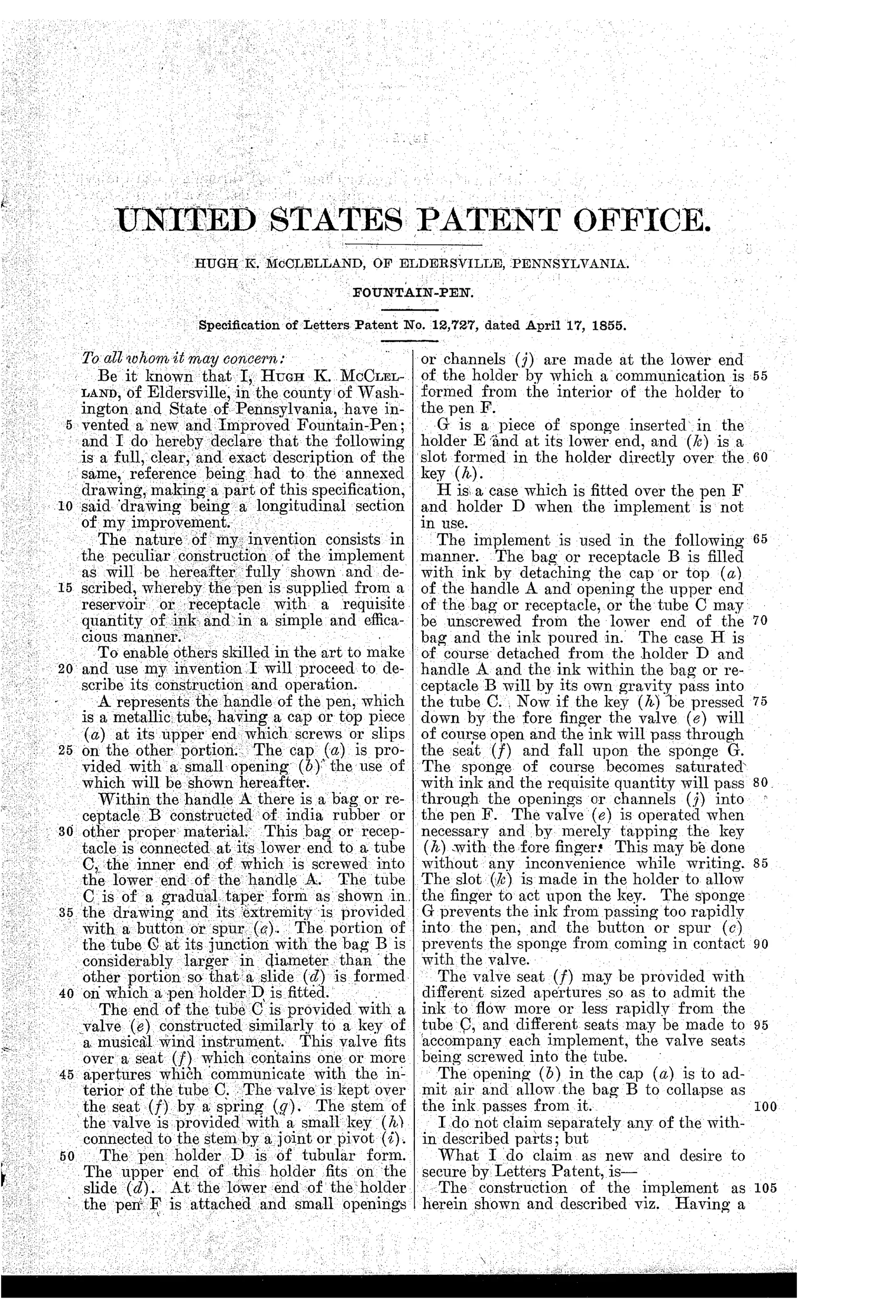
An india-rubber bag inside a metallic handle holds ink and feeds a tapered tube whose outlet is closed by a spring-loaded valve resembling a wind-instrument key. Pressing a small key with the forefinger opens the valve, letting ink pass through a seat onto a sponge in the pen holder. The saturated sponge then releases ink through small channels into the pen nib, with the sponge controlling flow rate and a spur preventing sponge contact with the valve. A protective case fits over the pen and holder when not in use, and a small air hole in the cap lets the bag collapse as ink is used.
✒ What was claimed
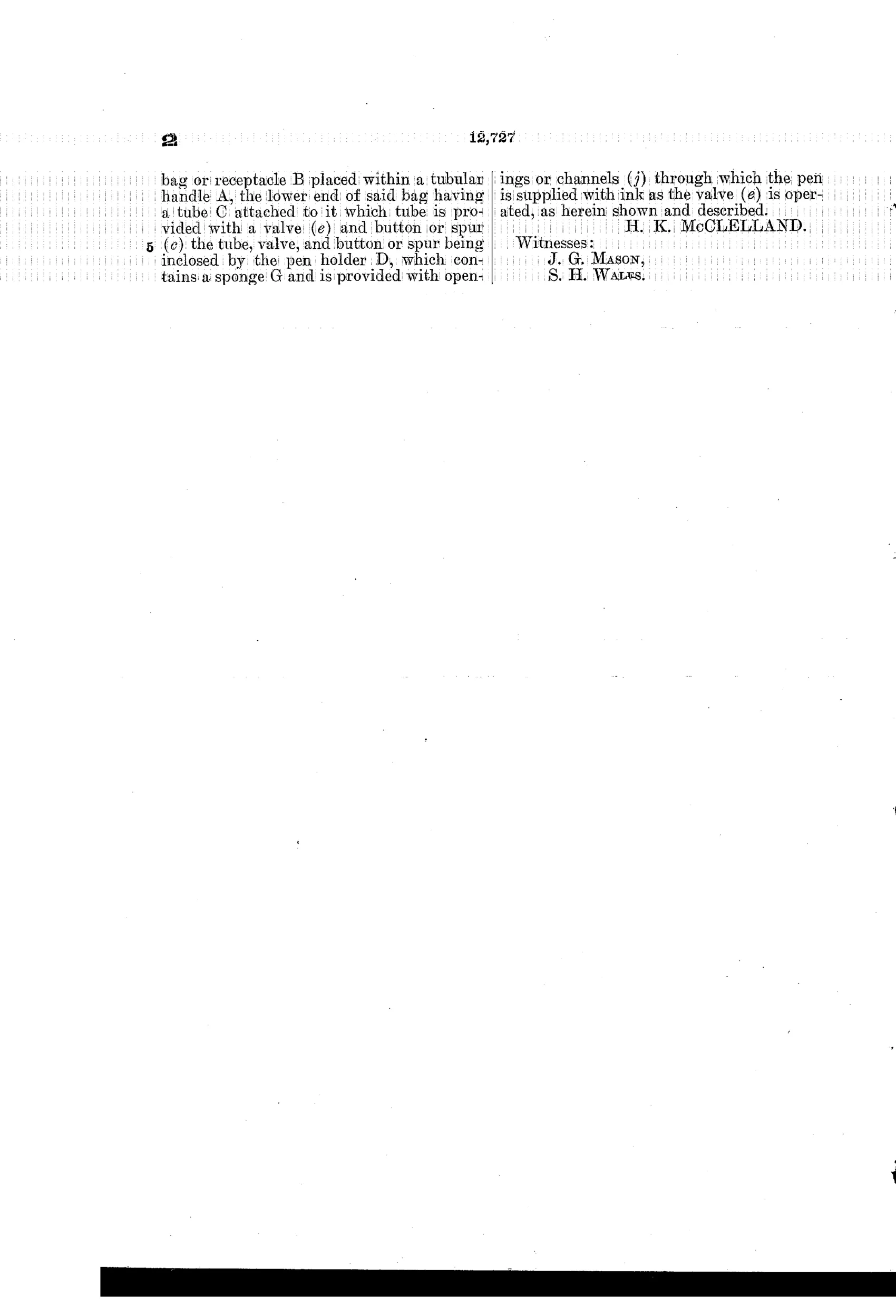
“The construction of the implement as herein shown and described viz. Having a bag or receptacle B placed within a tubular handle A, the lower end of said bag having a tube C attached to it which tube is provided with a valve (e) and button or spur (c) the tube, valve, and button or spur being inclosed by the pen holder D, which contains a sponge G and is provided with openings or channels (j) through which the pen is supplied with ink as the valve (e) is operated, as herein shown and described.”
In plain English: The pen's ink reservoir bag, valve-tipped feed tube, and sponge-filled holder with small channels work together so that pressing the valve releases ink to supply the pen nib.
✒ In the inventor’s words
“This may be done without any inconvenience while writing.”— Hugh K. McClelland, from the specification
Paper patent — likely never produced
No maker, marked example, or trade record is associated with this design, and the valve-and-sponge mechanism has no known commercial descendant; it almost certainly stayed on paper.
✒ Commentary
McClelland's pen has two ideas that would each take decades to become standard, jammed together in one 1855 patent. The india-rubber bag inside the barrel is essentially the ink sac that Conklin and Sheaffer would build the self-filling industry around after 1900 — though here it's just a reservoir, not a filler, with a small air hole in the cap letting it collapse as ink drains. And the flow control is frankly ingenious in conception: a spring-loaded valve modeled on a wind-instrument key, opened by pressing a button with the forefinger while writing. The claim's cheerful line that 'this may be done without any inconvenience while writing' is doing a lot of work.
The sponge is the tell that this is a pre-Waterman design. Ink released by the valve soaks a sponge in the holder, which then dribbles through small channels to the nib. That's a crude stand-in for what the problem actually required — a feed that meters ink and admits air in a controlled exchange. Waterman's 1884 capillary channels solved it passively; McClelland asks the writer to be the feed, tapping the key whenever the sponge runs dry.
As a document, it's a lovely fossil from the doomed-but-fascinating stratum: right instincts about the reservoir, wrong instincts about delivery. A valve pen with a saturated sponge an inch from your fingers would have been a reliable ink dispenser mainly onto the user.
Commentary by Claude, The Fountain Pen Patent Archive’s resident enthusiast