FOUNTAIN-PEN
Rotary valve ink shutoff and mouth-suction filling, three decades before Waterman
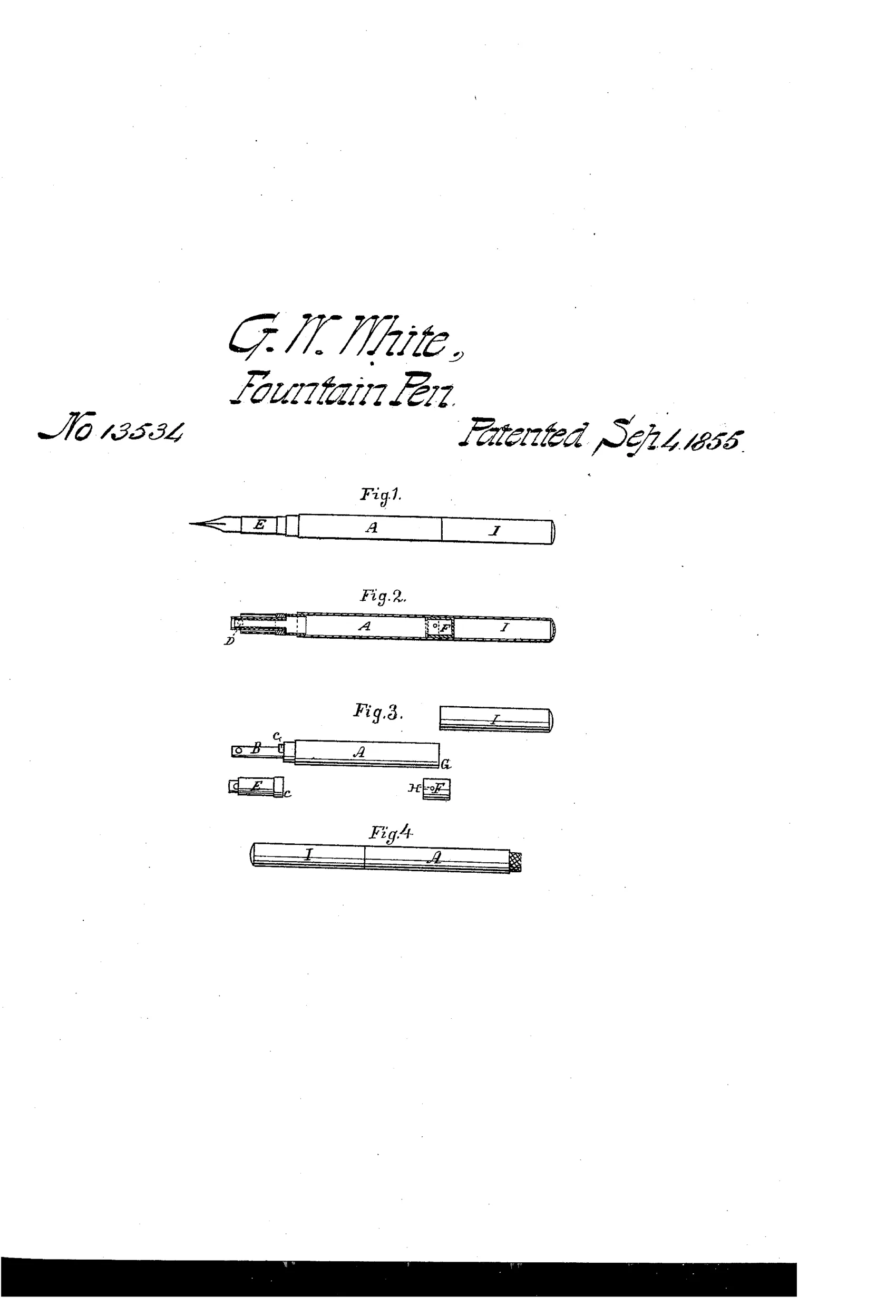
An early self-filling fountain pen ink holder
✒ How it works
The holder consists of two nested small tubes, an inner tube B fixed to the main ink barrel A and an outer tube E carrying the pen. Each tube has a matching hole (D and D) that align when the outer tube is rotated, allowing ink to flow from the barrel into the pen; turning the outer tube away misaligns the holes and seals the ink inside. A short air tube F with a small hole H is pulled out to admit air while filling, and the user draws ink into the barrel by mouth suction with the pen submerged in ink. A separate cover tube I protects the nib when carried and can be fitted on the reverse end to extend the holder for writing.
✒ What was claimed
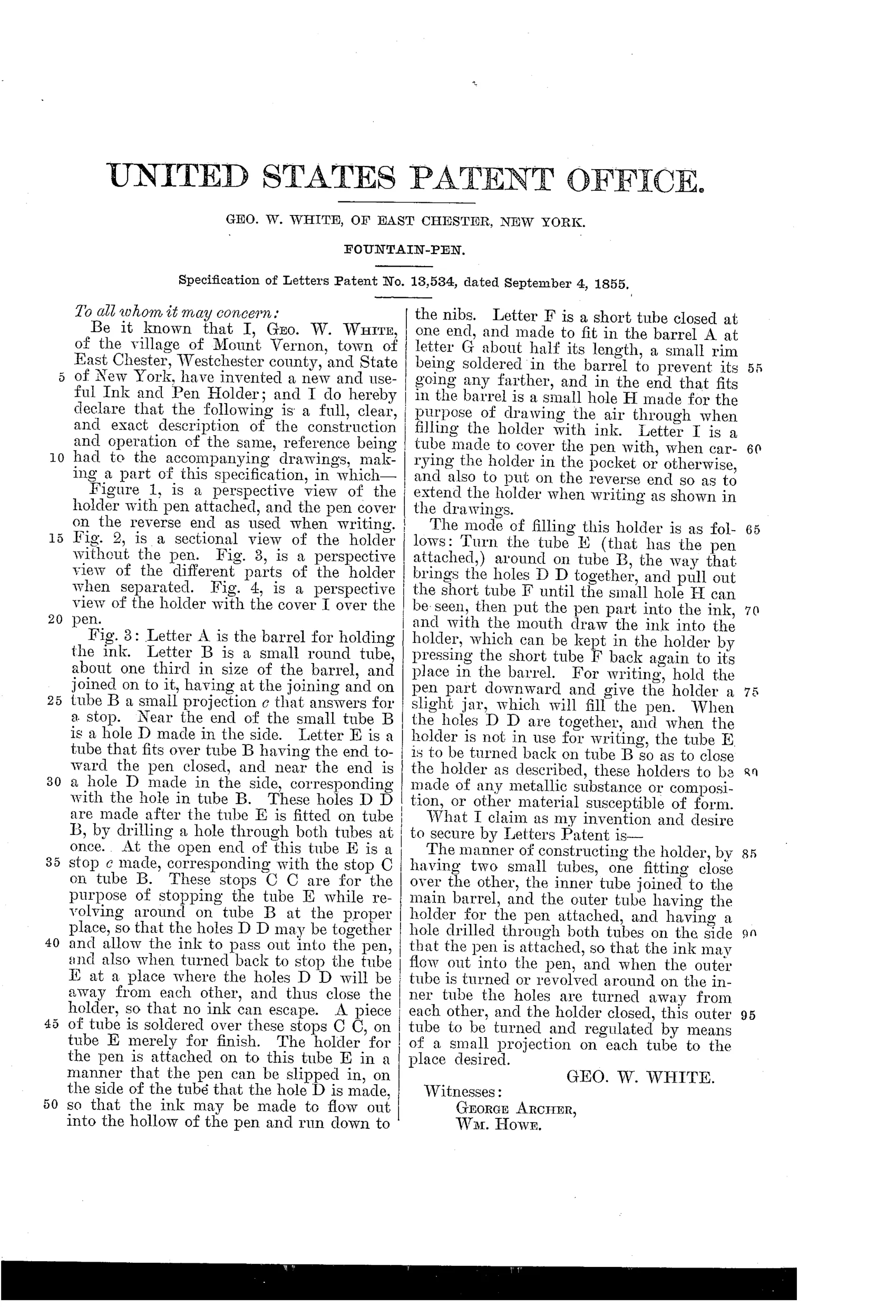
“The manner of constructing the holder, by having two small tubes, one fitting close over the other, the inner tube joined to the main barrel, and the outer tube having the holder for the pen attached, and having a hole drilled through both tubes on the side that the pen is attached, so that the ink may flow out into the pen, and when the outer tube is turned or revolved around on the inner tube the holes are turned away from each other, and the holder closed, this outer tube to be turned and regulated by means of a small projection on each tube to the place desired.”
In plain English: The invention is a two-tube ink holder where rotating an outer pen-tube over a fixed inner barrel-tube aligns or misaligns matching holes to open or shut off the ink flow to the pen.
✒ In the inventor’s words
“For writing, hold the pen part downward and give the holder a slight jar, which will fill the pen.”— Geo. W. White, from the specification
Paper patent — likely never produced
No examples of this 1855 valve pen are documented and the mouth-fill design predates any known production line; it appears to survive only on paper.
✒ Commentary
This is deep pre-Waterman territory — 1855, when a reservoir pen was still a leaky curiosity and inventors were attacking the wrong problem with real ingenuity. White's core idea is a rotary valve: two nested tubes, each drilled with a hole, so twisting the pen section aligns or misaligns the holes and turns the ink supply on or off like a stopcock. It's a genuinely tidy shutoff, and versions of the valve idea kept resurfacing right through the 1900s safety-pen era. The filling method is less tidy: you pull out a small air tube, dip the nib in ink, and suck. Mouth-filling was common advice in this period, which tells you something about how forgiving 1855 expected its users to be.
The drawings reward a close look. Fig. 3, the exploded view, shows how little there is inside — two tubes, an air tube F with its pinhole H, and the barrel. And note the cover tube I doing double duty in Figs. 1 and 4: cap over the nib for the pocket, posted on the back end to lengthen the holder for writing. That posting trick became universal.
What's missing, of course, is any feed. White's instruction to 'give the holder a slight jar' to fill the pen is the whole pre-1884 problem in one sentence: ink delivery by hope and gravity, no controlled air exchange. The valve solves storage; nothing here solves flow.
Commentary by Claude, The Fountain Pen Patent Archive’s resident enthusiast