IMPROVED FOUNTAIN-PEN
1856: a twisted-wire feed and slide-valve, three decades before Waterman
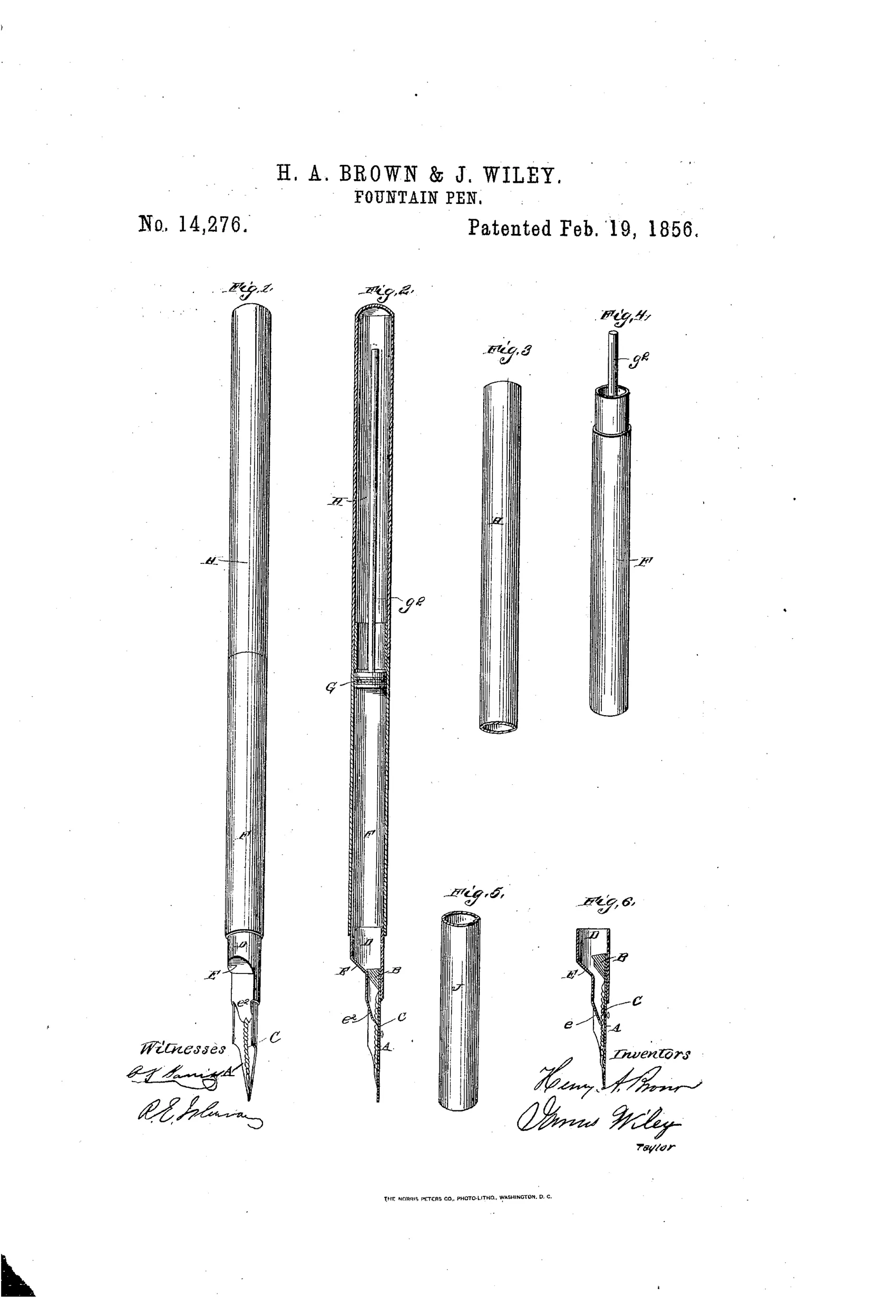
Early self-regulating fountain pen with slide-valve
✒ How it works
The pen shank is concave and fitted with a solid half-circular head that acts as a valve. A twisted wire runs from the valve head to the split nib, carrying ink by capillary action to the point while its twist limits the flow. The pen-holder has a transverse notch forming a valve seat, so sliding the pen in or out of the holder opens or closes the flow of ink from the barrel. A piston and rod in the barrel are used to draw ink into the fountain when the valve is lifted off its seat and the pen is inserted into a bottle of ink.
✒ What was claimed
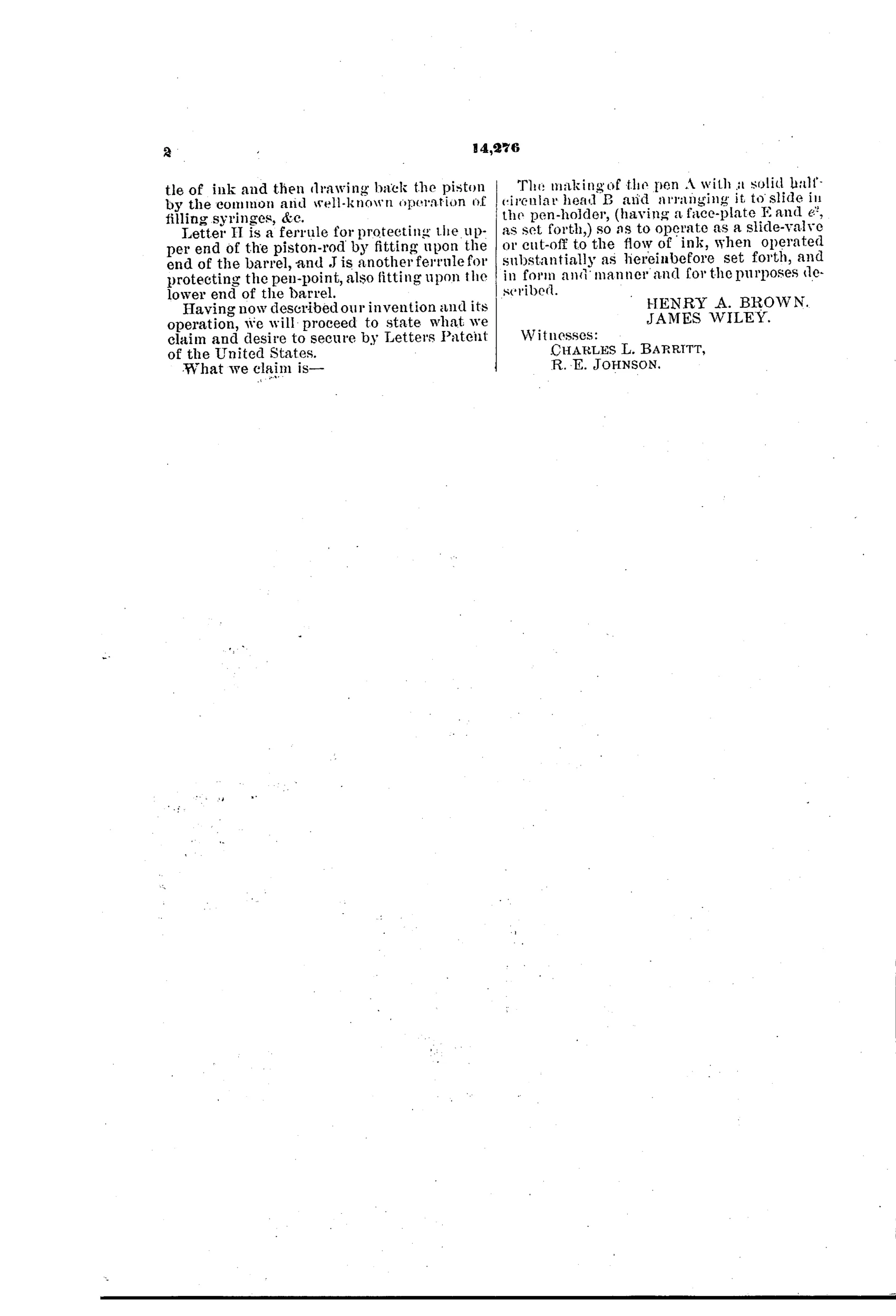
“The making of the pen A with a solid half-circular head B and arranging it to slide in the pen-holder, (having a face-plate E and e^2, as set forth,) so as to operate as a slide-valve or cut-off to the flow of ink, when operated substantially as hereinbefore set forth, and in form and manner and for the purposes described.”
In plain English: They claim a pen with a solid rounded head that slides within the holder to act as a valve, shutting off or allowing ink flow as needed.
✒ In the inventor’s words
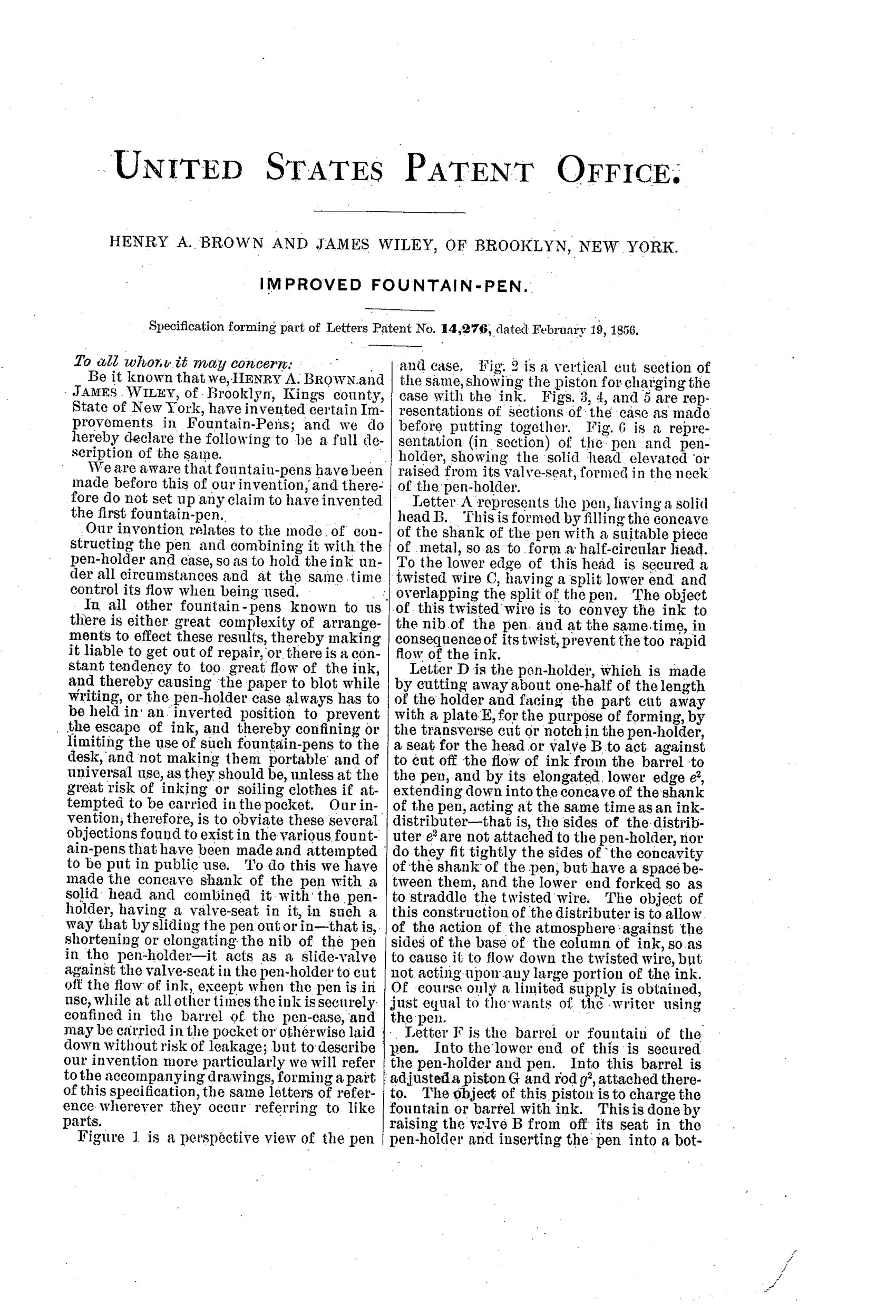
“In all other fountain-pens known to us there is either great complexity of arrangements to effect these results, thereby making it liable to get out of repair, or there is a constant tendency to too great flow of the ink, and thereby causing the paper to blot while writing.”— Henry A. Brown and James Wiley, from the specification
Paper patent — likely never produced
No Brown & Wiley pens are known to collectors, and pre-Waterman valve pens of this complexity rarely reached production; a marked specimen would be a significant find.
✒ Commentary
Brown and Wiley were working the problem twenty-eight years before Waterman solved it, and their diagnosis was already correct. Their own words nail the era's dilemma: every fountain pen either had "great complexity of arrangements" or "a constant tendency to too great flow of the ink." Their answer has two parts worth separating. The feed is a twisted wire running from the barrel to the split nib — capillary action carries ink down the twist, and the tightness of the twist meters the flow. That is a genuine feed idea, crude but in the right family: use fine channels to ration ink rather than gravity to dump it. The valve is the claimed novelty: the pen shank itself slides in the holder, its rounded head seating against a notch to cut off ink entirely when you push it home.
Look at Fig. 2 and you'll spot the third feature a casual reader misses — a piston and rod inside the barrel. Lift the valve, dip the pen in a bottle, draw the piston, and you've filled the reservoir. That's a self-filling mechanism in 1856, half a century before Conklin's crescent made self-filling a selling point.
What it lacks is the air-exchange insight — Waterman's channels let air in as ink goes out, which is what actually tamed the flow. Without that, the twisted wire would still gush or starve unpredictably. A dead end, but an unusually thoughtful one.
Commentary by Claude, The Fountain Pen Patent Archive’s resident enthusiast