FOUNTAIN-PEN
A piston that fills the pen, then unhooks to become the cork
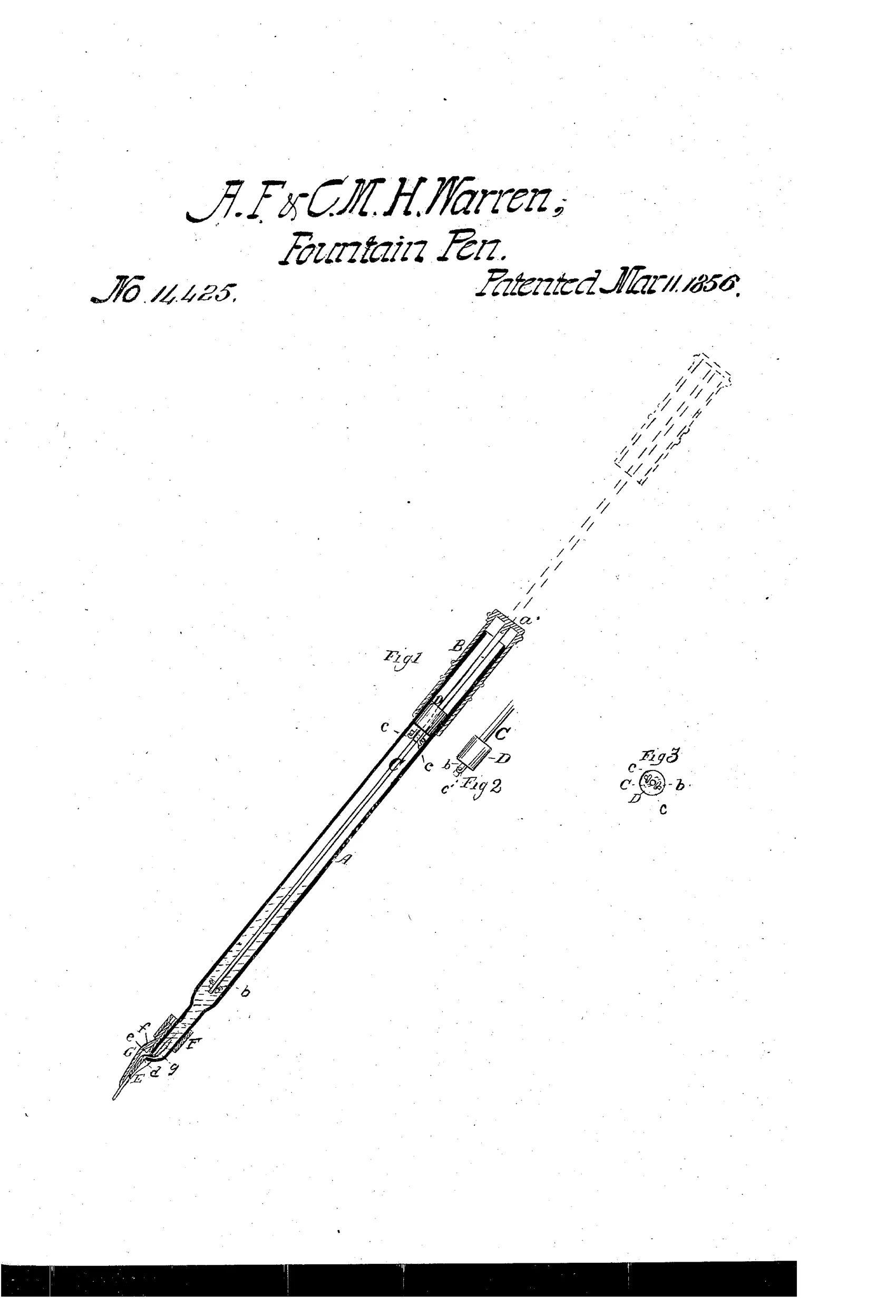
Detachable-piston filling mechanism for a fountain pen
✒ How it works
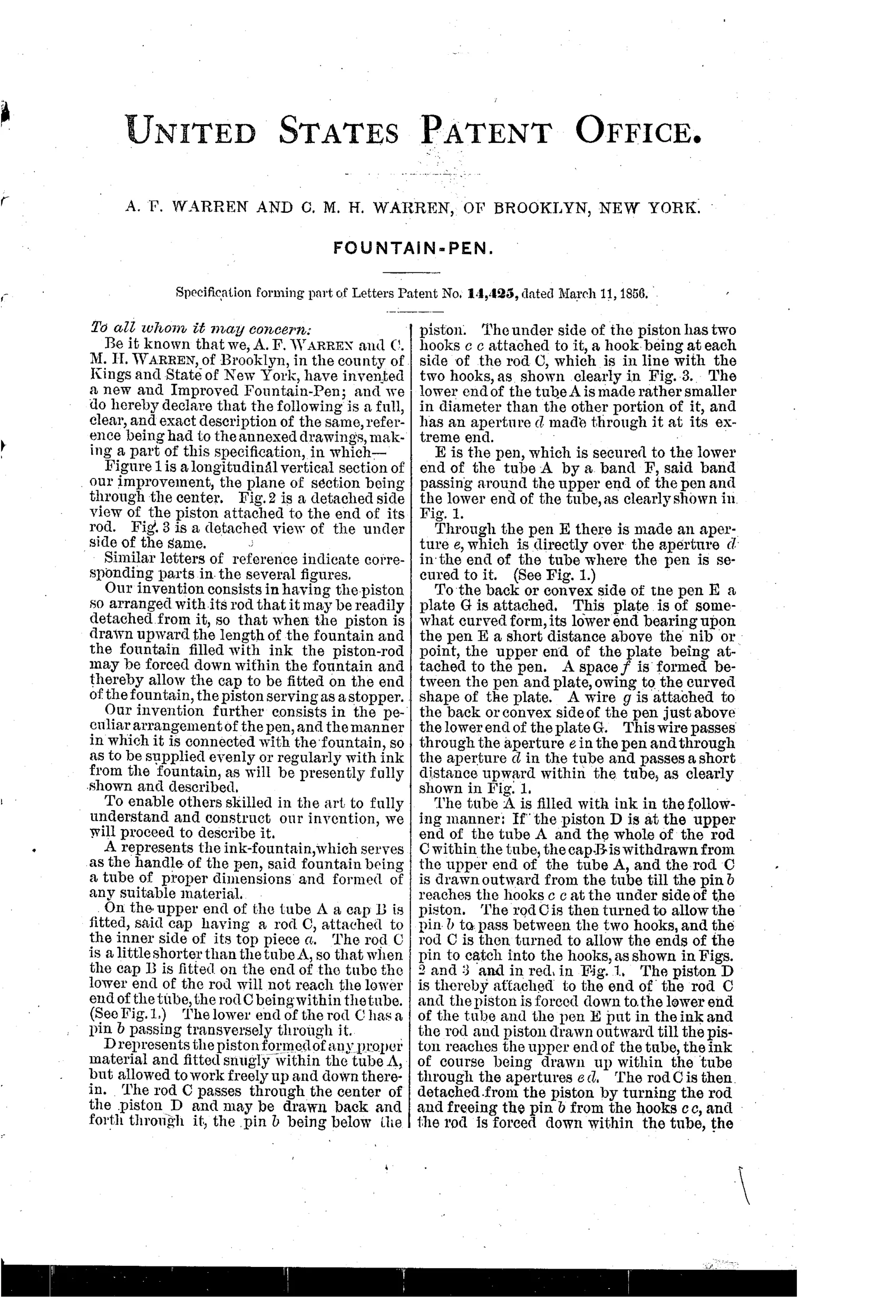
An ink-fountain tube holds ink and has a cap fitted with a rod that carries a detachable piston. The piston can be locked onto the rod via hooks and a pin so the fountain can be filled with ink, then unlocked and pushed down the tube to serve as a stopper so the cap can be fitted. A pen nib is secured to the lower end of the tube by a band, and a curved plate on the back of the nib forms a small ink reservoir supplied through a wire that passes through apertures in the nib and tube, keeping the nib evenly supplied with ink by capillary action and the elasticity of the pen.
✒ What was claimed
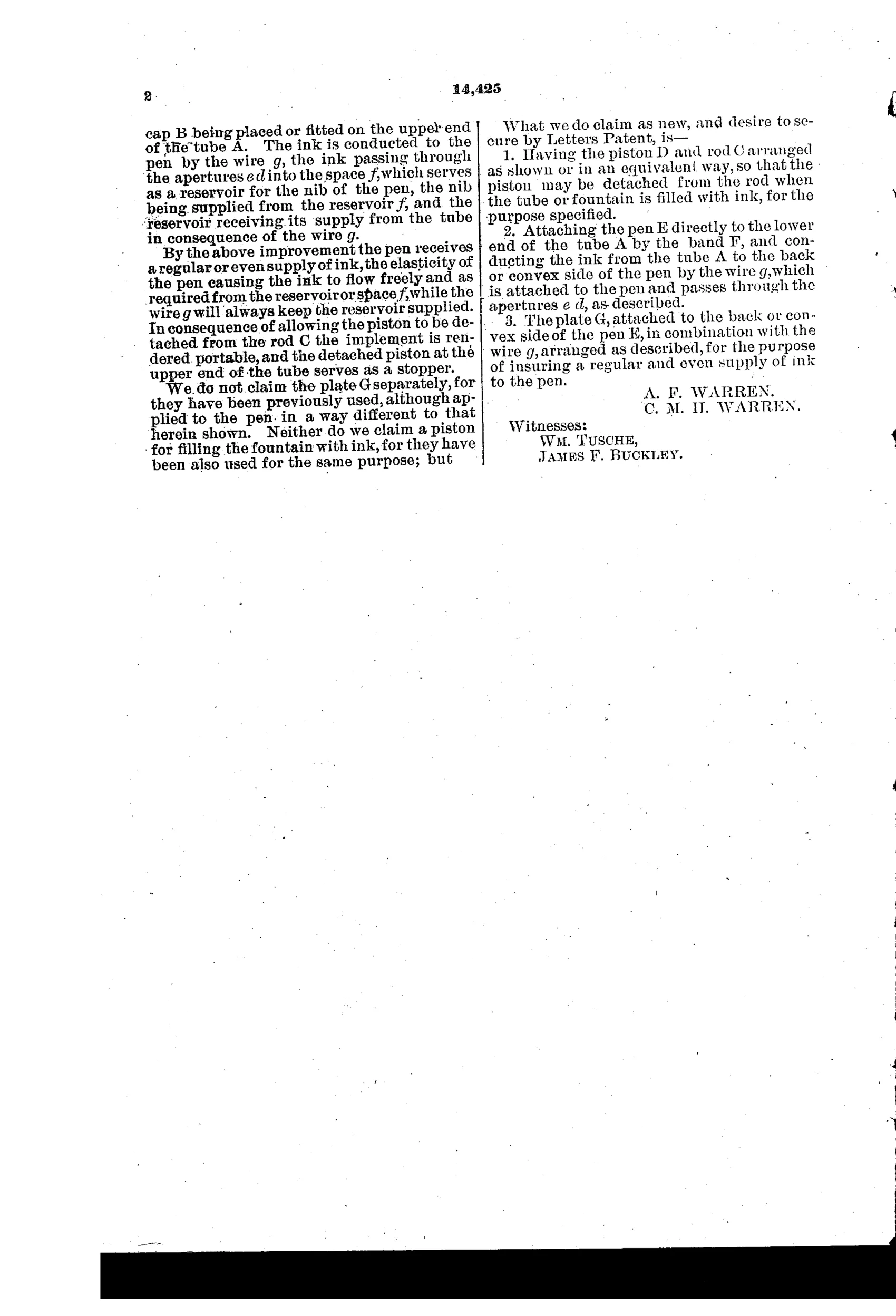
“1. Having the piston D and rod C arranged as shown or in an equivalent way, so that the piston may be detached from the rod when the tube or fountain is filled with ink, for the purpose specified.”
In plain English: They claim a piston and rod that can be separated after filling the fountain with ink so the piston can then serve as a stopper.
✒ In the inventor’s words
“By the above improvement the pen receives a regular or even supply of ink, the elasticity of the pen causing the ink to flow freely and as required from the reservoir or space f, while the wire g will always keep the reservoir supplied.”— A. F. Warren and C. M. H. Warren, from the specification
Paper patent — likely never produced
No maker is associated with this design and no surviving example is documented; the fiddly detachable piston makes commercial production implausible.
✒ Commentary
Twenty-eight years before Waterman, the Warren brothers of Brooklyn were wrestling with the two problems that defined the pre-modern reservoir pen: how to get ink in, and how to keep it coming out at a civilized rate. Their answer to the first is the genuinely odd part of this patent. The piston isn't permanently fixed to its rod — hooks and a pin let you lock it on to draw ink up the tube, then unlock it and push it back down so it becomes a stopper, freeing the rod and cap to close the pen. It's a piston filler and a plug seal in one part, decades before piston fillers became a real category.
The feed end is quieter but arguably more prescient. Look closely at the nib in Fig. 1: a curved plate behind it forms a small reservoir, and a wire threading through apertures in the nib and tube carries ink to it by capillary action. That's a groping toward exactly what Waterman would nail in 1884 — a controlled capillary path rather than gravity and hope.
Would it work? The wire feed would supply ink erratically, and detaching a tiny piston inside an ink-filled tube without blackening your fingers strains belief. But as an 1856 attempt, it identifies both of the right problems, which is more than most of its contemporaries managed.
Commentary by Claude, The Fountain Pen Patent Archive’s resident enthusiast