IMPROVEMENT IN FOUNTAIN-PENS
A thread wick and adjustable cap, ten years before Waterman got it right
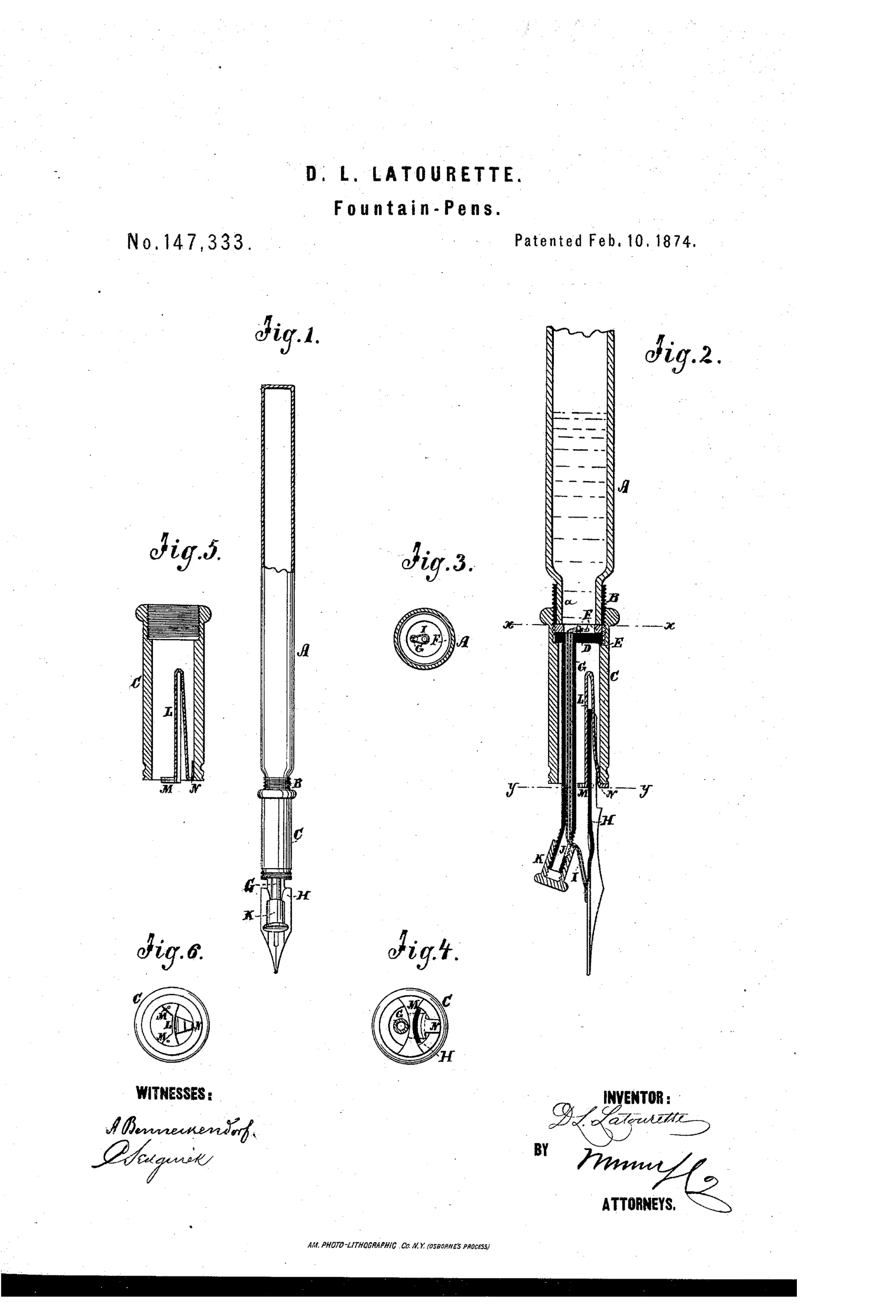
Fountain pen with capillary-fed ink regulation
✒ How it works
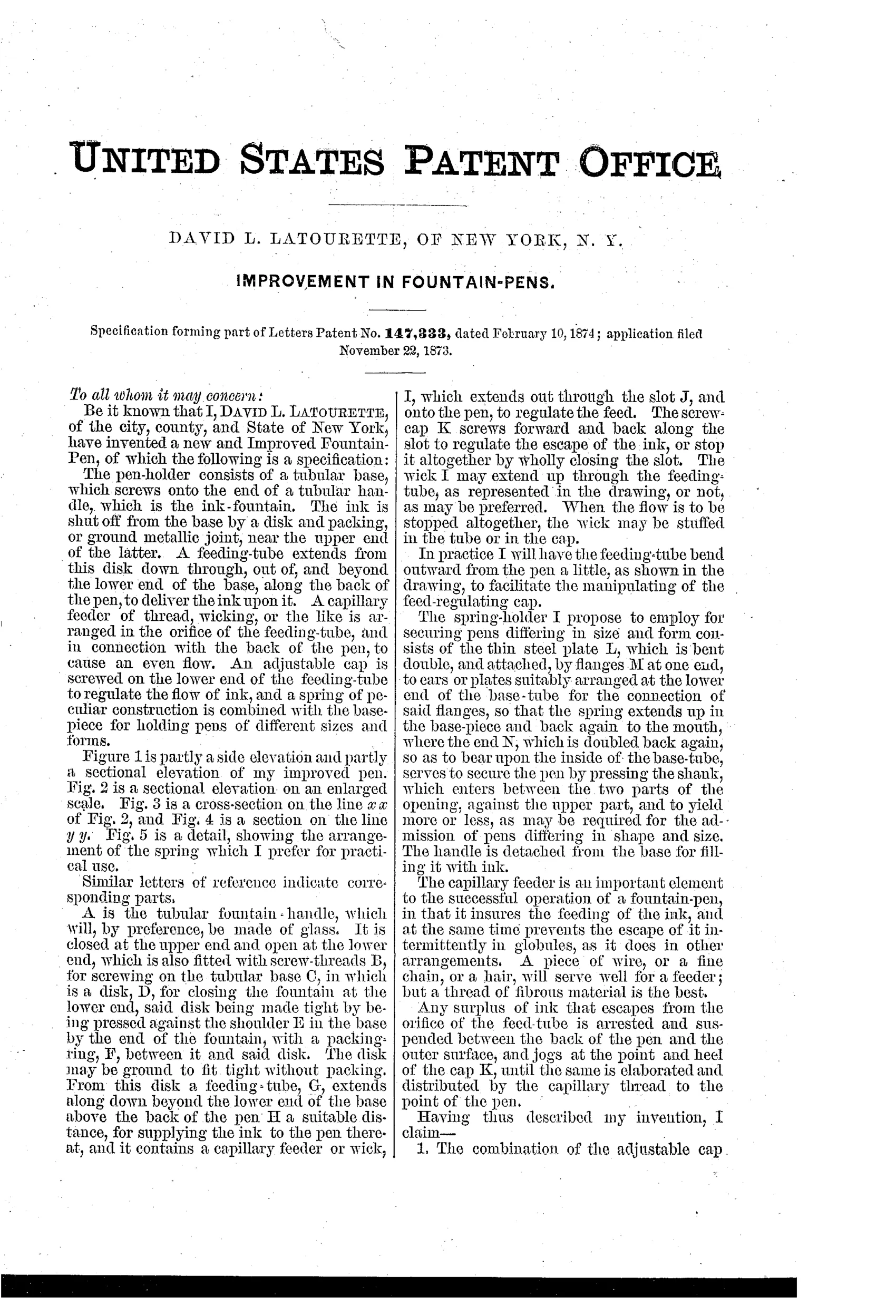
A tubular glass handle serves as the ink fountain and screws onto a tubular base holding the pen. Ink is shut off from the base by a ground metallic disk and packing joint, and a feeding-tube with a capillary thread wick delivers ink evenly to the back of the pen. An adjustable cap threaded along a slot regulates or stops the ink flow entirely. A doubled thin-steel spring inside the base yields to accommodate pens of varying size and shape while pressing them into place.
✒ What was claimed
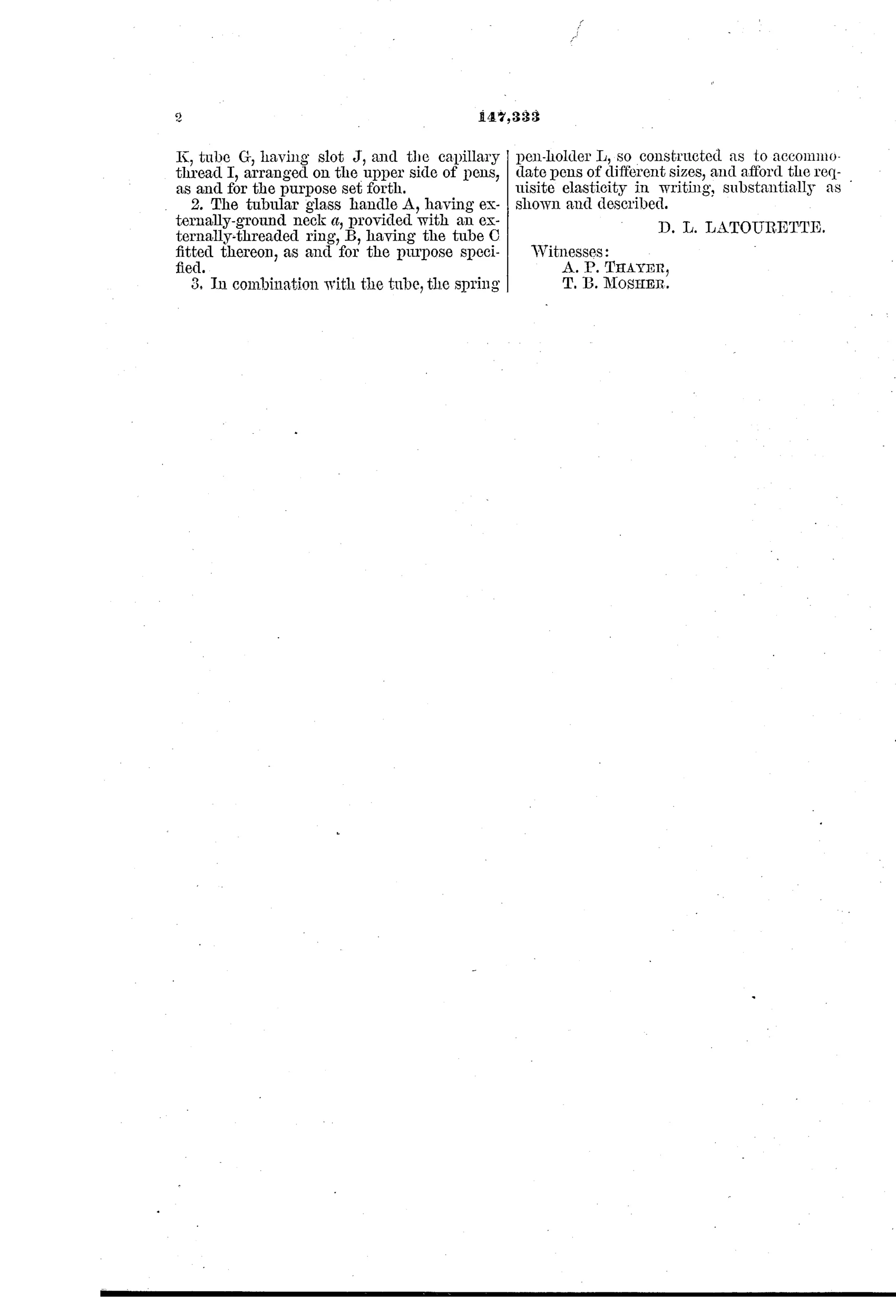
“The combination of the adjustable cap K, tube G, having slot J, and the capillary thread I, arranged on the upper side of pens, as and for the purpose set forth.”
In plain English: Claims the combination of an adjustable regulating cap, a feed tube with a slot, and a capillary thread positioned above the pen to control ink flow.
✒ In the inventor’s words
“The capillary feeder is an important element to the successful operation of a fountain-pen, in that it insures the feeding of the ink, and at the same time prevents the escape of it intermittently in globules, as it does in other arrangements.”— David L. Latourette, from the specification
Fate unknown
No production Latourette pen is documented to my knowledge; a surviving marked example or period advertisement would settle it.
✒ Commentary
This is the pre-Waterman stratum in its purest form: an 1874 attempt to tame the reservoir pen with a capillary thread. Latourette runs a slotted feed tube along the top of the nib, threads a wick through it, and lets capillarity do the metering. His stated enemy is exactly the right one — ink escaping "intermittently in globules," which is the classic failure of every gravity-fed reservoir of the era. He understood the problem a decade before Waterman patented the answer.
The answer here is close but not quite. A wick delivers ink steadily, yes, but it does nothing to let air back into the reservoir in a controlled way — and that air exchange, not ink delivery, is what Waterman's 1884 channels solved. Latourette papers over the gap with an adjustable cap (K) that slides along the slot to throttle or shut off flow entirely, which is really an admission that the pen won't self-regulate. A pen you must dial in before writing is a pen that blots when you guess wrong.
Two details in the drawings reward a close look: the glass barrel in Fig. 2, letting you actually see your ink level, and the doubled steel spring in Figs. 4-6 that grips ordinary dip nibs of any size — this is a fountain attachment for your existing pens, not a sealed instrument. Honest, clever in parts, and doomed by the physics it almost grasped.
Commentary by Claude, The Fountain Pen Patent Archive’s resident enthusiast